After-hours calls
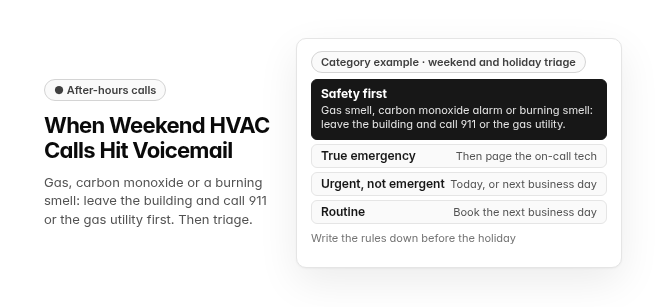
When Weekend HVAC Calls Hit Voicemail Gas, carbon monoxide or a burning smell: leave the building and call 911 or the gas utility first. Then triage.
Category example · weekend and holiday triage.
- Safety first: gas smell, carbon monoxide alarm or burning smell: leave the building and call 911 or the gas utility.
- True emergency: then page the on-call tech.
- Urgent, not emergent: today, or next business day.
- Routine: book the next business day.
Write the rules down before the holiday.
When HVAC emergency calls go to voicemail on weekends and holidays, many callers hang up without leaving a message and call the next contractor who answers. The fix is operational, and it starts with safety.
If a caller smells gas or a carbon monoxide alarm is going off, the first instruction is to leave the building and call 911 or the gas utility from outside, before any booking, paging or dispatch step. The same goes for a burning smell or smoke from the equipment: leave the building and call 911.
After that, someone, or something, covers the line, true emergencies reach the on-call technician, and routine requests are booked for the next business day.
What does a weekend or holiday voicemail cost an HVAC business?
A weekend or holiday voicemail usually costs an HVAC contractor the job, and often the customer too. These are also some of the highest-value calls of the week. Callers with a dead system don’t wait for Monday. They dial the next listing.
- The job goes to a competitor: A caller who reaches voicemail on a Saturday or a holiday often hangs up and calls a competing contractor. Many won't wait for a callback.
- Few callers leave a message: Many callers who reach voicemail hang up without leaving a message, so your voicemail box shows only a fraction of the demand you lost.
- Premium-rate work walks away: Weekend and holiday repairs are often billed at an after-hours rate, so the calls you miss tend to be the ones worth more. Use your own after-hours invoices to see what that work is worth to your shop.
- The relationship goes with it: A caller whose system is fixed by another contractor on a holiday weekend often stays with that contractor for the maintenance visit and the eventual replacement.
To put a dollar figure on your own shop’s losses, use our guide to what missed calls cost, which works it out from your own call log. This page focuses on why weekend and holiday calls hit voicemail and how to route them.
Why do HVAC calls end up in voicemail on weekends and holidays?
Many weekend and holiday voicemails come from phone configuration, not from a lack of staff. The phone system follows a weekday rule that nobody updated for the holiday. Or the call is sent somewhere that no longer answers.
- No holiday schedule override: If the phone system only knows “weekday” and “weekend,” a Monday holiday is treated as a normal business day. Calls ring an empty office and then roll to voicemail.
- Time-of-day routing gaps: After-hours rules sometimes start in the evening on weekdays but have no weekend rule at all. A Saturday call then falls to the default voicemail.
- Call forwarding switched off: Someone disables forwarding to fix a ring problem or run a test and never turns it back on before the weekend.
- On-call phone off or out of coverage: The rotation sends calls to a technician whose phone is off, on silent or outside cell coverage. The call drops through to voicemail with no backup.
- Ring-group errors: A group still lists a tech who left or who is on vacation. Calls ring a dead line until the voicemail timer wins.
None of these problems is visible from the office on a Friday afternoon. That is why the holiday checklist later on this page starts with the schedule itself.
What counts as an after-hours HVAC emergency?
An after-hours HVAC emergency is any call where waiting until the next business day creates a safety risk, property damage or a dangerous indoor temperature. Everything else can be booked for the next open slot. The table below sorts weekend and holiday calls into three triage levels your call-takers can apply the same way every time.
Safety comes first at every level. If a caller smells gas, a carbon monoxide alarm is going off, or there is a burning smell or smoke from the equipment, the first instruction is to leave the building and call 911 or the gas utility from outside, before any paging, fee or dispatch step. If someone is in danger from heat or cold, the caller should call 911.
This is a category model for writing your own triage rules, not a description of any one product.
| Triage level | Typical call signs | Weekend and holiday action |
|---|---|---|
| True emergency | Gas smell, carbon monoxide alarm, burning odor or smoke from equipment; electrical faults at the unit or panel; major water leak from equipment; no heat or no cooling in dangerous indoor temperatures, especially with vulnerable occupants | Safety first: for gas, carbon monoxide, burning odor or smoke, the caller leaves the building and calls 911 or the gas utility from outside. Then page the on-call tech |
| Urgent, not emergent | System running poorly; one of two systems down; no heat or cooling in mild weather; minor leak that is contained | Offer weekend service at the after-hours rate, or the first slot on the next business day |
| Routine | Maintenance and tune-ups; thermostat questions; quote requests; noise with normal operation | Book for the next business day, page no one |
Writing these rules down also protects the on-call rotation. When non-emergencies get dispatched on a holiday night, techs burn out and the rotation is harder to staff. Our guide to emergency call prioritization covers how the dispatch board orders urgent work once it lands.
How can an HVAC company cover emergency calls on weekends and holidays?
HVAC contractors cover weekend and holiday calls in four main ways. Many shops combine at least two of them: something that picks up the line, plus a rotation that handles the emergencies. Whichever you choose, the script it follows should open with the safety instruction: a caller who smells gas or has a carbon monoxide alarm going off is told to leave the building and call 911 or the gas utility, before any paging or booking step.
- Live answering service: Trained operators answer, screen the call against your emergency definition and page the on-call tech. Adopting one means writing a detailed triage script, keeping the on-call schedule current with the service, and checking how messages and bookings reach your office.
- AI receptionist: A voice agent answers calls outside office hours, captures the caller’s name, address and issue, books routine work and routes emergencies on your rules. Adopting one means setting your emergency rules, price-book answers and handoff paths up front, and confirming it writes into your scheduling system rather than sending a summary email.
- Structured on-call rotation: A named tech, with a named backup, covers each weekend day and holiday under written rules for what gets dispatched. This sets who responds once a call is screened. It does not answer the phone.
- Cell forwarding with missed-call text-back: The main line forwards to the on-call tech’s cell, and an unanswered call gets a text-back. It is the lowest-effort setup, but every call, including routine ones, interrupts the tech. That wears people down fast over a holiday weekend.
If calls are answered but jobs still don’t get booked, our comparison of an answering service vs an AI receptionist covers what each leaves behind after the call, and our guide to what an AI receptionist books covers what actually lands on the board.
Which coverage option handles the full weekend call, start to finish?
Comparisons often score coverage options on speed and availability. The questions that decide whether a weekend call becomes paid work are below.
This is a category comparison, not a description of any one product. Confirm each answer in a demo against your own setup.
| Question | Live answering service | AI receptionist | On-call rotation alone | Cell forwarding + text-back |
|---|---|---|---|---|
| Picks up the call live? | Yes, within staffing limits | Yes, where it is set up for these hours | No, it covers dispatch only | Only if the tech picks up |
| Triages by your emergency rules? | If you supply and maintain the script | If the rules are configured | Depends on the tech | Depends on the tech |
| Hands exceptions to a person? | Yes, by paging | Only if a handoff path is set | Not applicable | The tech is the only person |
| Lands as a job on your board with full call details? | Only with an integration into your software | Only with an integration into your software | Only if the tech enters it | Only if the tech enters it |
| Dispatches by schedule, location and skills? | No, it pages whoever is listed | Only when connected to dispatch | Whoever is on call | Whoever is on call |
| Quotes the after-hours fee from your price book? | Only if the fee is in the script | Only if connected to your price book | If the tech remembers it | If the tech remembers it |
How should weekend and holiday HVAC calls be routed by call type?
A weekend and holiday routing matrix tells everyone who answers each type of HVAC call, who gets paged, which fee is quoted and where the record lands. This keeps holiday calls from depending on whoever happens to pick up. Maintenance-agreement members and commercial sites get priority weekend dispatch under defined rules, consistent with service plans that promise priority scheduling.
The safety step sits above the whole matrix. If a caller smells gas, a carbon monoxide alarm is going off, or there is a burning smell or smoke from the equipment, the caller is first told to leave the building and call 911 or the gas utility from outside. Only after that does the call follow its row.
This is a category model for your own routing rules, not a description of any one product.
| Call type | Who answers | Who gets paged | Fee quoted to the caller | Where the record lands |
|---|---|---|---|---|
| True emergency | Live answer; the safety instruction comes first | On-call tech, after the safety step, then the backup if there is no acknowledgment within your set window | Weekend or holiday emergency rate from the price book, accepted before the truck rolls | Dispatched job on the board with the full call details |
| Urgent, not emergent | Live answer | On-call tech notified only if the caller accepts weekend service | Caller chooses: the after-hours rate today or the standard rate on the next business day | Job tagged urgent, placed in today’s on-call slot or the first slot of the next business day |
| Routine or maintenance | Live answer | No one | Standard rate | Booked into the next business day schedule |
| Maintenance-agreement member | Live answer, account recognized | On-call tech, ahead of non-members, for true emergency or urgent calls | Agreement terms for after-hours work | Job on the member’s account, linked to the agreement and equipment |
| Commercial site or property manager | Live answer, site recognized | On-call tech with commercial skills, per the site’s service terms | Commercial after-hours rate or contract terms | Job on the correct site and unit under the property manager’s account |
The matrix works only if the call, the dispatch, the fee and the invoice share one record. If your current system splits these steps across tools, ask each vendor to show a weekend call landing as one record, from the call through to the invoice.
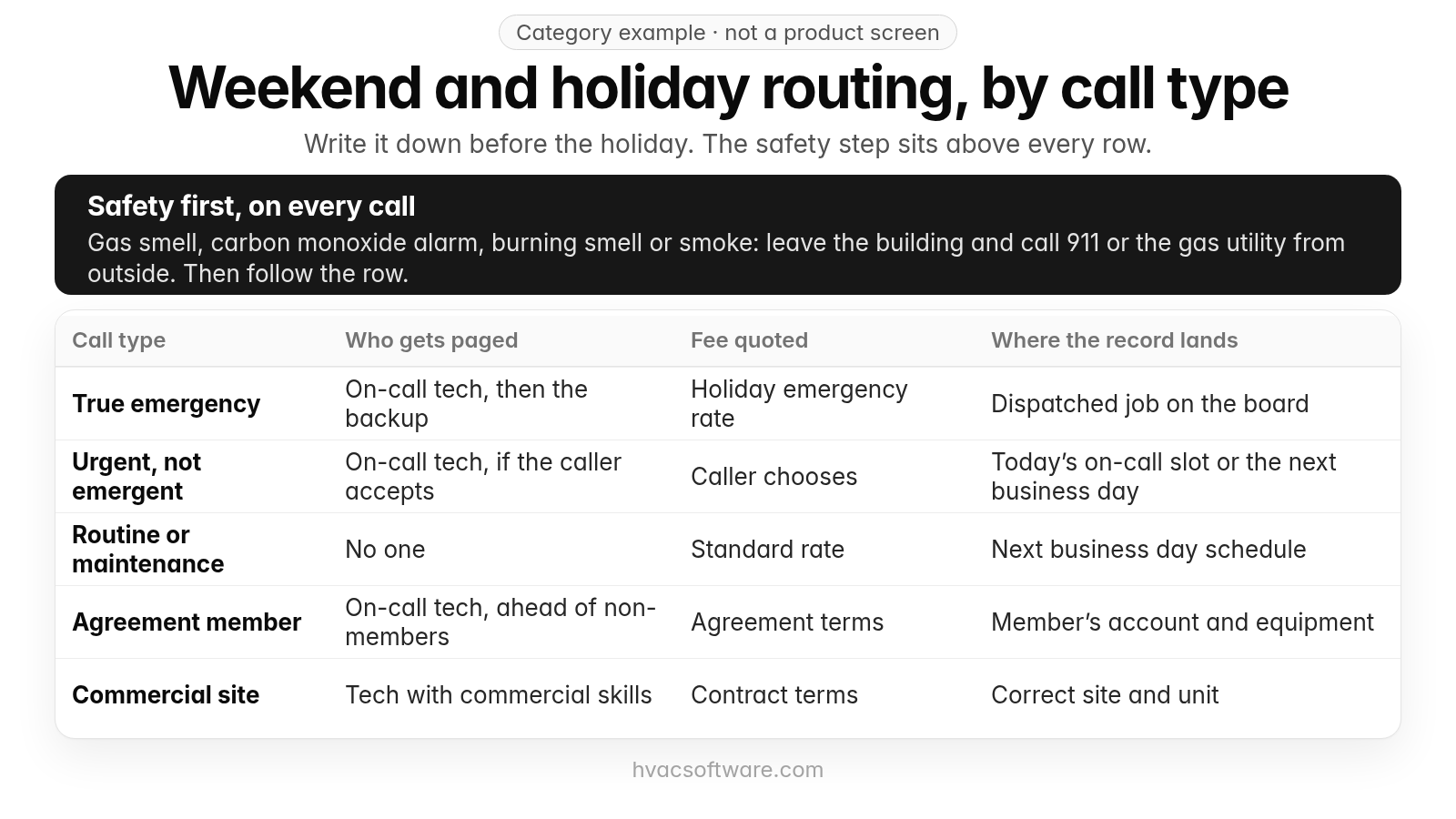
Category example · not a product screen
Weekend and holiday routing, by call type
Write it down before the holiday. The safety step sits above every row.
Safety first, on every call. Gas smell, carbon monoxide alarm, burning smell or smoke: leave the building and call 911 or the gas utility from outside. Then follow the row.
- True emergency: on-call tech, then the backup; holiday emergency rate; dispatched job on the board.
- Urgent, not emergent: on-call tech, if the caller accepts; caller chooses; today’s on-call slot or the next business day.
- Routine or maintenance: no one; standard rate; next business day schedule.
- Agreement member: on-call tech, ahead of non-members; agreement terms; member’s account and equipment.
- Commercial site: tech with commercial skills; contract terms; correct site and unit.
How do you quote the after-hours fee before dispatching on a weekend?
State the weekend or holiday fee to the caller before any truck rolls, using a rule the office sets once and not a number the call-taker makes up. Callers who hear the fee up front can make a decision. Callers who first see it on the invoice dispute it.
The fee never comes before safety: a caller who smells gas or has a carbon monoxide alarm going off first hears to leave the building and call 911 or the gas utility.
- One central rate rule: The office sets the weekend, holiday and emergency rates in the price book. Answering staff, AI and techs all quote from that same source.
- Quote before commit: The caller hears the fee and agrees to it before the on-call tech is paged.
- Offer the alternative: For urgent, non-emergency calls, offer the standard rate on the next business day alongside the after-hours rate. Let the caller choose.
- Note the acceptance: The quoted fee and the caller’s agreement go on the job. The invoice then matches what was promised.
What should an HVAC shop set up before a holiday weekend?
Set the holiday coverage up before the holiday. Many holiday voicemails trace back to a schedule that was never changed.
Whatever you set up, the greeting, the script and the on-call brief all start with the same safety instruction: a caller who smells gas or has a carbon monoxide alarm going off leaves the building and calls 911 or the gas utility, before any paging or booking step.
- Enter closed days in the phone system’s holiday schedule for every holiday on the calendar, including Monday holidays and the day after Thanksgiving if the office closes.
- Assign the on-call contact and backup for each holiday day and load them into the routing before the office closes.
- Confirm call forwarding and ring groups point to people who are actually working that day.
- Update the after-hours greeting so callers hear that they are reaching emergency coverage, not a mailbox, and that anyone who smells gas or has a carbon monoxide alarm going off should leave the building and call 911 or the gas utility first.
- Load the holiday emergency rate into the price book so every call-taker quotes the same fee.
- Brief the on-call tech on the triage rules, starting with the safety instruction (leave the building and call 911 or the gas utility for gas, carbon monoxide, a burning smell or smoke), then the agreement and commercial priority rules in the matrix.
- Dial your main line after the holiday schedule goes live and confirm where the call lands.
- Review every holiday call on the next business day. Check what was answered, paged and booked, then remove the override.
Our guide to real-time job status covers what each job status should tell the office once weekend work is on the board.
How does FieldCamp fit a shop planning weekend and holiday coverage?
FieldCamp fits contractors running residential and commercial work in one system, with a person still deciding the day. Here is what FieldCamp does today, and what to ask in a demo.
This site is published by FieldCamp.
- On the dispatch board: When your dispatcher drags a job onto a technician, the board checks skills, drive time and schedule conflicts, and the dispatcher confirms the assignment.
- For the customer: The customer gets a text when a job is assigned or moved.
- For the technician: A technician’s assigned jobs and schedule show on their phone.
- One record: Each job stays on one record from the first call to the paid invoice.
- Residential and Commercial Together: Residential service calls and commercial maintenance work run in one system, not two.
- Who decides: A person still decides the day. Assignment stays a decision the dispatcher makes.
- What to ask in the demo: This page does not describe call answering, after-hours coverage, answering-service or AI receptionist connections, booking on the call, triage and on-call routing, on-call paging and backup escalation, holiday schedules and time-of-day routing, call forwarding and ring groups, after-hours greetings, missed-call text-back, call handoff, call transfer, bilingual calls, caller recognition, lead qualification, fee quoting and price-book answers, after-hours call review, or booking confirmations and reminders as FieldCamp features. Ask in the demo how weekend and holiday calls would reach your board, and for each piece, whether it is available today, needs setup or a connected tool, is in a pilot, or is planned. Also ask about maintenance-agreement member routing and booking, commercial site and unit matching, dispatching an answered call by schedule, location and skills, noting the quoted fee and the caller’s acceptance on the job, offering the caller the after-hours rate today or the standard rate on the next business day, capturing the caller’s name, address and issue on the job rather than sending a summary email, tagging the job as urgent, keeping the on-call schedule current with the answering service, and answering-service messages reaching the office, and for each of those, whether it is available today, needs setup or a connected tool, is in a pilot, or is planned.
Our guide to HVAC AI voice agents covers what a voice agent conversation should hand back to the office, the HVAC contact center overview covers how calls connect to the rest of the front office, and our guide to customer text notifications covers the texts a customer gets once a job is assigned or moved.
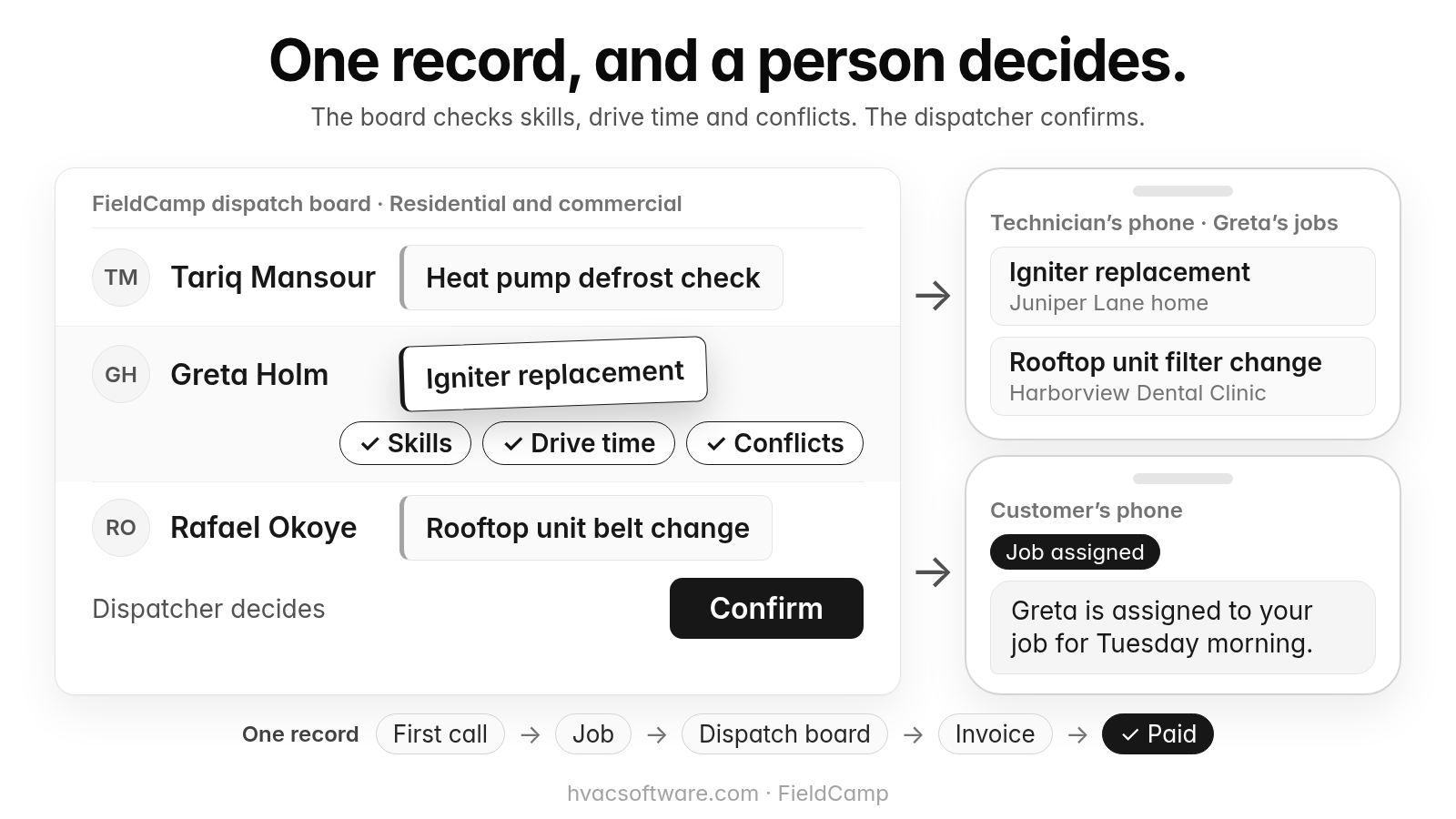
One record, and a person decides.
The board checks skills, drive time and conflicts. The dispatcher confirms.
FieldCamp dispatch board · Residential and commercial: Tariq Mansour: Heat pump defrost check. Greta Holm: Igniter replacement. Rafael Okoye: Rooftop unit belt change.
- Skills
- Drive time
- Conflicts
Dispatcher decides: Confirm.
Technician’s phone · Greta’s jobs: Igniter replacement (Juniper Lane home). Rooftop unit filter change (Harborview Dental Clinic).
Customer’s phone. Job assigned: "Greta is assigned to your job for Tuesday morning."
One record: First call → Job → Dispatch board → Invoice → Paid.
Planning weekend and holiday coverage? Book a 30-minute walkthrough to see how a job moves from the first call onto the dispatch board.
Frequently asked questions
What is considered an emergency HVAC call?
Safety comes first. If a caller smells gas or a carbon monoxide alarm is going off, the first instruction is to leave the building and call 911 or the gas utility from outside, before any booking, paging or dispatch step. A burning smell or smoke from the equipment also means leaving the building and calling 911, and if someone is in danger from heat or cold, the caller should call 911. After that, shops usually treat no heat or no cooling in dangerous indoor temperatures, especially with vulnerable occupants, a major water leak from equipment and an electrical fault at the unit as true emergencies for the on-call technician. Everything else can be booked for the next business day.
Do HVAC techs charge more on weekends?
Many HVAC companies charge an after-hours or holiday rate for weekend work, because the technician is working outside normal hours. The amount varies by shop and market. Whatever you charge, set the weekend and holiday rates once in your price book, quote the fee to the caller before the truck rolls, and offer callers whose problem can wait the standard rate on the next business day as an alternative.
How much is an after-hours HVAC call?
Safety comes first. If there is a gas smell, smoke, fire or carbon monoxide risk, the first instruction is to leave the building and call 911 or the gas utility from outside, before any booking, paging or dispatch step. It depends on the shop, the market, the day and the job, so there is no single price. For an HVAC business, the useful answer is a rule, not a number: set the after-hours, weekend and holiday rates in your price book, make sure whoever picks up the phone quotes from that same source, and note the caller's agreement on the job before anyone is sent out, so the invoice matches what was promised.
Are HVAC techs on call on weekends and holidays?
Many HVAC companies run an on-call rotation, so a named technician and a backup cover nights, weekends and holidays, but it depends on the shop. Safety comes first on any after-hours call: if a caller smells gas or a carbon monoxide alarm is going off, the first instruction is to leave the building and call 911 or the gas utility from outside, before any booking, paging or dispatch step. After that, true emergencies go to the on-call technician, and routine work waits for the next business day. Write down who covers each holiday day before the office closes.
What hours do HVAC people usually work?
Safety comes first. If there is a gas smell, smoke, fire or carbon monoxide risk, the first instruction is to leave the building and call 911 or the gas utility from outside, before any booking, paging or dispatch step. Office and field staff at many HVAC companies work regular weekday business hours, with longer days in peak heating and cooling season. Nights, weekends and holidays are usually covered by an on-call rotation, an answering layer or both. For callers, what matters is what happens outside office hours: whether someone picks up, who is sent out and how the job reaches the board the next morning.
Is a furnace not working an emergency?
It depends on the conditions. Safety comes first: if a caller smells gas, a carbon monoxide alarm is going off, or there is a burning smell or smoke from the furnace, the first instruction is to leave the building and call 911 or the gas utility from outside, before any booking, paging or dispatch step. If someone is in danger from the cold, the caller should call 911. After that, a furnace that is out in freezing weather, especially with vulnerable occupants or a risk of frozen pipes, is usually a true emergency for the on-call technician, while a furnace that is out in mild weather can usually wait for the first slot on the next business day.
Final recommendation
Before the next holiday weekend, write your triage rules and routing matrix down, enter the holiday schedule in the phone system and dial your own main line to confirm where the call lands. Check that every script, greeting and on-call brief starts with the safety instruction: a caller who smells gas or has a carbon monoxide alarm going off should leave the building and call 911 or the gas utility, before any booking, paging or dispatch step.