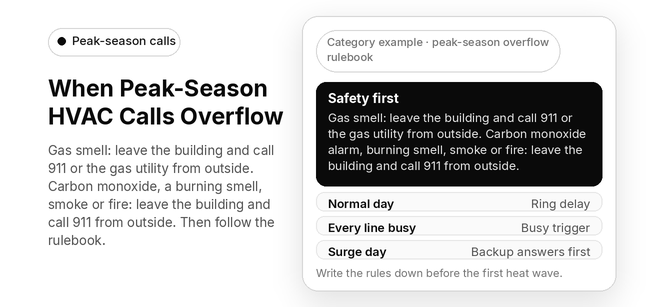
Peak-season calls
When Peak-Season HVAC Calls Overflow Gas smell: leave the building and call 911 or the gas utility from outside. Carbon monoxide, a burning smell, smoke or fire: leave the building and call 911 from outside. Then follow the rulebook.
Category example · peak-season overflow rulebook.
- Safety first: gas smell: leave the building and call 911 or the gas utility from outside. Carbon monoxide alarm, burning smell, smoke or fire: leave the building and call 911 from outside.
- Normal day: ring delay.
- Every line busy: busy trigger.
- Surge day: backup answers first.
Write the rules down before the first heat wave.
When a heat wave or cold snap lights up every line, HVAC call overflow routing sends the calls your CSRs can’t reach to a backup, such as an AI receptionist or an answering service, instead of to voicemail or a busy signal. The backup should screen for safety first, sort urgent calls from routine ones, and leave a job or a clear handoff behind, not just a message.
If a caller smells gas, the first instruction is to leave the building and call 911 or the gas utility from outside, before any booking, paging or dispatch step. If a carbon monoxide alarm is going off, or there is a burning smell, smoke or fire, the first instruction is to leave the building and call 911 from outside, before any booking, paging or dispatch step. If someone is in danger from heat or cold, the caller should call 911.
After that, the overflow rules decide which calls go to the backup, which reach a person, and how routine work lands on the board while your office catches up.
Why do HVAC shops miss calls in peak season?
HVAC shops miss calls in peak season because demand arrives all at once, and the phone setup was built for an average week. The office isn’t trying less hard. The calls simply outnumber the people who can pick them up.
- Volume outruns the CSRs on shift: A heat wave or cold snap brings many calls at the same moment. Each CSR can take one call at a time, so the rest ring out, queue or roll to voicemail.
- Voicemail doesn’t hold the caller: Some callers may hang up without leaving a message and call the next contractor, so your voicemail box shows only part of the demand you lost.
- Misses cluster where coverage is thinnest: Lunch breaks, shift changes, the end of the day, and nights and weekends are when the phones are least covered and a surge does the most damage.
- One rollover rule for every day: A phone system set up for a quiet week sends calls to the same place whether one line is busy or all of them are.
- Answered calls still stall: A call that ends as a note in an inbox has to be called back and re-entered during the busiest week of the year.
To put a figure on your own shop’s losses, use our guide to what missed calls cost, which works it out from your own call log.
How does call overflow routing to AI work?
Call overflow routing is a chain: a trigger moves the call, something picks up the line, it screens for safety and urgency, routine work gets booked, and everything else is handed to a person with the details already captured. Whoever picks up, the safety instruction comes first: a caller who smells gas is told to leave the building and call 911 or the gas utility from outside, before any booking or paging step. A caller with a carbon monoxide alarm, a burning smell, smoke or fire is told to leave the building and call 911 from outside, before any booking or paging step.
- Trigger: Your phone system forwards the call when the line is busy, when no one answers within the ring delay you set, or when your office has declared a surge day. After-hours calls follow your after-hours rule.
- Safety and urgency: It tells a caller who smells gas to leave the building and call 911 or the gas utility from outside first. It tells a caller with a carbon monoxide alarm, a burning smell, smoke or fire to leave the building and call 911 from outside, then asks the urgency questions your office wrote and sorts urgent calls from routine repairs and maintenance.
- Confirm the caller: After the safety instruction, the backup confirms who is calling and the service address.
- Book: Routine work goes onto the schedule against real availability, if the backup is connected to your scheduling system.
- Hand off: Urgent calls go to a person or the on-call technician under your rules, and the caller’s name, address, equipment and problem travel with the call.
Your CSRs stay first. The backup covers the gap between what the phones bring in and what your people can pick up.
What must overflow coverage do during peak season?
Peak-season overflow coverage has six jobs, and a gap in any one of them lets the surge leak. Use this list to judge any setup, whether it is an AI receptionist, an answering service or extra staff.
- Safety first: For a gas smell, the caller is told to leave the building and call 911 or the gas utility from outside before anything else happens. For a carbon monoxide alarm, a burning smell, smoke or fire, the caller is told to leave the building and call 911 from outside before anything else happens. A person follows up after that.
- Simultaneous calls: The backup can take several calls at once, so callers aren’t queued behind the one CSR who happens to be off the phone.
- Urgency sorting: No-heat and no-cool calls, especially with older adults, young children or people with health conditions in the home, are flagged urgent and reach a person or the on-call technician under your written rules.
- Real availability: Routine jobs are booked against the live schedule, and any fee the caller hears comes from your price book rather than an improvised quote.
- A reply to hang-ups: A caller who hangs up before anyone connects gets a text-back, ideally with a booking link for routine work, so the request stays open.
- Clean handoffs: The caller’s name, address, equipment, problem and urgency are written down where your office works, so the CSR who picks up the job never re-asks the caller.
Which overflow trigger should send a call to the backup?
The right overflow trigger depends on the day, not on one fixed ring count. Published advice conflicts on how many rings to allow before rolling a call over. Each answer is right in a different situation, so write the trigger down per situation instead of picking one number for the season.
The safety step sits above the whole rulebook. If a caller smells gas, the caller is first told to leave the building and call 911 or the gas utility from outside. If a carbon monoxide alarm is going off, or there is a burning smell, smoke or fire, the caller is first told to leave the building and call 911 from outside. Only after that does the call follow its row.
This is a category model for writing your own overflow rules, not a description of any one product.
| Situation | Trigger to use | What the call must leave behind | Always goes to a person |
|---|---|---|---|
| Gas, carbon monoxide, burning smell, smoke or fire | Whatever trigger is live | Safety first: for a gas smell, the caller is told to leave the building and call 911 or the gas utility from outside. For a carbon monoxide alarm, a burning smell, smoke or fire, the caller is told to leave the building and call 911 from outside. Then a person follows up | Always, after the safety step |
| Normal day, CSRs available | Ring delay: the backup answers only if no CSR picks up within your set threshold | A booked job or a captured request with full details | The safety row above |
| Every CSR already on a call | Busy trigger: roll over when every line is occupied | A booked job with a suggested technician and a fee from the price book | The safety row above, vulnerable occupants |
| After hours | Time-of-day rule: the backup answers first | Urgent calls handed to the on-call technician; routine work booked into the next real opening | The safety row above, vulnerable occupants |
| Declared surge day | Backup first: it answers right away while CSRs work exceptions and callbacks | A booked job, a suggested technician, a fee and completed intake details | The safety row above, vulnerable occupants, unusual or high-value requests |
| Commercial site or property manager | Same trigger as the situation it falls in | A job on the correct site and unit, with property manager or tenant billing flagged | Unusual or high-value requests, anything needing approval |
On a normal day, a ring delay gives your CSRs the first chance at every call. The busy trigger should stay on all season, because a caller who hears a busy signal is gone. On a surge day you can switch to backup-first on purpose. It is the one exception to CSRs answering first, and it ends when the surge does. Name the person who can declare a surge day before the season starts.
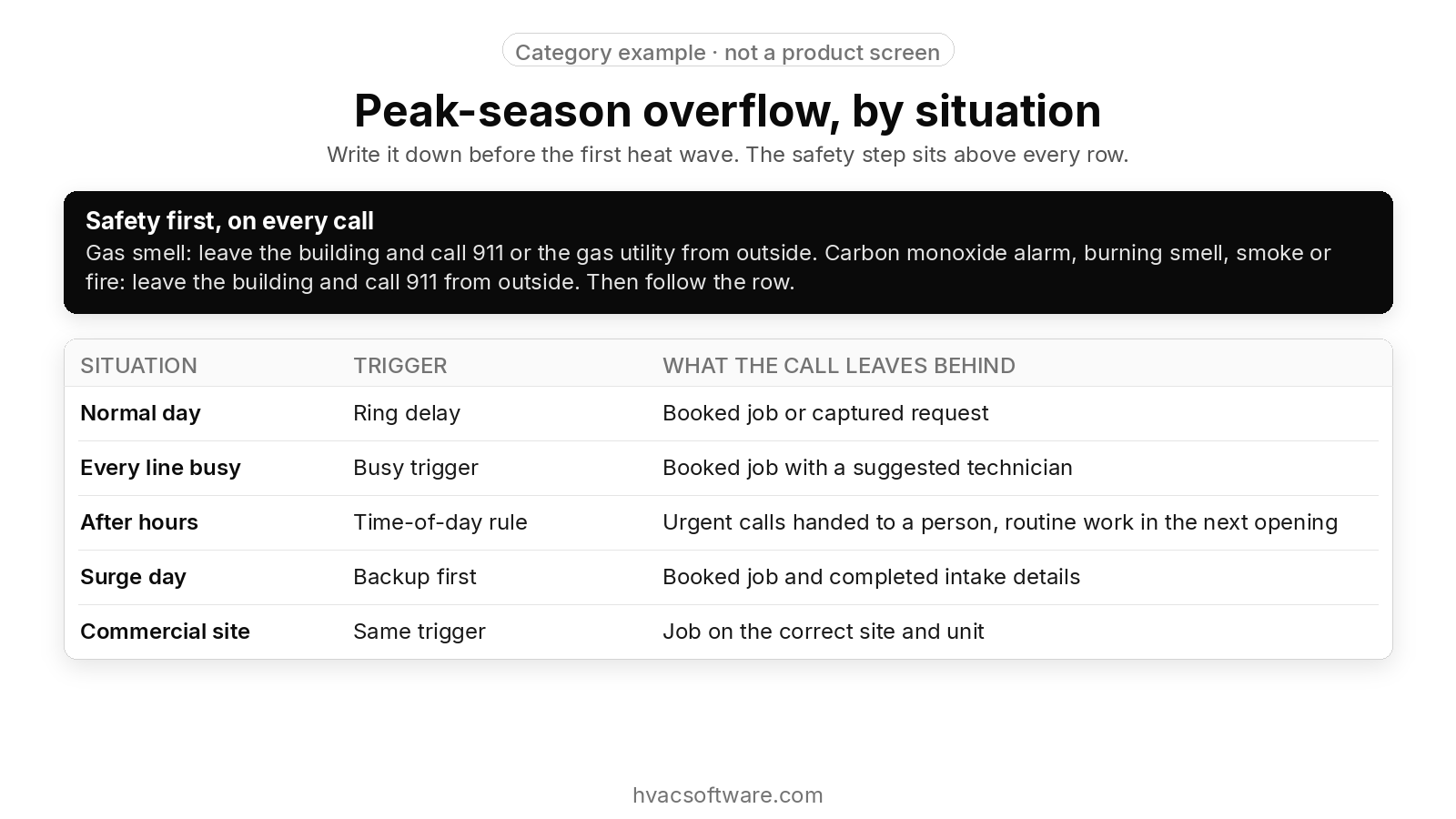
Category example · not a product screen
Peak-season overflow, by situation
Write it down before the first heat wave. The safety step sits above every row.
Safety first, on every call. Gas smell: leave the building and call 911 or the gas utility from outside. Carbon monoxide alarm, burning smell, smoke or fire: leave the building and call 911 from outside. Then follow the row.
- Normal day: ring delay; booked job or captured request.
- Every line busy: busy trigger; booked job with a suggested technician.
- After hours: time-of-day rule; urgent calls handed to a person, routine work in the next opening.
- Surge day: backup first; booked job and completed intake details.
- Commercial site: same trigger; job on the correct site and unit.
How should commercial overflow calls route?
Commercial overflow calls route by site and unit, not just by caller. The call should capture which building and which piece of equipment it is about, and whether the property manager or the tenant is billed, so the job lands on the right account instead of in a pile someone sorts later.
Which coverage option can take peak-season overflow?
HVAC shops cover peak-season overflow in a few ways, and many combine two: more of their own people on the phones, plus a backup that picks up what they can’t. Whichever you choose, the script it follows should open with the safety instruction: a caller who smells gas is told to leave the building and call 911 or the gas utility from outside, before any paging or booking step. A caller with a carbon monoxide alarm, a burning smell, smoke or fire is told to leave the building and call 911 from outside, before any paging or booking step.
- Your own CSRs, better arranged: A simultaneous ring or hunt group sends each call to every available CSR at once, and staggered breaks and shift changes keep someone on the phones. It adds no new tool, but it can’t take more calls than you have people.
- AI receptionist built into your field service software: The AI is part of the system that holds your schedule. Check whether it can book on your plan today, and which call types it can book.
- Separate AI receptionist: A standalone voice agent connects to your field service software. Check whether it creates real jobs on your board or only sends notes that a CSR must re-enter.
- Live answering service: Trained operators answer, screen against your rules and page your on-call contact. Check how messages and bookings reach your office, and keep your on-call schedule current with the service.
- Text-back and a booking link: A caller who hangs up gets a text-back, and routine callers can pick a slot online. It recovers callers but does not answer the phone.
If calls are answered but jobs still don’t get booked, our comparison of an answering service vs an AI receptionist covers what each leaves behind, our guide to what an AI receptionist books covers what actually lands on the board, and our guide to why after-hours calls hit voicemail covers weekend and holiday routing.
Which overflow option books the job instead of taking a message?
Comparisons often score overflow options on how fast they pick up. The questions that decide whether a peak-season call becomes paid work are below.
This is a category comparison, not a description of any one product. Confirm each answer in a demo against your own setup.
What happens after the call is answered, when the board is already full?
In peak season, answering more calls only helps if each call lands on a board with real room for the work. A shop that picks up more callers but can’t fit the work into the schedule has turned a missed call into a broken promise. Safety still comes first: a caller who smells gas is told to leave the building and call 911 or the gas utility from outside before any booking or dispatch step. A caller with a carbon monoxide alarm, a burning smell, smoke or fire is told to leave the building and call 911 from outside before any booking or dispatch step.
- Routine work goes to the next real opening: It is booked against the live schedule, not a guess.
- Urgent calls go to a person: After the safety step, they reach the on-call technician or the dispatcher under the urgency rules you wrote before the season.
- Maintenance-agreement members come first in the same urgency level: Inside one urgency level, members go ahead of non-members, which is part of what they pay for.
- The right technician is sent: The dispatcher picks the technician by schedule, location and skills, not by whoever is open first.
- No same-day promise the board can’t keep: If the board is full, the caller hears an honest window instead of an apology tomorrow.
Our guide to technician capacity planning covers how to hold room for urgent work in peak weeks, and our guide to emergency call prioritization covers how the dispatch board orders urgent work once it lands.
What should you measure once calls are answered?
Watch three things in order: how many calls were answered, how many became booked jobs, and how many of those were dispatched when promised. A rising answer count with flat bookings means calls are reaching voicemail by another name. Healthy bookings with slipping visits mean the board, not the phones, is the bottleneck. All three are easiest to read when you can trace each call to its job and its invoice.
How do you set up overflow routing before the first heat wave?
Set up and test overflow routing before peak season, while the phones are still quiet. Shops that wait until the first heat wave end up writing rules mid-surge.
Whatever you set up, the greeting, the script and the on-call brief all start with the same safety instruction: a caller who smells gas is told to leave the building and call 911 or the gas utility from outside, before any paging or booking step. A caller with a carbon monoxide alarm, a burning smell, smoke or fire is told to leave the building and call 911 from outside, before any paging or booking step.
- Set the forwarding triggers: Turn on the busy trigger, choose your ring delay, set the after-hours rule and name who can declare a surge day.
- Write the urgency rules: Define what counts as urgent for no-heat, no-cool and vulnerable-occupant calls, and how each one reaches a person or the on-call technician.
- Put safety first in every script: Every greeting and script tells a caller who smells gas to leave the building and call 911 or the gas utility from outside first. It tells a caller with a carbon monoxide alarm, a burning smell, smoke or fire to leave the building and call 911 from outside, and tells anyone in danger from heat or cold to call 911.
- Lock the person-only list: Unusual or high-value requests, and anything your rules say a person must handle, go to a named person with a backup.
- Connect the schedule and the price book: Ask each vendor to show the backup seeing live availability and quoting only fees your office has set.
- Turn on text-back with a booking link: It is the fallback for anyone who hangs up first.
- Stagger breaks and shift changes: Keep someone on the phones through lunch and the end of the day on the busiest weeks.
- Run a mock surge: Have office staff place several calls at once, including a test call that mentions a gas smell and a test call that mentions smoke or a carbon monoxide alarm. Check that a caller who smells gas was told to leave the building and call 911 or the gas utility from outside. Check that a caller who mentions smoke or carbon monoxide was told to leave the building and call 911 from outside, and that every call left the record your rulebook asks for.
Use the shoulder season to take pressure off peak: our guide to recurring maintenance scheduling covers placing agreement tune-ups in spring and fall so they don’t compete with no-cool calls in the busiest weeks.
Which overflow setup fits your shop?
The right overflow setup depends on two things: the software you run now, and how far your peak-week calls outrun your CSRs. Start from whichever of these describes your shop.
- Overflow is occasional: A ring delay, the busy trigger and a text-back usually cover the gaps.
- Your CSRs are swamped most afternoons in peak weeks: Plan backup-first surge days, and staff those days for exceptions and callbacks rather than first answers.
- A single-CSR office: One person can’t cover breaks, the end of the day and a surge alone. A backup on the busy and ring-delay triggers carries the load, and text-back catches the rest.
- Several locations: Use the same urgency rules and rollover triggers at every location, and make sure answered calls land on one board that can see every branch’s schedule.
- Residential and commercial work: Choose a setup where overflow calls land as jobs on the right site and unit, not as messages someone sorts later.
- Replacing your software anyway: Time the switch so it finishes before the first heat wave, not during it.
How does FieldCamp fit a shop planning for peak season?
FieldCamp fits contractors running residential and commercial work in one system, with a person still deciding the day. Here is what FieldCamp does today, and what to ask in a demo.
This site is published by FieldCamp.
- On the dispatch board: When your dispatcher drags a job onto a technician, the board checks skills, drive time and schedule conflicts, and the dispatcher confirms the assignment.
- For the customer: The customer gets a text when a job is assigned or moved.
- For the technician: A technician’s assigned jobs and schedule show on their phone.
- One record: Each job stays on one record from the first call to the paid invoice.
- Residential and Commercial Together: Residential service calls and commercial maintenance work run in one system, not two.
- Who decides: A person still decides the day. Assignment stays a decision the dispatcher makes.
- What to ask in the demo: This page does not describe call answering, call overflow routing, call forwarding triggers (busy, ring delay and time-of-day rules), surge-day switching, AI receptionist or answering-service connections, taking several calls at once, simultaneous ring and hunt groups, call queueing and hold, calls that still reach voicemail, callers who hear a busy signal, staggered breaks and shift changes, company greetings, safety screening and triage, urgency and vulnerable-occupant flags, on-call paging, call handoff and transfer, booking on the call, availability and capacity checks during the call, fee quoting and price-book answers, missed-call text-back, online booking links, or caller recognition as FieldCamp features. Ask in the demo how peak-season overflow calls would reach your board, and also about capturing the caller’s name, address, equipment and problem on the job, suggesting or dispatching a technician for an answered call by schedule, location and skills, maintenance-agreement member priority, commercial site and unit matching with property manager or tenant billing, routing unusual or high-value requests to a named person and a backup, callback lists for CSRs on surge days and who can declare a surge day, recording the caller’s agreement to the quoted fee on the job, telling the caller an honest window when the board is full, whether the backup writes a job or leaves a note a CSR must re-enter, which call types the backup can book today, answering-service messages reaching the office and what happens to calls above the plan, flagging a job that needs approval, a mock surge that tests each safety script, keeping the on-call schedule current with an answering service, one board across several locations, reporting on answered, booked and dispatched calls, and the time and help needed to switch from your current software, and for each of those, whether it is available today, needs setup or a connected tool, is in a pilot, or is planned.
Our guide to HVAC AI voice agents covers what a voice agent conversation should hand back to the office, the HVAC contact center overview covers how calls connect to the rest of the front office, and our guide to the dispatch board covers what the board should check when a job is assigned.
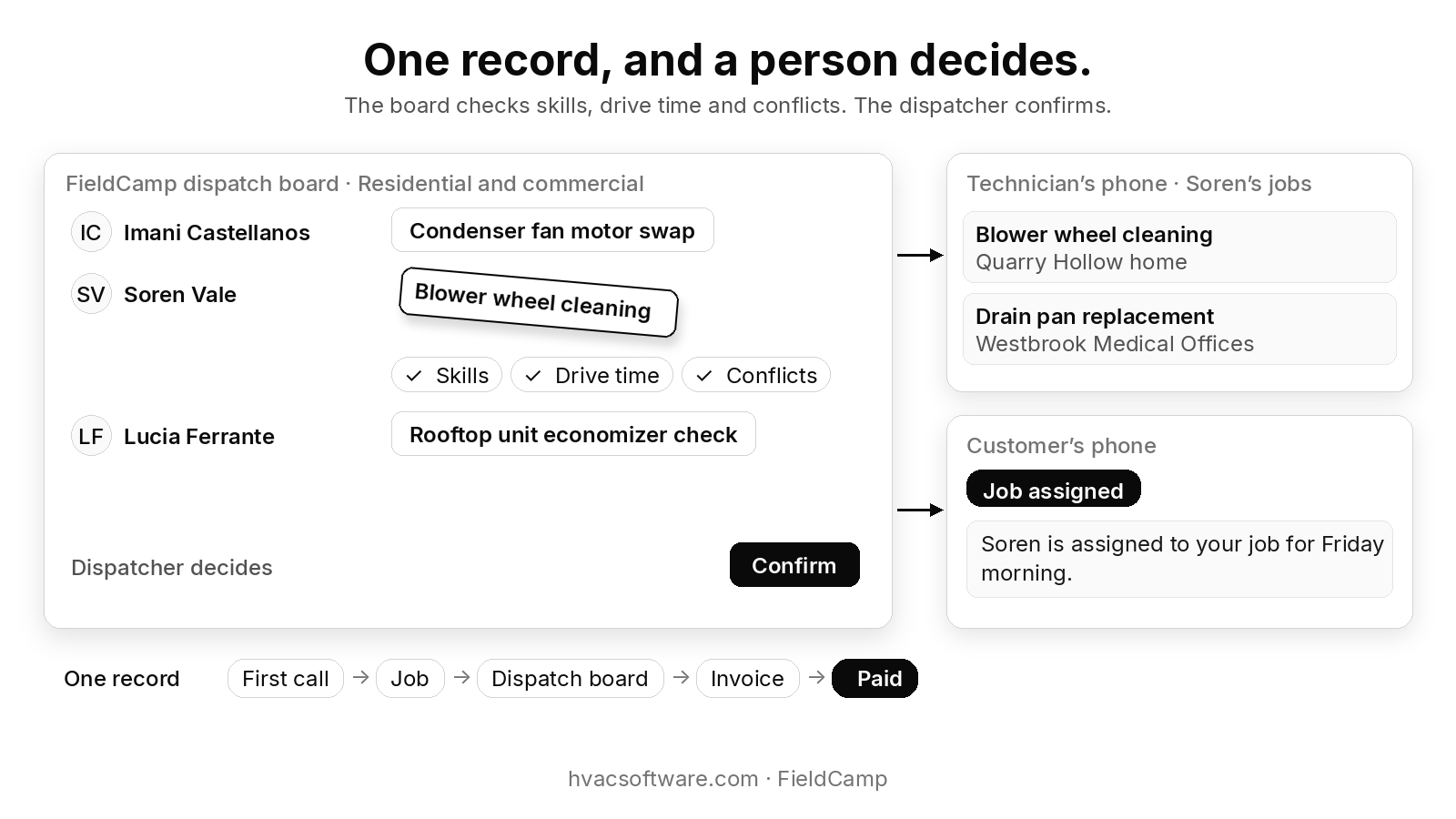
One record, and a person decides.
The board checks skills, drive time and conflicts. The dispatcher confirms.
FieldCamp dispatch board · Residential and commercial: Imani Castellanos: Condenser fan motor swap. Soren Vale: Blower wheel cleaning. Lucia Ferrante: Rooftop unit economizer check.
- Skills
- Drive time
- Conflicts
Dispatcher decides: Confirm.
Technician’s phone · Soren’s jobs: Blower wheel cleaning (Quarry Hollow home). Drain pan replacement (Westbrook Medical Offices).
Customer’s phone. Job assigned: "Soren is assigned to your job for Friday morning."
One record: First call → Job → Dispatch board → Invoice → Paid.
Planning for peak season? Book a 30-minute walkthrough to see how a job moves from the first call onto the dispatch board.
Frequently asked questions
What time of year is best for HVAC service?
For routine maintenance, the shoulder seasons are usually the best time: spring for cooling and fall for heating, before peak season. Tune-ups booked then don’t compete with repair calls in the busiest weeks, and the phones are quieter. For an HVAC business, placing maintenance-agreement tune-ups in spring and fall is one of the simplest ways to keep peak-season phone lines and schedules open for repair work.
How much does an answering service typically cost?
It depends on the service, how it bills and how many calls you send it, so there is no single price. Ask each service how it charges when peak-week volume spikes, and what happens to calls above your plan. For an HVAC business, compare the cost with what each call leaves behind: a booked job on your board is worth more than a message someone has to call back and re-enter. Ask the same questions of an AI receptionist.
How much should I charge for a service call at HVAC?
Safety comes first. If there is a gas smell, the first instruction is to leave the building and call 911 or the gas utility from outside, before any booking, paging or dispatch step. If there is smoke, fire, a burning smell or carbon monoxide risk, the first instruction is to leave the building and call 911 from outside, before any booking, paging or dispatch step. Beyond that, a service call fee depends on your market, your costs and the time of day, so there is no single right number. The useful rule is to set your standard and after-hours fees once in your price book, make sure whoever picks up the phone, including any overflow backup, quotes from that same source, and note the caller’s agreement on the job before anyone is sent out.
How hot is too hot for AC to keep up?
Safety comes first. If there is a gas smell, the first instruction is to leave the building and call 911 or the gas utility from outside, before any booking, paging or dispatch step. If there is smoke, fire, a burning smell or carbon monoxide risk, the first instruction is to leave the building and call 911 from outside, before any booking, paging or dispatch step. If someone is in danger from the heat, the caller should call 911. There is no single temperature. Many systems are sized for the usual hot days where they are installed, so in a long heat wave a working system can run constantly and still fall behind the thermostat setting. A system that blows warm air, stops running or ices up needs a technician. For an HVAC office, write down how a “not keeping up” call is sorted in a heat wave: urgent when older adults, young children or people with health conditions are in the home, and routine otherwise.
Final recommendation
Before the first heat wave, write your overflow rulebook down, turn on the busy trigger, name who can declare a surge day and run a mock surge with your own staff. Check that every script, greeting and on-call brief starts with the safety instruction: a caller who smells gas should leave the building and call 911 or the gas utility from outside, before any booking, paging or dispatch step. A caller with a carbon monoxide alarm, a burning smell, smoke or fire should leave the building and call 911 from outside, before any booking, paging or dispatch step.