Missed calls
What Missed HVAC Calls Cost Lost to voicemail, counted from your own call log.
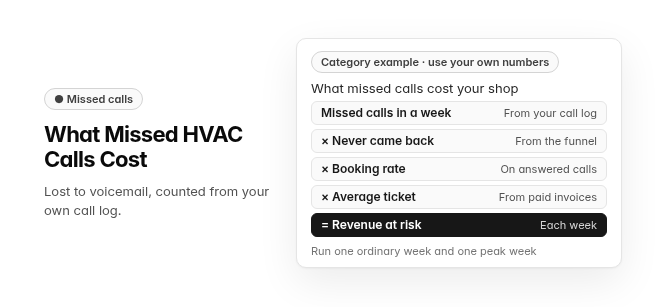
Category example · use your own numbers. What missed calls cost your shop: Missed calls in a week (from your call log) × Never came back (from the funnel) × Booking rate (on answered calls) × Average ticket (from paid invoices) = Revenue at risk (each week). Run one ordinary week and one peak week.
There is no single trustworthy number for how many calls an HVAC company loses to voicemail. Published figures disagree with each other, so the honest answer comes from your own call log: count the calls nobody answered, follow each one to a message, a callback or a booked job, and price the ones that went nowhere at your own average ticket.
One rule comes before any of the arithmetic. If a caller smells gas or a carbon monoxide alarm is going off, the first instruction is to leave the building and call 911 or the gas utility, before any booking or dispatch step. The same goes for a burning smell from the equipment: leave the building and call 911.
This guide gives you the funnel to count, the formula to price it, and the steps that keep a missed caller from booking with the next contractor on the list.
What percentage of HVAC calls go unanswered?
It depends on the shop, the season and the hour, and the published figures cover a wide range. Ordinary weekday hours sit at the low end. Busy weather, weekends and after-hours windows sit higher, because the same people are trying to answer more calls, or nobody is answering at all. Every shop misses some calls, so the useful question is where your own misses happen.
Why do the published miss rates disagree?
The published miss rates disagree because they measure different windows of time, different trades and different shops, not because one of them is the real number. Some report an average day and a weekend separately. Others fold busy periods into the business-hours figure and report after-hours on its own. Many are vendor estimates that cite each other, and few say how many shops or calls they counted.
Every version agrees on one thing: the miss rate climbs whenever the phone is under-staffed.
What counts as a "missed" call?
A missed call, as these sources use the term, is any inbound call that a live person doesn't answer. Some of those calls ring out. Others roll to voicemail. A few reach a full or unmonitored mailbox. The miss rate is where the voicemail problem starts, but it is not the same number as calls lost to voicemail. That smaller count comes later in the funnel.
How many callers leave a voicemail?
Fewer than you would hope. Sources that track it agree that a large share of callers who reach an HVAC company's voicemail hang up without leaving a message, though the exact share varies from source to source. For a service like heating or cooling, a recorded greeting rarely holds a caller who needs a technician today.
The callers who hang up aren't lost to voicemail alone. They leave no name, no address and no description of the problem, so the office has nothing to call back except a number in the phone log. Whether that number gets returned in time is a separate question. It is also where published figures start to blur together.
Why "no message" and "lost customer" are different numbers
Published figures often mix three separate measurements:
- Callers who leave no message.
- Callers who never call back.
- Callers who book with someone else.
Each of these is smaller than the one before it. Treating "no message" as "lost job" overstates the loss. Treating "left a message" as "safe" understates it, because a message that is returned late can still end with the job going elsewhere.
How many calls does your shop lose to voicemail each week?
Count it as a funnel. Start with every inbound call in one week, then take away the calls a person answered, the callers who left a message, the callers who called back and the callers you reached in time. What is left is the number of calls you lost to voicemail that week. Run it once for an ordinary week and once for a peak heating or cooling week.
The voicemail-loss funnel, stage by stage
This is a counting model for your own records, not a benchmark. Fill each stage from your phone system and your job records.
| Stage | What it counts | Where to find it |
|---|---|---|
| Inbound calls | Every call to the main line | Phone system call log |
| Missed | Calls not answered by a live person | Phone system call log |
| Reached voicemail | Missed calls that rolled to a mailbox | Phone system or voicemail log |
| No message left | Callers who hung up at the greeting | Voicemail log against missed calls |
| Never called back | Callers who didn't try your number again | Call log, matched by phone number |
| Booked elsewhere | Callers who hired another contractor | Callback notes, where the caller tells you |
How to read the funnel
The "no message left" stage is the most defensible answer to "how many calls are lost to voicemail". At that stage the caller has reached your voicemail and left nothing your office can act on. The last two stages decide how much of that loss is permanent. Published sources rarely measure those stages at all, which is why your own records matter more than any industry figure.
How shop size changes the count
The count scales with call volume, not truck count. A shop that takes more calls during a peak week should expect its weekly voicemail loss to grow at least in line with volume. During a peak week, fewer people are available to answer each additional call, so the loss can grow faster than volume.
Category example · not a product screen
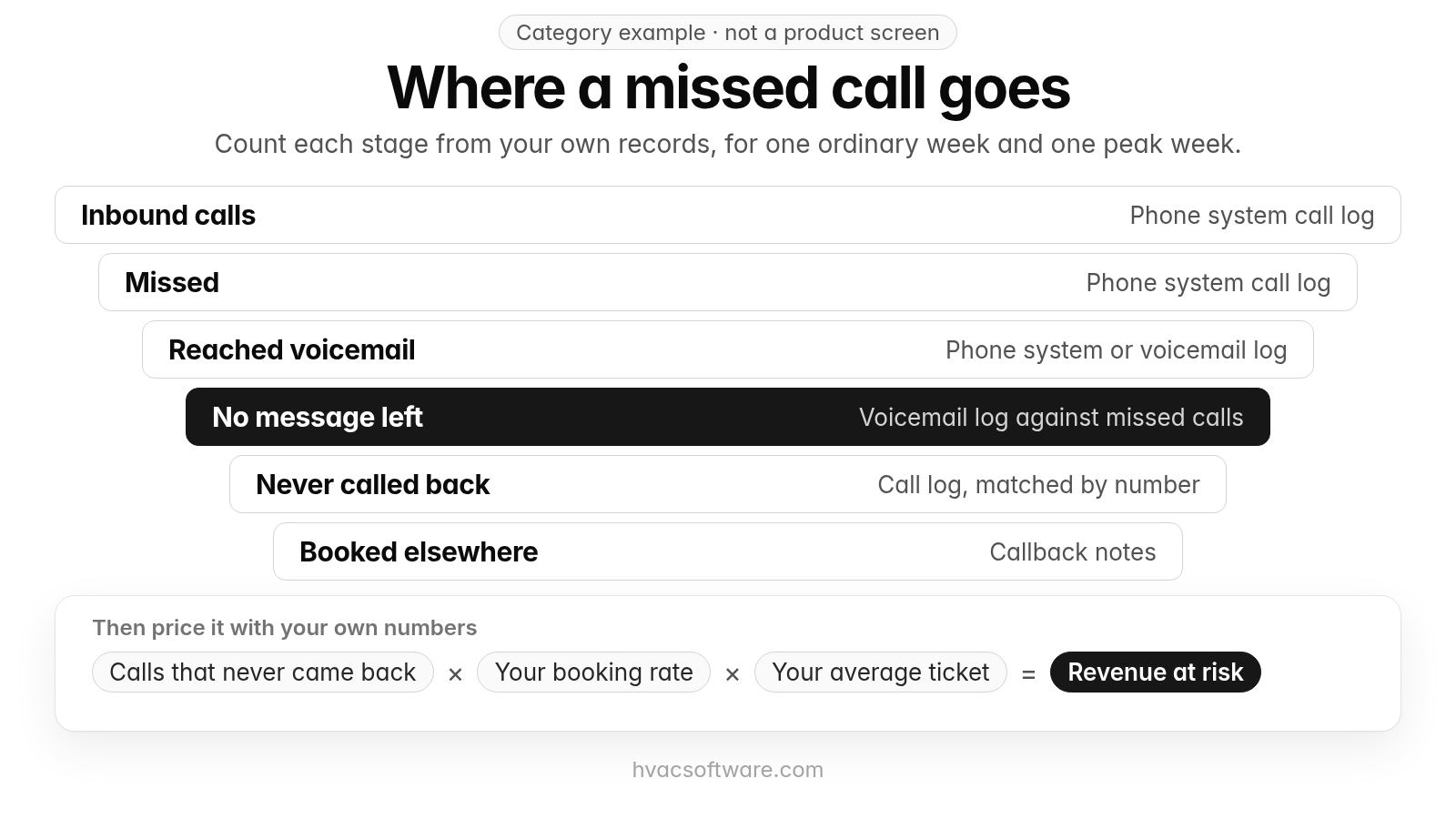
Where a missed call goes
Count each stage from your own records, for one ordinary week and one peak week.
- Inbound calls: phone system call log.
- Missed: phone system call log.
- Reached voicemail: phone system or voicemail log.
- No message left: voicemail log against missed calls.
- Never called back: call log, matched by number.
- Booked elsewhere: callback notes.
Then price it with your own numbers: Calls that never came back × Your booking rate × Your average ticket = Revenue at risk.
When do HVAC companies miss the most calls?
HVAC companies tend to miss the most calls after hours, when nobody covers the phone, then on weekends, then in peak heating and cooling season. Ordinary weekdays usually sit lowest. The pattern follows staffing: the miss rate rises whenever call volume outpaces the people available to answer.
- Weekday business hours: Calls go unanswered when the office is on another line, handling dispatch or taking a break.
- Peak season: Volume spikes when the weather turns, while the same office staff work the same phones.
- Weekends: Shops run a skeleton crew, or nobody answers live at all.
- After hours: Unless someone is assigned to cover the phone, the main line goes to voicemail.
Commercial calls follow the same pattern but carry more weight per call. A property manager who reaches voicemail about one site may be the contact for several other sites as well.
How do you calculate what missed calls cost your shop?
You only need four numbers from your own shop: how many calls you miss in a week, how many of those callers never come back, how many answered calls you normally book, and what a booked job is worth. Multiply them to get the revenue at risk each week.
Missed calls in a week × share of missed callers who never come back × your booking rate on answered calls × your average ticket = revenue at risk that week
- Missed calls in a week: inbound calls that rang out, went to voicemail or were abandoned, taken from your phone system's call log.
- Share who never come back: from the funnel above. If you haven't measured it yet, start by counting every missed caller who left no message and didn't call back.
- Booking rate on answered calls: the share of answered inbound calls that turn into booked jobs in your own shop.
- Average ticket: your mean invoice for the job types that come in by phone, from your own paid invoices.
Multiply the weekly figure by the number of weeks you want to look at, and run peak weeks separately, because both the missed calls and the ticket change with the weather.
Price each missed call at the job it most likely was
The cost of a missed call depends on what the caller needed. Price each one at the call type it most likely belonged to, using your own invoices, not one flat number.
This is a template for your own invoices, not a price list.
| Call type | What to use as the ticket | What else is at stake |
|---|---|---|
| Tune-up or maintenance | Your average maintenance invoice | A maintenance agreement sign-up |
| Routine repair | Your average repair invoice | Future repair and replacement work |
| Peak-season repair | Your average repair invoice for peak weeks | A replacement conversation on aging equipment |
| Urgent no-heat or no-cool | Your average urgent or after-hours invoice | A replacement if the system is beyond repair |
| System replacement lead | Your average installed system | Installation, agreement and years of service |
| Commercial request | Your average commercial job for that site | Other units, other sites and the contract |
An urgent call is worth more than its ticket, and it also carries a duty of care. Whatever the price, a caller who smells gas or has a carbon monoxide alarm going off should first hear to leave the building and call 911 or the gas utility, before any booking or dispatch step.
What does a missed call cost beyond the first ticket?
The first ticket is only part of the loss. A missed caller who books elsewhere often stays with that contractor. With them can go the maintenance agreement, the eventual replacement and the referrals, plus the marketing money you already spent to make the phone ring.
- Customer lifetime value: an HVAC customer is worth far more over the relationship than a single job.
- Maintenance agreement value: a caller who books a competitor's tune-up is a likely sign-up for that competitor's agreement, not yours.
- Future system replacement: the contractor who has serviced the equipment is usually the one asked to quote the replacement.
- Referrals: a customer you never served won't refer neighbors to you.
- Wasted ad spend: each paid lead has a real acquisition cost, and a missed call wastes it.
- Ad hours versus phone hours: Google's Local Services Ads let you choose the days and times your ad runs, such as only the hours when you can respond to calls in a timely manner. Match ad hours to the hours your phone is covered.
What does a missed commercial HVAC call cost?
Published estimates of missed-call cost are built on residential tickets. A missed commercial call works differently. One property-manager request can cover several units or sites. Billing can split between the property manager and the tenant. A missed renewal call can put a full year of scheduled maintenance visits at risk at once.
- Property-manager service requests: one caller often represents several buildings. Losing the call can mean losing the account.
- Multi-site and multi-unit work: the job value grows with the number of rooftop units or sites on the request.
- Property manager versus tenant billing: the same call can produce invoices to more than one party, so the lost revenue is more than one ticket.
- Maintenance-agreement renewals: a missed renewal call puts every recurring visit for the year at risk.
How to measure your own voicemail loss
To measure your own voicemail loss, follow every missed call from the phone log through to a booked job or a dead end. Split the results by time window and by job type. Published rates are averages across many shops. Your own funnel shows where your phone actually leaks, and it tells you whether the loss is concentrated on weekends, after hours or at peak.
- Pull a full week of call logs, plus one week from peak heating or cooling season.
- Split every inbound call into three windows: weekday business hours, weekends and after hours. Calculate a miss rate for each window.
- For each missed call, record four outcomes: whether it reached voicemail, whether a message was left, whether the caller called back, and whether a job was booked.
- Tag each missed call by job type: urgent no-heat or no-cool, maintenance agreement visit, or commercial site.
- Follow recovered calls through to the invoice, so that each saved call shows its actual revenue rather than an industry average.
On the urgent calls you tag, check the order too: a caller who smells gas or has a carbon monoxide alarm going off should first have heard to leave the building and call 911 or the gas utility, before any booking or dispatch step.
Step five is the hard part when the phone system, the schedule and billing are separate tools. When the job, the customer's site and equipment and the invoice all sit in one record, the funnel is much easier to build.
How do you stop missed callers from booking a competitor?
A caller whose call goes unanswered often tries the next contractor on the list and books whichever one responds first. The fix is a system you set up in advance: a fast reply to every missed call, coverage that books the job instead of taking a message, safety-first triage, short overflow timing, an online booking path, and a weekly look at the numbers.
- Reply to every missed call quickly. A missed-call text-back is a short text sent to a caller whose call went unanswered, with your company name, one question and a way to book. Where you offer it, it should fire on unanswered calls and new web forms without anyone pressing a button. For an after-hours text, put the safety line first: "If you smell gas or a carbon monoxide alarm is going off, leave the building and call 911 or the gas utility now. Otherwise, are you without heat or cooling right now? Reply here and we will get back to you." In the United States, FCC rules ban autodialed texts to a mobile phone without the owner's prior consent, commercial texts need written consent, and people can opt out at any time, so confirm your consent and opt-out wording with counsel before you turn it on.
- Send unanswered calls to coverage that books, not a voicemail box. The test for any coverage, whether an AI receptionist, a trade-specific answering service or an on-call technician, is whether the call ends with a job on your board or only a note for the morning. Our comparison of an answering service vs an AI receptionist covers what each leaves behind after the call, and our guide to what an AI receptionist books covers what actually lands on the board.
- Put safety first, then triage. If the caller smells gas or a carbon monoxide alarm is going off, the first thing the caller hears is to leave the building and call 911 or the gas utility, before any booking or dispatch step. After that, urgent no-heat and no-cool calls go to your on-call technician, routine work books into the next open window, and anything outside your rules goes to a person. Our guide to emergency call prioritization covers how the board orders urgent work once it lands.
- Set overflow timing and an on-call rotation. Ring the main line for a short, set number of rings, then roll the call to the on-call technician or the answering layer. With conditional forwarding, your phone still rings first and only the missed calls roll over. Every after-hours shift needs a named on-call tech, a backup and a schedule the answering layer can see. Call your own line after hours and confirm where the call actually ends up.
- Keep online booking open on your site and your Google Business Profile. Some callers would rather pick a service window themselves than wait for anyone. A booking button on your website, and a booking link on your Google Business Profile, give them a path late at night that doesn't depend on a phone. Our guide to online booking covers what valid booking options look like before a customer confirms.
- Measure missed calls and response time every week. Review missed calls by hour and by channel, including web forms, and compare booked jobs against messages taken. The funnel above is the weekly report.
What should HVAC software do with a call that would hit voicemail?
Ask each vendor whether HVAC software should turn a call that would have hit voicemail into a job the office can act on, not another message to return. Whoever or whatever picks up, a person, an answering service or an AI receptionist, check what it leaves in your software against these points:
- Live calendar access: whoever or whatever picks up should see real openings, not a static schedule.
- Triage rules you control: you decide which calls are urgent and which always go to a person, with the safety instruction first on any gas, carbon monoxide or burning-smell call (leave the building and call 911 or the gas utility).
- Skill-aware dispatch: a booked commercial rooftop job should reach a technician qualified for it.
- One record: the call, the job, the visit and the invoice should share one record, so the funnel above can be built without stitching reports together.
- Agreement awareness: a maintenance-agreement customer should be booked against the agreement.
The HVAC contact center overview covers how calls connect to the rest of the front office, and our guide to HVAC AI voice agents covers what a voice agent conversation should hand back to the office.
How does FieldCamp fit a shop working out its missed-call cost?
FieldCamp fits contractors running residential and commercial work in one system, with a person still deciding the day. Here is what FieldCamp does today, and what to ask in a demo.
This site is published by FieldCamp.
- On the dispatch board: When your dispatcher drags a job onto a technician, the board checks skills, drive time and schedule conflicts, and the dispatcher confirms the assignment.
- For the customer: The customer gets a text when a job is assigned or moved.
- For the technician: A technician’s assigned jobs and schedule show on their phone.
- One record: Each job stays on one record from the first call to the paid invoice.
- Residential and Commercial Together: Residential service calls and commercial maintenance work run in one system, not two.
- Who decides: A person still decides the day. Assignment stays a decision the dispatcher makes.
- What to ask in the demo: This page does not describe call answering, missed-call text-back, after-hours coverage, booking on the call, triage and on-call routing, call handoff, call transfer, bilingual calls, caller recognition, lead qualification, fee quoting, call logs and missed-call reporting, or booking confirmations and reminders as FieldCamp features. Ask in the demo how calls would reach your board, and for each piece, whether it is available today, needs setup or a connected tool, is in a pilot, or is planned. Also ask about live calendar and availability checks during the call, missed-call alerts, conditional forwarding and overflow routing, web-form replies, online booking links, and agreement-aware booking, and for each of those, whether it is available today, needs setup or a connected tool, is in a pilot, or is planned.
Our guide to customer text notifications covers the texts a customer gets once a job is assigned or moved, and our guide to the dispatch board covers what the board should show once a job lands.
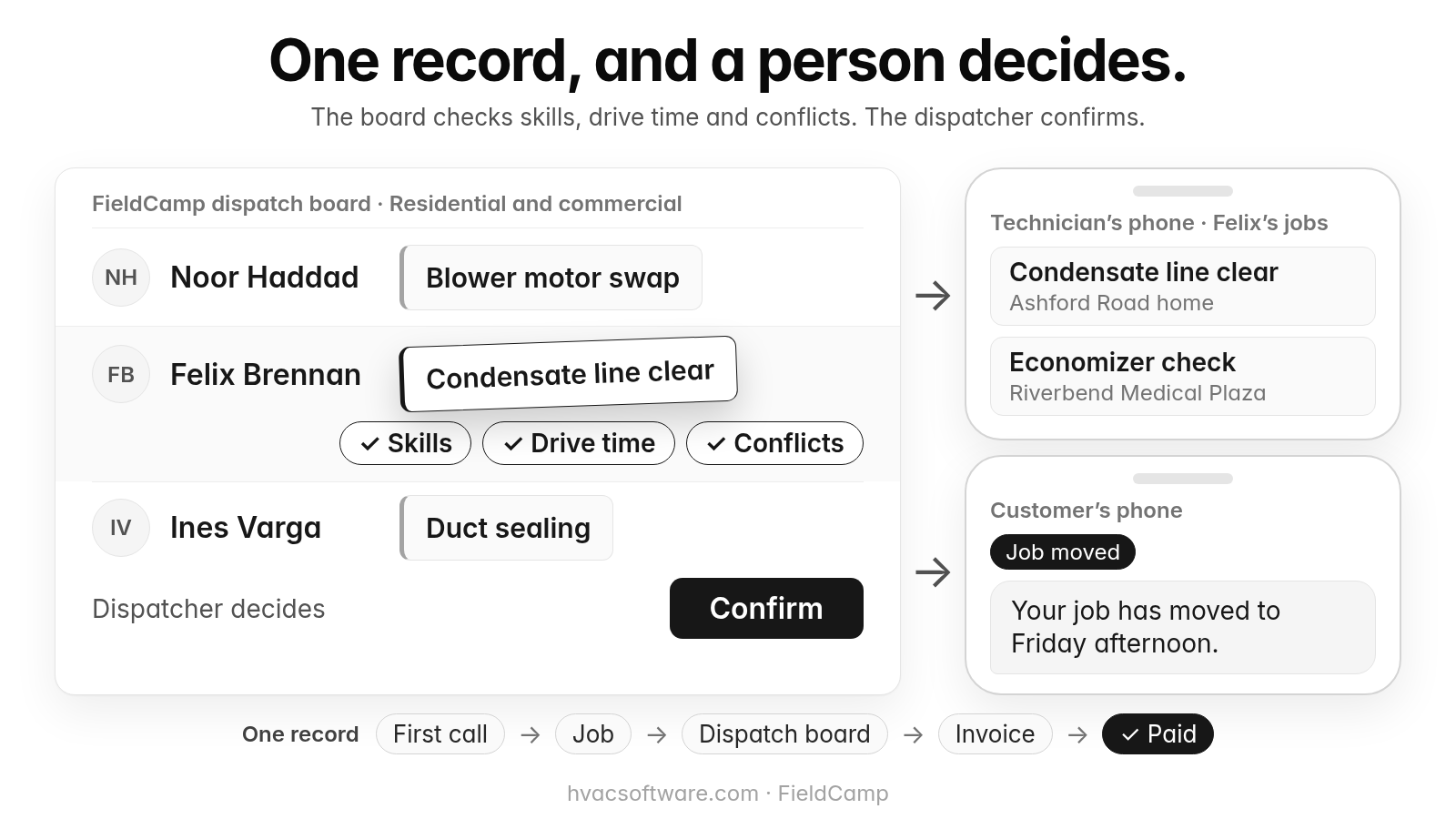
One record, and a person decides.
The board checks skills, drive time and conflicts. The dispatcher confirms.
FieldCamp dispatch board · Residential and commercial: Noor Haddad: Blower motor swap. Felix Brennan: Condensate line clear. Ines Varga: Duct sealing.
- Skills
- Drive time
- Conflicts
Dispatcher decides: Confirm.
Technician’s phone · Felix’s jobs: Condensate line clear (Ashford Road home). Economizer check (Riverbend Medical Plaza).
Customer’s phone. Job moved: "Your job has moved to Friday afternoon."
One record: First call → Job → Dispatch board → Invoice → Paid.
Working out what missed calls cost you? Book a 30-minute walkthrough to see how a job moves from the first call onto the dispatch board.
Frequently asked questions
How do you respond to a missed call professionally?
Reply quickly, by text or a callback, with your company name, an apology for missing the call and one question that moves the job forward, such as whether the system is out completely or running but not keeping up. Offer a way to book, and follow up by phone if the caller doesn't reply. In the United States, texts sent with an autodialer need the caller's prior consent and an easy way to opt out, so confirm your wording with counsel.
How do you turn on missed-call notifications for an HVAC business?
Start in your phone system or carrier settings, which often offer missed-call alerts by text or email, and conditional forwarding so unanswered calls roll to an on-call phone or an answering layer. If you add a missed-call text-back, make sure the replies reach a person who can book the job, and test the setup by calling your own line after hours.
Are HVAC technicians on call after hours?
Many HVAC companies run an on-call rotation, so a named technician and a backup cover nights, weekends and holidays, but it depends on the shop. Safety comes first on any after-hours call: if a caller smells gas or a carbon monoxide alarm is going off, the first instruction is to leave the building and call 911 or the gas utility, before any booking or dispatch step. After that, an urgent no-heat or no-cool call should reach the on-call technician, and routine work can wait for the next open window.
How do you get more calls for an HVAC business?
Start by answering the calls you already get. Before you buy more leads, count how many inbound calls went unanswered last week and how many of those callers never came back. Match your paid ad hours to the hours your phone is covered, keep an online booking path open on your website and your Google Business Profile, and reply quickly to every missed call and web form.
What is considered an emergency HVAC call?
Safety comes first. If a caller smells gas or a carbon monoxide alarm is going off, the first instruction is to leave the building and call 911 or the gas utility, before any booking or dispatch step. A burning smell from the equipment also means leaving the building and calling 911, and if someone is in danger from heat or cold, the caller should call 911. After that, shops usually treat a no-heat call in freezing weather, a no-cool call in extreme heat with a vulnerable person in the home, and a commercial failure that affects a business as urgent work for the on-call technician.
Final recommendation
Before you buy more leads or another way to answer the phone, run the voicemail-loss funnel on one ordinary week and one peak week, then price the lost calls with your own booking rate and average ticket. Check where the urgent calls went first: a caller who smells gas or has a carbon monoxide alarm going off should hear to leave the building and call 911 or the gas utility, before any booking or dispatch step.