Category example
Answered the call. Did it book?
Gas smell: leave the building and call 911 or the gas utility from outside.
Carbon monoxide alarm, burning smell, smoke or fire: leave the building and call 911 from outside.
- Offer two specific time slots
- Ask for the booking
- Review the calls that didn’t book
A low HVAC Customer Service Representative (CSR) booking rate is often a call-handling problem, not a lead problem: calls go unanswered, CSRs quote a price instead of offering a time, and nobody reviews the calls that didn’t book. Published industry ranges disagree with each other, so treat any benchmark you see as a prompt to check current industry reports and your own call logs rather than as a target. To raise call conversion, recover every bookable call, sell the visit with two specific time slots, and review unbooked calls each week.
One rule sits above every booking ask. If a caller smells gas, the first instruction is to leave the building and call 911 or the gas utility from outside, before any intake, booking or dispatch step. If a carbon monoxide alarm is going off, or the caller reports a burning smell, smoke or fire, the first instruction is to leave the building and call 911 from outside, before any intake, booking or dispatch step.
What is a good HVAC CSR booking rate?
A good HVAC CSR booking rate is the one your shop can defend from its own call log, split by call type. Blended averages published by vendors and trade writers move from year to year and from shop to shop, so compare yourself to your own recent window before you compare yourself to someone else’s headline number. Check current industry reports if you want an outside reference, then read your urgent-service, maintenance and replacement mixes separately, because a replacement-heavy week can make a blended rate look low while your CSRs are doing the job.
Use your own records to answer three questions:
- What share of answered calls became a booked visit in the last quarter?
- How does that share change for urgent service calls, maintenance visits and replacement estimates?
- How much of the loss sits in unanswered calls versus answered calls that never got a booking ask?
Our guide to what missed HVAC calls cost covers the unanswered side. This page stays on the answered calls that should have booked and didn’t.
Why answered calls don’t book: a six-reason diagnostic
Answered calls go unbooked for one of six reasons, and each reason has a different fix. If you sort every lost call into one of these buckets, you will know whether you have a training problem, a capacity problem or a phone-coverage problem.
What are the six reasons a call doesn’t book?
- Never answered, or no callback. The caller reached voicemail or waited too long, and nobody followed up quickly. Fix: coverage and callback speed, not scripts.
- No booking ask. The CSR answered the caller’s questions but never offered an appointment. Fix: a required two-slot close on every bookable call.
- Price given, no time offered. The CSR quoted a number and the call ended there. Fix: state the diagnostic fee, explain what the visit includes, then offer times.
- No capacity shown. The CSR said the shop was booked out and let the caller go. Fix: live board visibility, a cancellation list and an after-hours option.
- Not a bookable lead. Spam, vendor calls, existing-job questions and out-of-area callers belong in this bucket. Fix: take these out of the bookable rate so they stop dragging down CSR scores.
- Replacement shopper sent to think about it. The caller wanted a system price and left without a scheduled in-home estimate. Fix: book the estimate visit as the next step instead of discussing equipment on the phone.
How do you tag and read the reason mix?
Add a required unbooked-reason field to the call record. The CSR picks one of the six reasons before closing the call, and a manager corrects the tag during the weekly recording review. Each week, read the share of losses in each bucket by CSR and by call type.
Each pattern points to a different owner:
- Reasons two, three and six: a coaching job.
- Reason one: a coverage job.
- Reason four: a dispatch and capacity job.
If most of your losses are reason four, more CSR training won’t fix it.
Category example · not a product screen
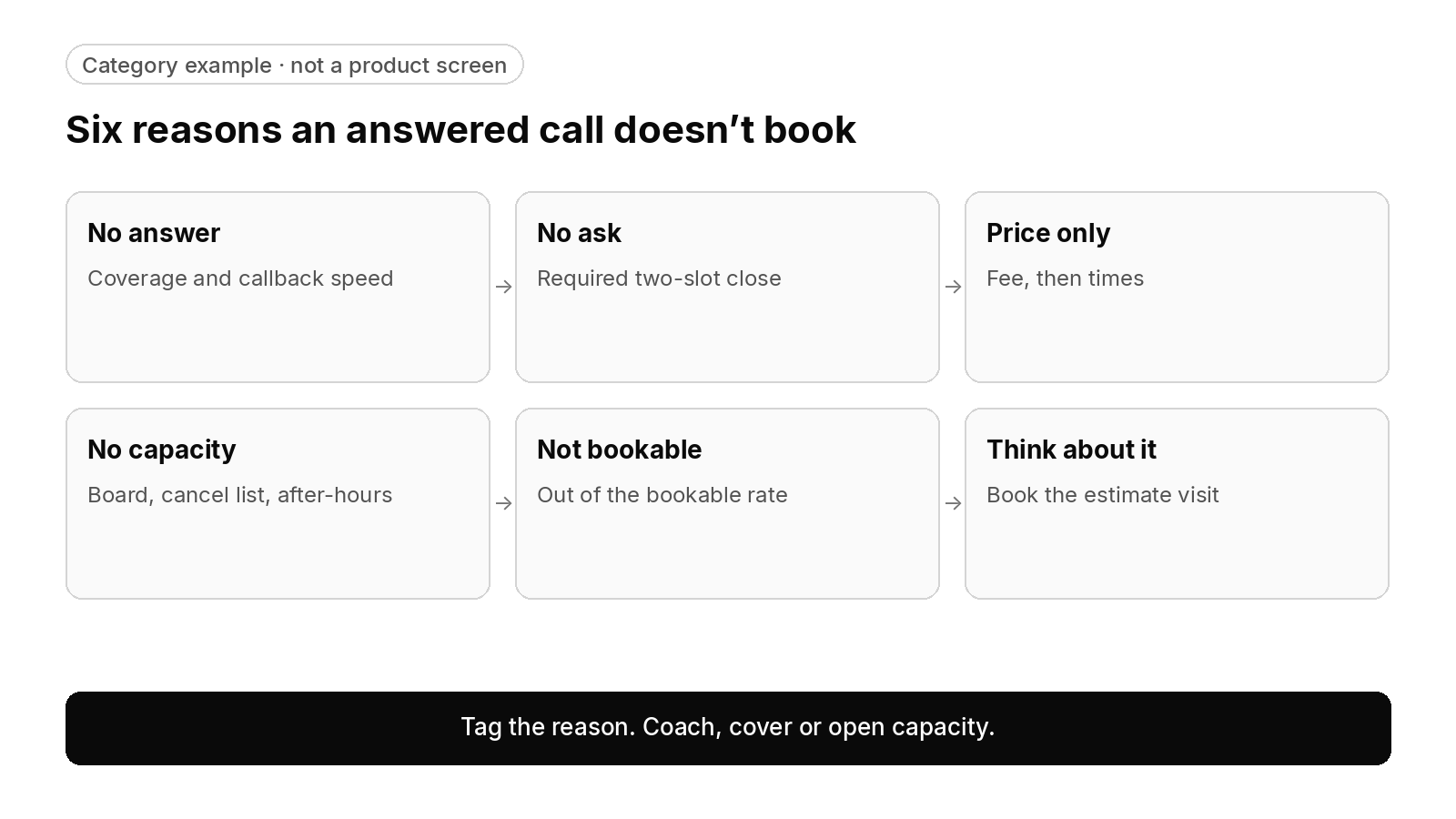
Six reasons an answered call doesn’t book
- No answer: Coverage and callback speed
- No ask: Required two-slot close
- Price only: Fee, then times
- No capacity: Board, cancel list, after-hours
- Not bookable: Out of the bookable rate
- Think about it: Book the estimate visit
Tag the reason. Coach, cover or open capacity.
Nine fixes to raise your HVAC CSR booking rate
The fixes follow the order a call actually takes: capture it, handle the conversation, then measure and reward the result. Start with whichever bucket from the diagnostic above holds most of your losses.
How do you capture more calls before the conversation starts?
- Pick up the call or recover it fast. An unanswered call can’t book, and a slow callback usually reaches someone who has already called the next contractor. Where you offer it, send a missed-call text with an online booking link, and send overflow and after-hours calls to coverage that can schedule the job. Taking messages is not enough. Our guide to what missed HVAC calls cost covers the coverage setup in full.
- Qualify urgency early, after safety. If a caller smells gas, the first instruction is to leave the building and call 911 or the gas utility from outside. If a carbon monoxide alarm is going off, or the caller reports a burning smell, smoke or fire, the first instruction is to leave the building and call 911 from outside. After that, if anyone in the home is in danger from heat or cold, the caller should call 911. Then ask whether the system is fully down and whether anyone vulnerable is in the building. That answer sets the priority, the fee and which slots to offer.
What should CSRs say on the call?
- Answer price with the diagnostic fee, then pivot. Don’t quote repair prices on the phone, because nobody can price a repair the tech hasn’t seen. State the diagnostic or service call fee your office has set, explain what the visit covers, and move straight to times. Our guide to how an AI phone agent quotes fees covers the same fee handoff for an agent on the line.
- Always offer two specific time slots. Asking what works for the caller invites them to hang up and think about it. A two-slot close gives an easy choice: a tech in their area tomorrow morning, or later in the week at a second named window.
- Ask for the appointment on every bookable call. CSRs who act as order-takers answer questions well and then wait for the caller to ask to book. Make the booking ask a required step in the call flow, and score it in every recording review.
- Keep the lead when you’re full. Saying the shop is booked should never end the call. Offer the earliest real slot, a spot on a cancellation list with a callback promise, or a paid after-hours option for urgent calls. Then log the outcome so capacity losses show up in your data.
How do you measure and reward booking?
- Review a small set of unbooked calls per CSR each week. Use call recordings to find the moment each call was lost: a missed ask, an improvised price, or a time that was never offered. Coach one behavior per session and re-check it the following week.
- Track booking rate by CSR and call type. Measure booked conversion, not call duration. A long call that books nothing is still a lost call. Keep urgent service, maintenance and replacement calls in separate lines so a replacement-heavy mix doesn’t look like a coaching failure.
- Tie part of CSR pay to booking conversion. A bonus on booked calls tells CSRs which outcome the business values. Base it on the bookable rate, with reason-five calls removed, so CSRs aren’t penalized for spam and vendor calls.
How to calculate your CSR booking rate
Your CSR booking rate is booked calls divided by answered calls. Answer rate is a separate metric, and multiplying the two gives you your real call conversion.
- Booking rate = booked calls ÷ answered calls.
- Effective conversion = answer rate × booking rate. Work the product from your own logs for a recent window.
- Raw vs bookable rate. Raw rate counts every answered call. Bookable rate removes calls that could never book, such as spam, vendors and out-of-area callers. Coach CSRs on the bookable rate and report the raw rate to the owner.
- Window and cut. Pull a recent window such as the last quarter. Split the result by CSR and by call type, and keep answer rate on its own line next to it.
When answer rate is high and booking rate is low, the leak is in the conversation or the capacity. When both are low, start with coverage. Our guide to why calls don’t land as job records covers what one inbound call should write onto the customer and job records so the rate is countable.
Coach from recordings and a booking scorecard
Weekly call review is how a shop turns the six-reason diagnostic into behavior change. Review a small set of unbooked recordings each week, with one skill on the table, and look for the missed booking ask or the price-without-time moment in those recordings. AI call scoring tools in this category can grade every CSR call against a custom scorecard and flag missed bookings into a review queue; treat that as category software, and ask in the demo whether it is available today, needs setup or a connected tool, is in a pilot, or is planned.
What should an HVAC CSR scorecard check?
Score behavior, not outcome. A CSR who ran every step on a call that didn’t book still did the job. Use a short yes/no scorecard as your starting rubric:
- Greeting and urgency. Did the CSR answer with the approved greeting? Safety comes first. If a caller smells gas, the first instruction is to leave the building and call 911 or the gas utility from outside. If a carbon monoxide alarm is going off, or the caller reports a burning smell, smoke or fire, the first instruction is to leave the building and call 911 from outside. After that, did they identify a system that won’t heat or cool and escalate when your rules say to?
- Lead details. Did the CSR capture the caller’s name, callback number and service address, plus equipment type and access notes for the tech?
- Price and booking. Did the CSR handle “how much?” by booking the diagnostic rather than quoting a flat repair price, explain the diagnostic fee, offer two specific time slots, ask for the booking, and confirm next steps?
- Agreement offer. Did the CSR offer the maintenance agreement or membership when your rules say to?
Score the handoff, not only the conversation
A booked call still fails if dispatch can’t send a tech without calling anyone back. Add handoff checks to the same scorecard: the correct service site and unit, the equipment record, whether an agreement covers the visit, commercial bill-to and site access, and whether the urgency the CSR named reached the dispatch board. Keep residential and commercial calls in one scoring system against the same customer and job records, so a commercial caller about a second building doesn’t look like a new lead.
How do you run the weekly coaching loop?
- Pick one skill for the week, such as booking the diagnostic instead of quoting a price.
- Review a few flagged calls where a CSR handled that skill well and a few where they didn’t.
- Role-play the miss using the transcript’s wording.
- Before blaming the CSR, check whether the board was full. If capacity lost the job, fix the schedule, not the CSR.
- Each morning, call back yesterday’s unbooked opportunities from the flagged queue.
Working on one skill at a time is what turns scores into behavior change. Handing a CSR every failed criterion at once may not help.
Where you record calls, confirm the applicable notice and consent requirements with qualified legal counsel before recording, and configure your process accordingly. Set a retention and deletion schedule for recordings and transcripts before you start storing them. This page is not legal advice.
What your HVAC software has to support so CSRs can book on the first call
Your HVAC software has to give the CSR three things during the call: a real slot, a set fee and a record that reports the outcome. Without them, even a well-trained CSR hesitates or improvises. Treat the list below as category requirements to confirm in a demo, not as a description of any one product.
This is a category checklist, not a description of any one product. Confirm each answer in a demo against your own setup.
| Need on the call | Why it matters for booking rate | What to confirm |
|---|---|---|
| Coverage when the desk is busy | An unanswered call can’t book | Overflow and after-hours coverage that can schedule, not only take a message |
| Live capacity on the CSR’s screen | CSRs who don’t trust the board hedge, and hedging loses bookings | Real slots by location and skills, plus a cancellation list |
| A posted diagnostic fee the CSR can state | Improvised prices end calls without a time offer | The same fee every CSR states, from the office’s rate card |
| Missed-call recovery | Callers who hit voicemail often dial the next contractor | A text with a booking link, and confirmations after a booking |
| One countable outcome per call | Booking rate by CSR and call type needs a report, not a spreadsheet | An unbooked-reason tag, call type and outcome on the same job record |
Our guide to what an AI receptionist books covers what should land on the dispatch board once a call is booked, our guide to how an AI receptionist qualifies leads covers intake before the booking ask, and our guide to the HVAC contact center covers the office side of the phones.
How does FieldCamp fit a shop that runs residential and commercial service?
FieldCamp fits contractors running residential and commercial work in one system, with a person still deciding the day. Here is what FieldCamp does today, and what to ask in a demo.
This site is published by FieldCamp.
- On the dispatch board: When your dispatcher drags a job onto a technician, the board checks skills, drive time and schedule conflicts, and the dispatcher confirms the assignment.
- For the customer: The customer gets a text when a job is assigned or moved.
- For the technician: A technician’s assigned jobs and schedule show on their phone.
- One record: Each job stays on one record from the first call to the paid invoice.
- Residential and Commercial Together: Residential service calls and commercial maintenance work run in one system, not two.
- Who decides: A person still decides the day. Assignment stays a decision the dispatcher makes.
- What to ask in the demo: This page does not describe call answering, overflow or after-hours coverage, missed-call text-back, online booking links, booking on the call, the two-slot close, diagnostic-fee or price quoting, price-book lookup, call recording, call transcripts, AI call scoring, booking scorecards, unbooked-reason tagging, booking-rate reporting, urgency triage, lead qualification, maintenance-agreement offers, callbacks, call routing, call handoff or call transfer as FieldCamp features. Ask in the demo how an answered call that never got a booking ask, a call where the CSR quoted a price with no time offered and an unbooked call flagged for weekly coaching would reach your board, and for each piece, whether it is available today, needs setup or a connected tool, is in a pilot, or is planned. Also ask about giving the safety instruction first on the call, before any intake, booking or dispatch step, telling the caller to call 911 if anyone in the home is in danger from heat or cold, identifying urgent calls about a system that won’t heat or cool and sending them to office staff or the on-call technician, answering overflow when the office lines are busy, recovering a missed call with a text and a booking link, collecting the caller’s name, service address, equipment and issue, stating your posted diagnostic fee and declining to quote a repair sight unseen, offering two specific time slots and asking for the booking on every bookable call, keeping a lead when the board is full with a cancellation list or an after-hours option, tagging each unbooked call with one of the six reasons, tracking booking rate by CSR and by call type on the bookable rate, reviewing a small set of unbooked call recordings each week and coaching one skill at a time, scoring CSR calls against a booking scorecard and flagging missed bookings into a review queue, using AI call scoring tools in this category to grade transcripts, checking handoff quality so dispatch can act without calling anyone back, offering a maintenance agreement when your rules say to, calling back yesterday’s unbooked opportunities from the flagged queue, placing a recording notice and setting retention for recordings and transcripts, placing test calls before go-live, a standalone receptionist, an answering service or an agent inside your field service software, and which connection, app or import has to be in place first, and for each of those, whether it is available today, needs setup or a connected tool, is in a pilot, or is planned.
Our guide to HVAC AI voice agents covers what a voice agent conversation should hand back to the office, our guide to how urgent calls reach a tech covers escalation when the on-call tech doesn’t answer, and our guides to after-hours calls, peak-season overflow, caller recognition and answering service vs AI cover the coverage choices around the desk.
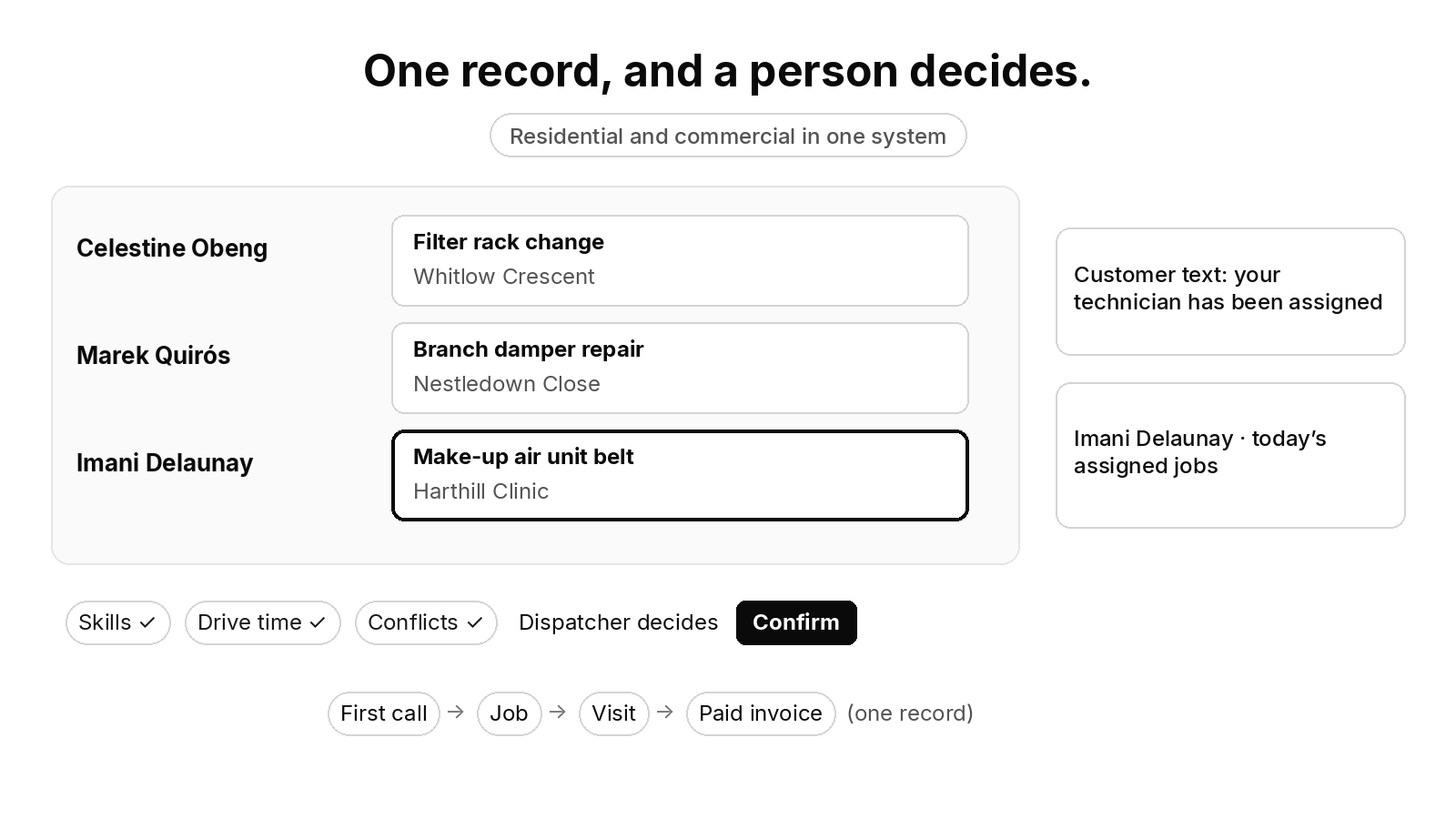
One record, and a person decides.
- Celestine Obeng: Filter rack change · Whitlow Crescent
- Marek Quirós: Branch damper repair · Nestledown Close
- Imani Delaunay: Make-up air unit belt · Harthill Clinic
Skills ✓ · Drive time ✓ · Conflicts ✓ · Dispatcher decides · Confirm
Customer text: your technician has been assigned
Imani Delaunay · today’s assigned jobs
First call → Job → Visit → Paid invoice (one record)
Residential and commercial in one system
Raising booking rate from the desk? Book a 30-minute walkthrough to see how a job moves from the first call onto the dispatch board.
Frequently asked questions
How do you calculate HVAC CSR booking rate?
Divide booked calls by answered calls. Keep answer rate on its own line, and multiply the two for effective conversion from all inbound calls. Report a raw rate and a bookable rate that removes spam, vendor and out-of-area calls, then split both by CSR and by call type for a recent window such as the last quarter.
Why do answered HVAC calls not book?
Most losses fall into a small set of reasons: no booking ask, a price given with no time offered, no capacity shown, a replacement shopper left to think about it, or a call that was never bookable. Tag each unbooked call with one reason, then coach, fix coverage or fix capacity based on which bucket holds the most losses.
How do you coach a CSR whose booking rate is low?
Pull a small set of that CSR’s unbooked call recordings each week and find where each call was lost. Coach one behavior per session, such as the booking ask or the two-slot close, and re-check it the following week. Compare the CSR’s rate against your own call-type mix first, because a replacement-heavy week can make a blended rate look low.
What should an HVAC CSR booking scorecard check?
Safety comes first. Ask yes/no questions that track how a booked call is earned: greeting after any safety instruction, lead details, diagnostic-fee handling, the two-slot close, the booking ask, the agreement offer and next-step confirmation. Score behavior, not outcome, and add handoff checks so the office can act on the job without calling anyone back.
Is HVAC call recording legal in the US?
Call-recording requirements vary by jurisdiction. Confirm the applicable notice and consent requirements with qualified legal counsel before recording calls, and configure your process accordingly. Set a retention and deletion schedule for recordings and transcripts before you store them. This page is not legal advice.
Final recommendation
Before you chase a blended booking-rate target, run the six-reason diagnostic on your own unbooked calls and coach one skill a week from the recordings. Make sure every script starts with the safety instruction: a caller who smells gas should leave the building and call 911 or the gas utility from outside, before any intake, booking or dispatch step. A caller with a carbon monoxide alarm going off, or who reports a burning smell, smoke or fire, should leave the building and call 911 from outside, before any intake, booking or dispatch step.