Category example
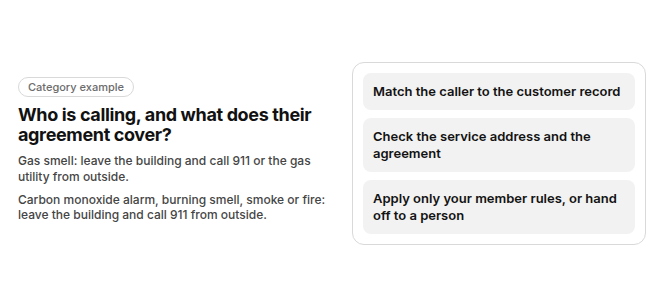
Who is calling, and what does their agreement cover?
Gas smell: leave the building and call 911 or the gas utility from outside.
Carbon monoxide alarm, burning smell, smoke or fire: leave the building and call 911 from outside.
- Match the caller to the customer record
- Check the service address and the agreement
- Apply only your member rules, or hand off to a person
An HVAC AI receptionist identifies existing customers and maintenance agreement members by matching each caller to the customer record in your field service software or customer database while the call is live. The standard to hold it to is simple: it should read from the same record that holds the agreement, so coverage, history and your member rules travel with the call.
One rule sits above every lookup. If a caller smells gas, the first instruction is to leave the building and call 911 or the gas utility from outside, before any record lookup, booking or dispatch step, whether or not the caller is a member. If a carbon monoxide alarm is going off, or the caller reports a burning smell, smoke or fire, the first instruction is to leave the building and call 911 from outside, before any record lookup, booking or dispatch step, whether or not the caller is a member.
After that, the receptionist confirms who is calling, checks what their agreement covers, applies only the rules you set and hands anything uncertain to a person.
What should an HVAC AI receptionist check when an existing customer calls?
An HVAC AI receptionist should check five things, in order, before it treats a caller as an existing customer or a maintenance agreement member.
- Caller ID matching: The incoming phone number is checked against the customer records in your field service management (FSM) software, CRM or customer database.
- Customer profile: A matched caller brings up the customer record, including the service address, equipment history, past repairs and warranty status.
- Agreement verification: The receptionist checks whether the matched customer has an active maintenance agreement, service agreement or membership, and what it covers.
- Member rules: Priority scheduling, a greeting by name and tune-up booking are applied only as the rules you configure allow.
- Human handoff: Billing disputes, warranty questions and callers who can't be verified go to a person, with the profile and the call so far attached.
Why do existing customers and members need different handling on the phone?
If a large share of your calls come from existing customers, and some are maintenance plan members you have promised faster service, these callers need their customer record, not a generic intake script. When the receptionist can't find the record, they need an honest handoff. When a person does take the call, everything already collected goes with it, so the customer doesn't repeat the issue, the address or the system details.
The real question isn't whether the AI can pick up. It's what happens after the call: whether the right visit gets booked against the right agreement, on the right equipment, so the work order and invoice line up later.
How does an HVAC AI receptionist identify an existing customer?
An HVAC AI receptionist identifies an existing customer and checks maintenance agreement status in a fixed order. Each step depends on the one before it.
- Match the caller ID. The incoming number is compared with the phone numbers on customer records in your FSM software or CRM.
- Confirm the service address. The receptionist asks the caller to say the service address rather than reading the address on file back to them. A phone number can belong to more than one property, and one property can have more than one caller.
- Pull service and equipment history. It loads the equipment on file, warranty status and recent repairs, so the caller isn't asked for system details you already hold.
- Check the agreement. It reads whether a maintenance agreement or membership is active for that address and what it covers.
- Apply your rules. Member benefits are applied exactly as the business has set them, and nothing outside them is offered. Examples include priority scheduling, booking the seasonal tune-up a plan includes, or a renewal prompt when coverage is ending.
The lookup never delays safety. If a member or any other caller smells gas, the first instruction is to leave the building and call 911 or the gas utility from outside, before any verification, booking or dispatch step. If a carbon monoxide alarm is going off, or the caller reports a burning smell, smoke or fire from the equipment, the first instruction is to leave the building and call 911 from outside, before any verification, booking or dispatch step. After that, the receptionist keeps routine maintenance requests apart from no-heat and no-cool calls, so a member's tune-up request and a member's furnace that won't run don't land in the same queue.
What changes on the call for members, existing customers and new callers?
An HVAC AI receptionist handles three kinds of callers differently once it can identify existing customers and maintenance agreement members.
This is a category model for writing your own caller rules, not a description of any one product.
| Caller type | What the receptionist knows | What it does |
|---|---|---|
| Maintenance agreement member | Customer record, equipment history, active agreement and what it covers | Greets the caller by name, acknowledges the membership, applies your priority scheduling rules, books included tune-ups, and raises renewal when coverage is ending |
| Existing customer, no agreement | Customer record and service history | Skips repeat intake, books against the existing record, and offers a maintenance plan if your script allows it |
| New caller | Nothing on file | Runs full intake, creates a new customer record, and books or routes the request by how soon it needs a visit |
What should happen when the match isn't certain?
When an HVAC AI receptionist can't confirm the customer record, it should not treat the caller as a maintenance agreement member. A number can be new, shared or out of date, so the standard is verify first, then apply benefits.
- Fallback verification: If the phone number doesn't match, the receptionist checks by name and service address.
- No benefits on a guess: Priority, discounts and included visits apply only when the record is matched and your business allows them.
- A claim is not an entitlement: A caller saying "I'm on the plan" never unlocks member treatment by itself.
- Nothing read back before verification: Account details, the address on file and agreement terms aren't read out to a caller until the match is confirmed. Check your local privacy rules before you decide what an AI may say back to a caller.
- A person handles the exception: Callers who can't be verified or who dispute their coverage go to your office or dispatcher, with everything collected so far attached.
How do you match a commercial caller to the right agreement?
On commercial work, the caller, the site and the agreement are three different things. A residential match finds one person at one address. On a commercial account, an HVAC AI receptionist has to resolve caller → site → unit → covered agreement before any maintenance agreement rule applies.
Why isn't a phone number enough on commercial accounts?
- One number, many sites: A property manager's number may map to several sites, each with its own units and its own service agreement.
- Known site, unknown caller: A tenant at a covered site may call from a number that isn't on any record.
- Different payer: Billing may go to the property manager, not the tenant who reported the problem.
- Coverage by unit: An agreement may cover some equipment at a site and not the rest.
A worked example (fictional)
A property management firm holds agreements for several buildings. A tenant in a suite in one of them calls from a cell phone that isn't on file to report that the heat pump serving the suite keeps short-cycling.
- The number doesn't match, so the receptionist asks for the building address and the suite.
- The address matches a site under the property manager's account.
- It confirms which unit serves the suite and whether that unit is under the site's agreement.
- If the unit is covered, the visit is booked under the property manager's agreement, with billing kept on the property manager's account.
- If the unit can't be identified, or coverage is unclear, the call goes to a person with the site, suite and symptom already attached.
This only works if your software holds the real field model: sites, units, equipment, property manager and tenant contacts, and agreements at each level. A system that tracks coverage only at the caller level can't make this match.
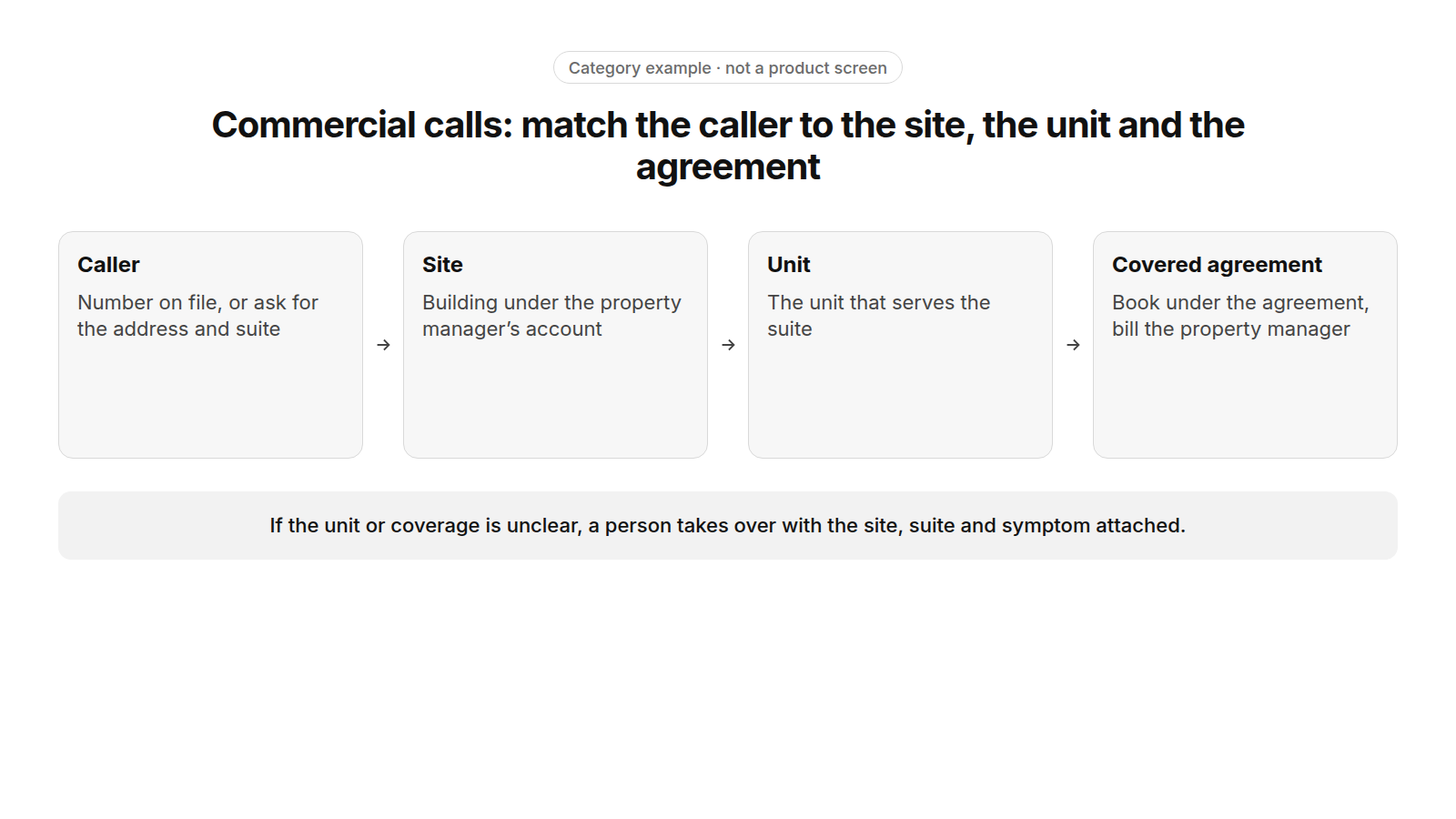
Category example · not a product screen
Commercial calls: match the caller to the site, the unit and the agreement
- Caller: Number on file, or ask for the address and suite
- Site: Building under the property manager’s account
- Unit: The unit that serves the suite
- Covered agreement: Book under the agreement, bill the property manager
If the unit or coverage is unclear, a person takes over with the site, suite and symptom attached.
How do you tell a solid caller-recognition setup from a weak one?
Five questions separate a setup that books the right visit against the right agreement from one that only answers the phone politely.
This is a category comparison, not a description of any one product. Confirm each answer in a demo against your own setup.
| Question | What to look for | Warning sign |
|---|---|---|
| Where does the agreement record live? | In the same system the receptionist reads from | In a separate tool or a synced copy that can drift |
| What can the AI apply? | Your price book and your agreement rules | A generic script with no access to your terms |
| What happens on an uncertain match? | Fallback verification, then a person with context | Benefits are skipped silently, or the caller's claim is accepted |
| How is coverage tracked? | By site and unit, including commercial accounts | By caller or customer only |
| Do the call, visit, agreement and invoice share one record? | Yes, on one shared record you can follow from the call to the invoice | Re-entered across tools |
Questions to ask before you choose an AI receptionist for existing customers
- Does it read agreements live? Ask whether agreement status comes from your system of record or from a copy.
- What does it need to identify a caller? Find out exactly which connection, app or import has to be in place, and who sets it up.
- What can members get without a person? Confirm that only the rules you configure are applied.
- What happens with an unknown number? Ask to see the name and address fallback, and when it hands off.
- What does it say before verification? Ask which account details it will read back, and to whom.
- Can it handle commercial accounts? Check whether it resolves site and unit, or only the caller.
- What does the handoff carry? The person taking over should see the profile and everything already said.
Our guide to what an AI receptionist books covers what should land on the dispatch board after the call, our guide to why calls don’t land as job records covers what one inbound call should write onto the customer and job records, and our guide to recurring maintenance scheduling covers how an agreement should drive each visit once the member is on the books.
How does FieldCamp fit a shop with many repeat customers?
FieldCamp fits contractors running residential and commercial work in one system, with a person still deciding the day. Here is what FieldCamp does today, and what to ask in a demo.
This site is published by FieldCamp.
- On the dispatch board: When your dispatcher drags a job onto a technician, the board checks skills, drive time and schedule conflicts, and the dispatcher confirms the assignment.
- For the customer: The customer gets a text when a job is assigned or moved.
- For the technician: A technician’s assigned jobs and schedule show on their phone.
- One record: Each job stays on one record from the first call to the paid invoice.
- Residential and Commercial Together: Residential service calls and commercial maintenance work run in one system, not two.
- Who decides: A person still decides the day. Assignment stays a decision the dispatcher makes.
- What to ask in the demo: This page does not describe call answering, AI receptionist or phone-system connections, booking on the call, caller recognition and caller ID matching, customer and agreement lookup during a call, triage, call handoff or call transfer as FieldCamp features. Ask in the demo how a call from an existing customer or member would reach your board, and for each piece, whether it is available today, needs setup or a connected tool, is in a pilot, or is planned. Also ask about matching a caller by phone number or by name and service address, reading agreement status live from your system of record rather than a copy, skipping repeat intake for a customer already on file, showing service and equipment history and warranty status to whoever takes the call, checking whether a maintenance agreement or membership is active and what it covers, applying member rules such as priority scheduling, member discounts, a greeting by name, included tune-up booking and renewal prompts, applying member benefits only after the record is matched, answering from your price book and agreement terms, offering a maintenance plan to a customer without one, creating a new customer record from a first-time call, keeping routine maintenance requests apart from calls about a system that won’t run, which account details are read back to a caller before verification, handing exceptions to a person with the call details attached, matching a commercial caller to the right site, unit and agreement, tracking coverage by site and unit, keeping billing on the property manager’s account, giving the safety instruction first on the call, before any lookup, writing what the caller said and the call details onto the customer record, acknowledging the membership, not treating a caller’s claim of being on the plan as proof, asking the caller to say the service address rather than reading the address on file back, routing a new caller by how soon the visit is needed, sending the call to a person when a contract term is not on the customer record, which connection, app or import has to be in place before it can identify a caller, and bringing your customer and agreement records over from your current software, and for each of those, whether it is available today, needs setup or a connected tool, is in a pilot, or is planned.
Our guide to HVAC AI voice agents covers what a voice agent conversation should hand back to the office, our guide to why after-hours calls hit voicemail covers how weekend and holiday calls should be routed, and our guide to why calls overflow in peak season covers how a heat wave or cold snap should be routed.
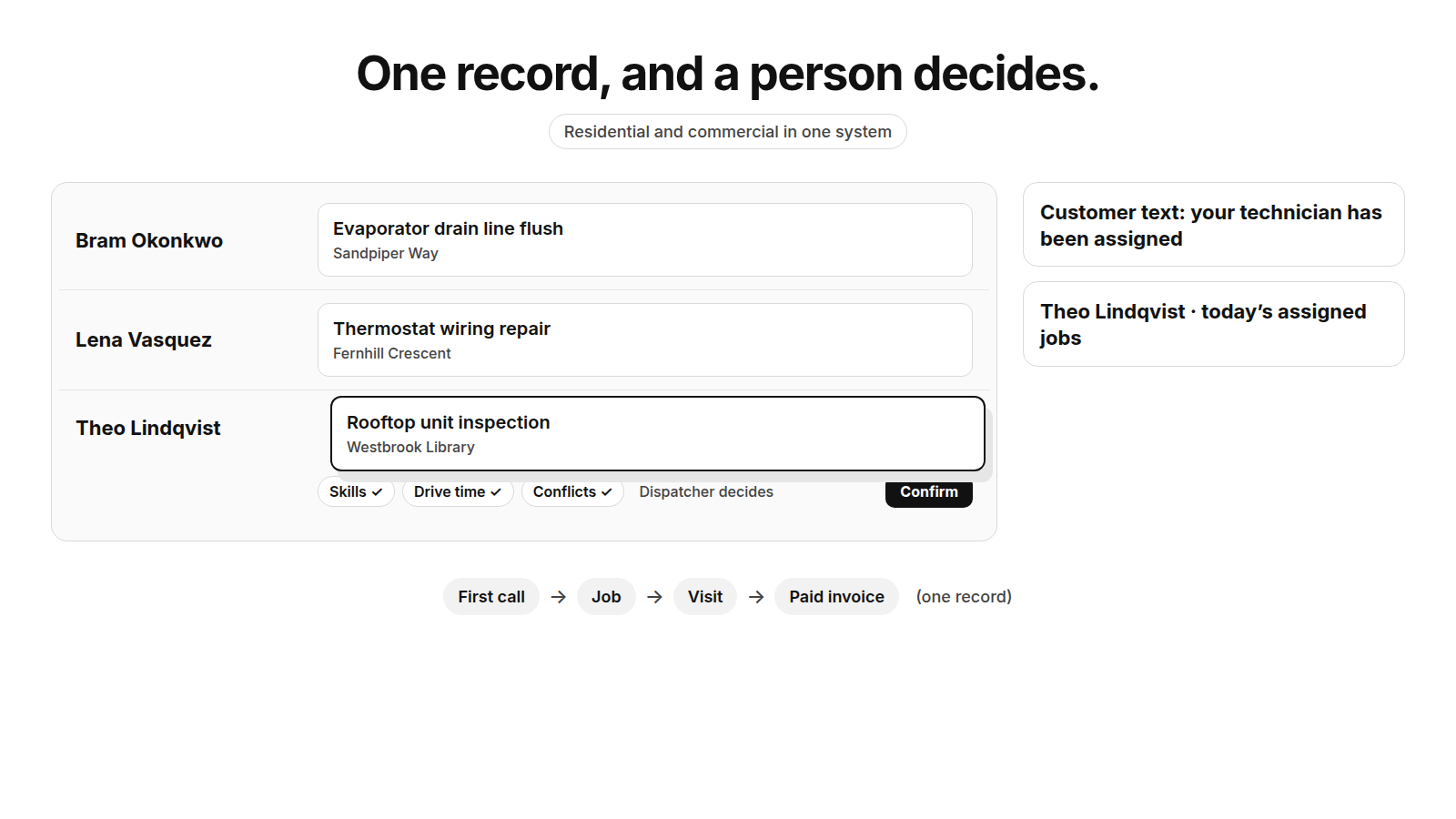
One record, and a person decides.
- Bram Okonkwo: Evaporator drain line flush · Sandpiper Way
- Lena Vasquez: Thermostat wiring repair · Fernhill Crescent
- Theo Lindqvist: Rooftop unit inspection · Westbrook Library
Skills ✓ · Drive time ✓ · Conflicts ✓ · Dispatcher decides · Confirm
Customer text: your technician has been assigned
Theo Lindqvist · today’s assigned jobs
First call → Job → Visit → Paid invoice (one record)
Residential and commercial in one system
Running a shop with many repeat customers? Book a 30-minute walkthrough to see how a job moves from the first call onto the dispatch board.
Frequently asked questions
Is there an AI answering service for HVAC technicians?
Yes. AI answering services and AI receptionists are sold to HVAC contractors. For a shop with many repeat customers, the useful test is whether the receptionist can match the caller to your customer record, confirm the service address, check what the maintenance agreement covers and apply only the rules you set. Ask each vendor what has to be connected for that to work and what happens when a caller can't be matched.
How can I use AI in my HVAC business?
Start where the work is repetitive and the rules are clear. On the phone, that means matching callers to customer records, booking routine maintenance such as included tune-ups, and capturing the details of a new request so nobody asks twice. Keep a person on the exceptions: billing disputes, warranty questions, unclear coverage and callers who can't be verified. Whatever you add should write into the same record the rest of the business uses, so the call, the visit and the invoice line up.
What does an AI receptionist cost?
It depends on the vendor, the call volume and what has to be connected, so there is no single price. For an HVAC business, the cost that matters is the total: the subscription, the work to connect it to your customer and agreement records, the setup of your member rules and scripts, and the staff time still needed for handoffs. Ask each vendor to list every one of those before you compare quotes.
What should be included in a HVAC maintenance contract?
A clear HVAC maintenance contract names the covered equipment and service address, the visits included and when they're due, any member benefits such as priority scheduling or repair discounts, what is excluded, and the start and renewal dates. Those same terms are what an AI receptionist has to read on a call, so keep them on the customer record rather than in a separate document. If a term isn't on the record, the receptionist can't apply it, and the call should go to a person.
Are receptionists being replaced by AI?
Not entirely. An AI receptionist can take routine calls, such as matching a known customer and booking an included tune-up, but billing disputes, warranty questions, unclear coverage and callers who can't be verified still need a person. The setups that hold up treat the AI as the first step and hand exceptions to a CSR or someone in the office with the call details attached, so the customer doesn't repeat themselves.
Final recommendation
Before you choose an AI receptionist for existing customers, call your own main line from a number on file, from a number that isn't, and as a tenant at a commercial site, and check where each call lands and what the caller hears. Make sure every script starts with the safety instruction: a caller who smells gas should leave the building and call 911 or the gas utility from outside, before any lookup, booking or dispatch step. A caller with a carbon monoxide alarm going off, or who reports a burning smell, smoke or fire, should leave the building and call 911 from outside, before any lookup, booking or dispatch step.