Category example
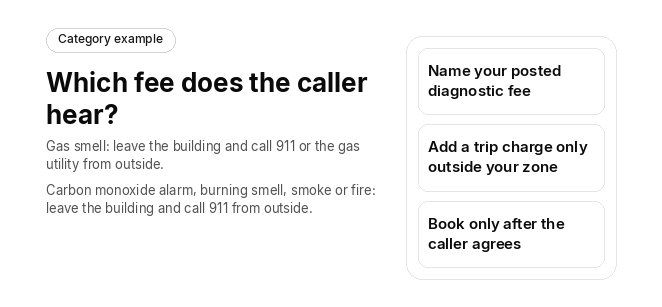
Which fee does the caller hear?
Gas smell: leave the building and call 911 or the gas utility from outside.
Carbon monoxide alarm, burning smell, smoke or fire: leave the building and call 911 from outside.
- Name your posted diagnostic fee
- Add a trip charge only outside your zone
- Book only after the caller agrees
An HVAC AI phone agent that quotes diagnostic fees and trip charges takes the inbound call, works out which of your posted fees applies, names it, and asks the caller to accept it before anything is booked. It should state only the fixed fees your office has set, including your after-hours and urgent-visit rates, and it should never invent a price or quote a repair before a technician has diagnosed the system. This page sets the standard for how that fee should be quoted, recorded and handled when a caller says no.
One rule sits above every fee. If a caller smells gas, the first instruction is to leave the building and call 911 or the gas utility from outside, before any fee, booking or dispatch step. If a carbon monoxide alarm is going off, or the caller reports a burning smell, smoke or fire, the first instruction is to leave the building and call 911 from outside, before any fee, booking or dispatch step.
After that, the agent confirms the service address, names the fee that applies, asks the caller to accept it and hands anything unclear to a person.
How should the agent quote diagnostic fees and trip charges?
After the safety instruction below, an HVAC AI phone agent should read diagnostic fees and trip charges from the price book or rate card your office maintains. It should not estimate, calculate or negotiate them. The agent applies the right rate for the time of the call and the service address, names the fee, and asks the caller to accept it before anything is booked. Set your own fees; the agent should recite whatever you set.
- Safety before any fee: If a caller smells gas, the first instruction is to leave the building and call 911 or the gas utility from outside. If a carbon monoxide alarm is going off, or the caller reports a burning smell, smoke or fire, the first instruction is to leave the building and call 911 from outside. No fee is named before that.
- Standard fees from your price book: The agent recites only the diagnostic fee, trip charge or service call fee the office has entered, so the caller hears your posted diagnostic fee, the same one a trained CSR would quote.
- After-hours and urgent-visit rates: The agent applies the rate tied to each time window you set, such as evenings, weekends or holidays, and names it as an after-hours or urgent-visit fee.
- Trip charge by zone: An added trip charge applies only when the service address falls outside the core service area, based on zones the office defines.
- No repair quotes sight unseen: When a caller asks what a repair will cost, the agent explains that repair pricing follows the diagnosis and offers to book the diagnostic visit.
- Fee acceptance before booking: The appointment is booked only after the caller agrees to the stated fee. A caller who declines is not booked and can be offered a person instead.
Setting up the zones themselves (ZIP lists, a radius or drive-time zones) is covered in our guide to how an AI receptionist qualifies leads, along with the intake questions for replacement leads and equipment age. This page assumes those zones already exist.
What happens to a quoted fee after the caller agrees?
A diagnostic fee quoted on the phone only protects the business if the same fee follows the job to the technician and onto the invoice. The fee decision table below maps each common call scenario to four things: the fee the agent names, what the agent says, whether the fee is credited toward the repair, and what should be written to the job record and invoice.
This is a category model for writing your own fee rules, not a description of any one product.
| Scenario | Fee type named | What the agent says | Credited toward repair? | Written to job record and invoice |
|---|---|---|---|---|
| Business-hours residential call | Diagnostic fee | States your posted diagnostic fee and asks the caller to agree before booking | Your policy | Diagnostic fee line, marked as accepted on the call |
| After-hours call | After-hours diagnostic rate | Names the fee as an after-hours rate and the time window that triggers it | Your policy | After-hours rate line, with the time window that applied |
| Holiday or urgent call | Holiday or urgent-visit rate | After the safety instruction, states the urgent-visit rate and can offer the next standard-rate opening instead | Your policy | Urgent-visit rate line, with the time window that applied |
| Address outside the core zone | Trip charge plus diagnostic fee | Names the trip charge separately from the diagnostic fee so the caller hears both | Your policy | Two lines: trip charge and diagnostic fee |
| Maintenance-agreement member | Member rate (discounted or waived) | Confirms the agreement on file before quoting the member rate | Your policy | Member rate, tied to the maintenance agreement |
| Commercial or property-manager site | Contracted service call fee for that site | Quotes the rate on the site’s account and confirms whether the property manager or the tenant is billed | Per contract | Fee billed to the correct party on the site record |
| Caller declines the fee | No fee booked | Thanks the caller and offers a callback or a person | Not applicable | Unbooked call logged with the fee that was quoted and declined |
The fee the caller agreed to should be the fee on the invoice, without anyone retyping it.
Category example · not a product screen
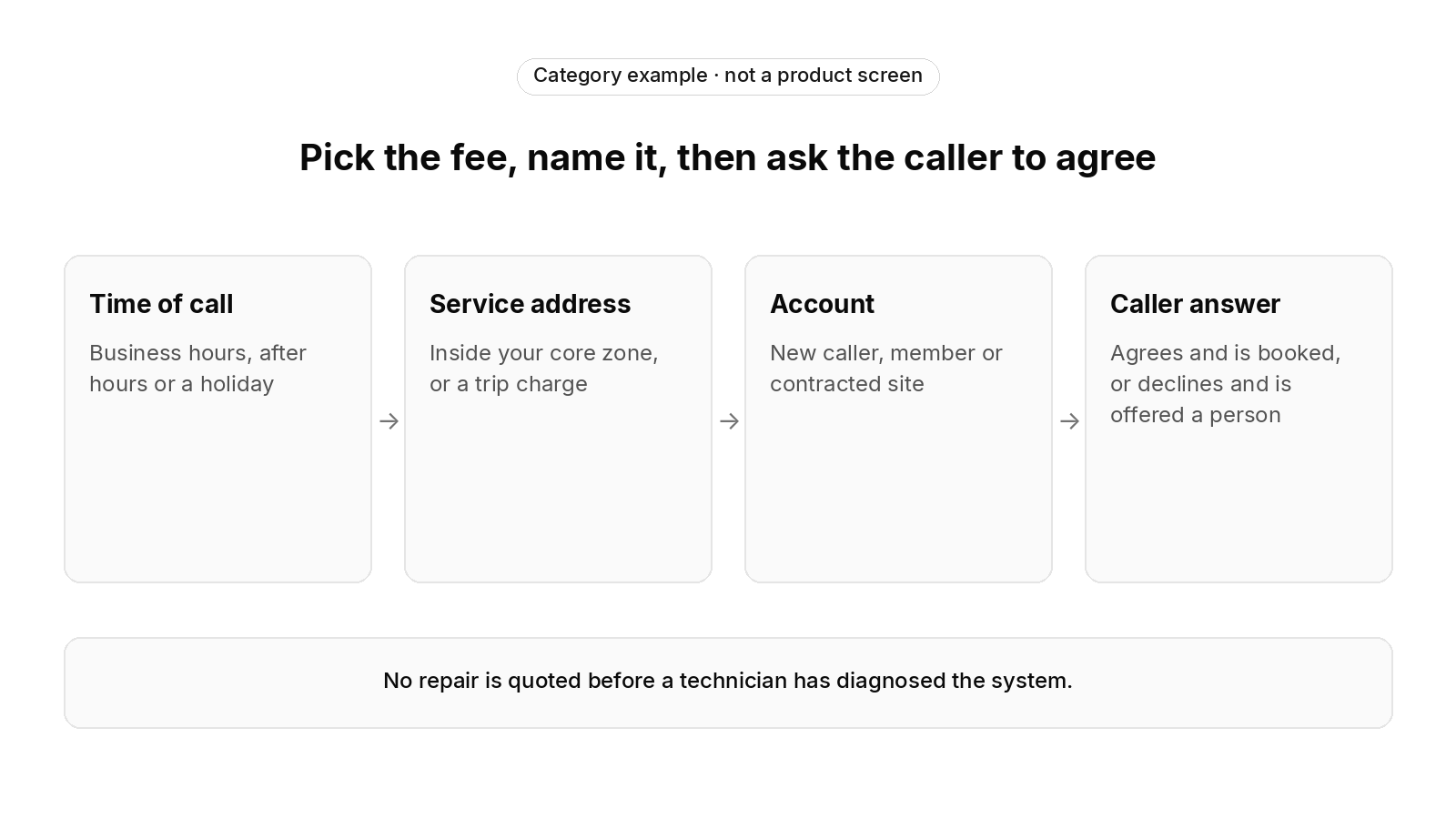
Pick the fee, name it, then ask the caller to agree
- Time of call: Business hours, after hours or a holiday
- Service address: Inside your core zone, or a trip charge
- Account: New caller, member or contracted site
- Caller answer: Agrees and is booked, or declines and is offered a person
No repair is quoted before a technician has diagnosed the system.
Which qualifying questions decide the fee the agent quotes?
Qualifying questions determine which fee applies before the agent says a number. The service address sets the zone and any trip charge. Urgency and time of call set the rate window. The account sets member or commercial pricing. The system type and symptoms tell the office what kind of visit is being booked.
- Urgency: Safety comes first. If a caller smells gas, the first instruction is to leave the building and call 911 or the gas utility from outside. If a carbon monoxide alarm is going off, or the caller reports a burning smell, smoke or fire, the first instruction is to leave the building and call 911 from outside. After that, urgency separates calls that need an urgent visit from calls that can wait for a standard-rate slot.
- Service address: Confirms the location is in the service area and whether a trip charge applies.
- Account on file: Identifies maintenance-agreement members and commercial sites with contracted rates.
- System type and symptoms: Records equipment and the reported problem so the technician arrives prepared.
Matching a caller to a member or commercial account is covered in our guide to how an AI receptionist spots members.
Booking isn’t dispatching: after the fee is accepted
Booking puts the job on the calendar. Dispatch decides who goes. Once the caller accepts the fee, the job should be booked against real technician availability, not an open slot on a generic calendar. Dispatch then assigns the right technician by schedule, location and skills. Our guide to what an AI receptionist books covers what should land on the dispatch board once the call is booked.
Urgent calls follow the safety rule first. If a caller smells gas, the first instruction is to leave the building and call 911 or the gas utility from outside, before any fee, booking or dispatch step. If a carbon monoxide alarm is going off, or the caller reports a burning smell, smoke or fire, the first instruction is to leave the building and call 911 from outside, before any fee, booking or dispatch step. After that, if anyone in the home is in danger from heat or cold, the caller should call 911. Then no-heat and no-cool calls go to the on-call technician, at the rate your rules set for that window. Our guide to how emergency calls reach a tech covers escalation levels and what happens when the on-call tech doesn’t answer.
Whatever field service software you run, ask two questions about any phone agent connected to it: where the accepted fee lands, and whether dispatch can see it. Connecting a separate agent is an integration that has to be scoped and tested.
When a person takes over
The principle is simple: the agent books the routine job, and a person handles the exceptions. An HVAC AI phone agent should recognize when a call needs judgment it has not been given, and hand the caller to staff with the quoted fee and call details already captured. The caller should not have to repeat anything.
- Fee disputes: A caller who argues the diagnostic fee or asks for a discount goes to a person. Discount authority stays with the office.
- Commercial billing questions: Property managers asking about multi-site billing, multi-unit buildings, or whether the property manager or tenant pays are routed to the staff member who owns that account.
- Replacement-quote requests: Callers asking for a system replacement price are routed to the person who schedules estimates.
Standalone receptionist vs. an agent inside your HVAC software
Where the phone agent lives decides how much work it takes for the quoted fee to survive the call. A standalone AI receptionist or an answering service can state a fee accurately. Carrying that fee to the job, the technician and the invoice depends on what the office sets up, maintains and re-keys afterward.
This is a category comparison, not a description of any one product. Confirm each answer in a demo against your own setup.
| Category | Fee comes from the office price book | Quoted fee carried to job and invoice | Dispatch by schedule, location and skills | Residential and commercial | Exceptions to a person |
|---|---|---|---|---|---|
| Standalone AI receptionist | A separate fee list that someone keeps in sync with the price book | Only through an integration the shop configures and tests | Handled in a separate system after booking | Depends on how the integration maps sites and accounts | Requires a transfer setup to the office |
| Answering service | A script the service reads, updated when the office requests it | Often re-keyed by the office from a message or entry | Handled by the office after the call | Depends on the scripts provided | Staff answer calls, but accuracy depends on script updates |
| Agent inside your field service software | The same price book the office edits | Can be written to the job at booking; confirm in a demo | Same system that booked the job | Depends on how that software handles both | Handoff inside the same system |
How to test the agent before go-live
Five test calls show whether an HVAC AI phone agent quotes the right fee and creates the right record. Place each call yourself before the agent answers real customers. A call passes only when the caller hears the right instruction or fee and the right job record, or the right unbooked-call log, is created.
- Safety caller: A caller reports a gas smell. The agent should tell them to leave the building and call 911 or the gas utility from outside. Repeat the call as a carbon monoxide alarm: the agent should tell them to leave the building and call 911 from outside. No fee should be named and nothing should be booked before that.
- Price-only caller: Asks only “how much?” The agent should state the diagnostic fee and decline to quote a repair.
- After-hours no-heat call: The agent should give the safety instruction first: a caller who smells gas should leave the building and call 911 or the gas utility from outside. A caller with a carbon monoxide alarm, a burning smell, smoke or fire should leave the building and call 911 from outside, and anyone in danger from heat or cold should call 911. Only then should the agent quote the after-hours rate and route the job to the on-call technician.
- Out-of-zone address: The agent should name the trip charge separately from the diagnostic fee.
- Caller who refuses the fee: The agent should not book the call, should log the declined fee, and should offer a person.
Our guide to why after-hours calls hit voicemail covers how weekend and holiday calls should be routed, our guide to why calls overflow in peak season covers how a heat wave or cold snap should be routed, our guide to why calls don’t land as job records covers what one inbound call should write onto the customer and job records, and our guide to what missed calls cost covers how to work out what calls that reach voicemail cost a shop.
How does FieldCamp fit a shop that runs residential and commercial service?
FieldCamp fits contractors running residential and commercial work in one system, with a person still deciding the day. Here is what FieldCamp does today, and what to ask in a demo.
This site is published by FieldCamp.
- On the dispatch board: When your dispatcher drags a job onto a technician, the board checks skills, drive time and schedule conflicts, and the dispatcher confirms the assignment.
- For the customer: The customer gets a text when a job is assigned or moved.
- For the technician: A technician’s assigned jobs and schedule show on their phone.
- One record: Each job stays on one record from the first call to the paid invoice.
- Residential and Commercial Together: Residential service calls and commercial maintenance work run in one system, not two.
- Who decides: A person still decides the day. Assignment stays a decision the dispatcher makes.
- What to ask in the demo: This page does not describe call answering, AI phone agents or phone-system connections, diagnostic-fee and trip-charge quoting, fee acceptance on the call, booking on the call, triage, call routing, call handoff or call transfer as FieldCamp features. Ask in the demo how a call where the caller accepts your posted diagnostic fee, a call where the caller declines it and an after-hours call would reach your board, and for each piece, whether it is available today, needs setup or a connected tool, is in a pilot, or is planned. Also ask about giving the safety instruction first on the call, before any fee is named, telling the caller to call 911 if anyone in the home is in danger from heat or cold, identifying urgent calls before any fee is named, reading the fee from your price book or rate card rather than a separate list, applying your after-hours, weekend, holiday and urgent-visit rates by time window, adding a trip charge by service zone and naming it separately from the diagnostic fee, checking the service address against your zones, declining to quote a repair before a technician has diagnosed the system, saying there is no diagnostic fee when your shop doesn’t charge one, asking the caller to accept the fee before anything is booked, not booking a caller who declines and offering a callback or a person, logging a declined fee on an unbooked call, noting the accepted fee on the job and carrying it to the technician and onto the invoice as its own line, telling the caller whether the fee is credited toward the repair and showing it on the job, confirming a maintenance-agreement member’s rate on file, matching an existing or commercial caller to the right account and site, quoting a contracted site rate and confirming whether the property manager or the tenant is billed, asking the service address, urgency, account and system type and symptoms before naming a fee, offering the next standard-rate opening instead of an urgent-visit rate, booking against real technician availability, sending calls about a system that won’t heat or cool to the on-call technician, sending fee disputes, discount requests, commercial billing questions and replacement-quote requests to a person with the quoted fee and call details attached, updating the fees the agent quotes when your rates change, keeping the agent from negotiating or discounting the fee, placing test calls before go-live, a standalone receptionist, an answering service or an agent inside your field service software, and which connection, app or import has to be in place first, and for each of those, whether it is available today, needs setup or a connected tool, is in a pilot, or is planned.
Our guide to HVAC AI voice agents covers what a voice agent conversation should hand back to the office.
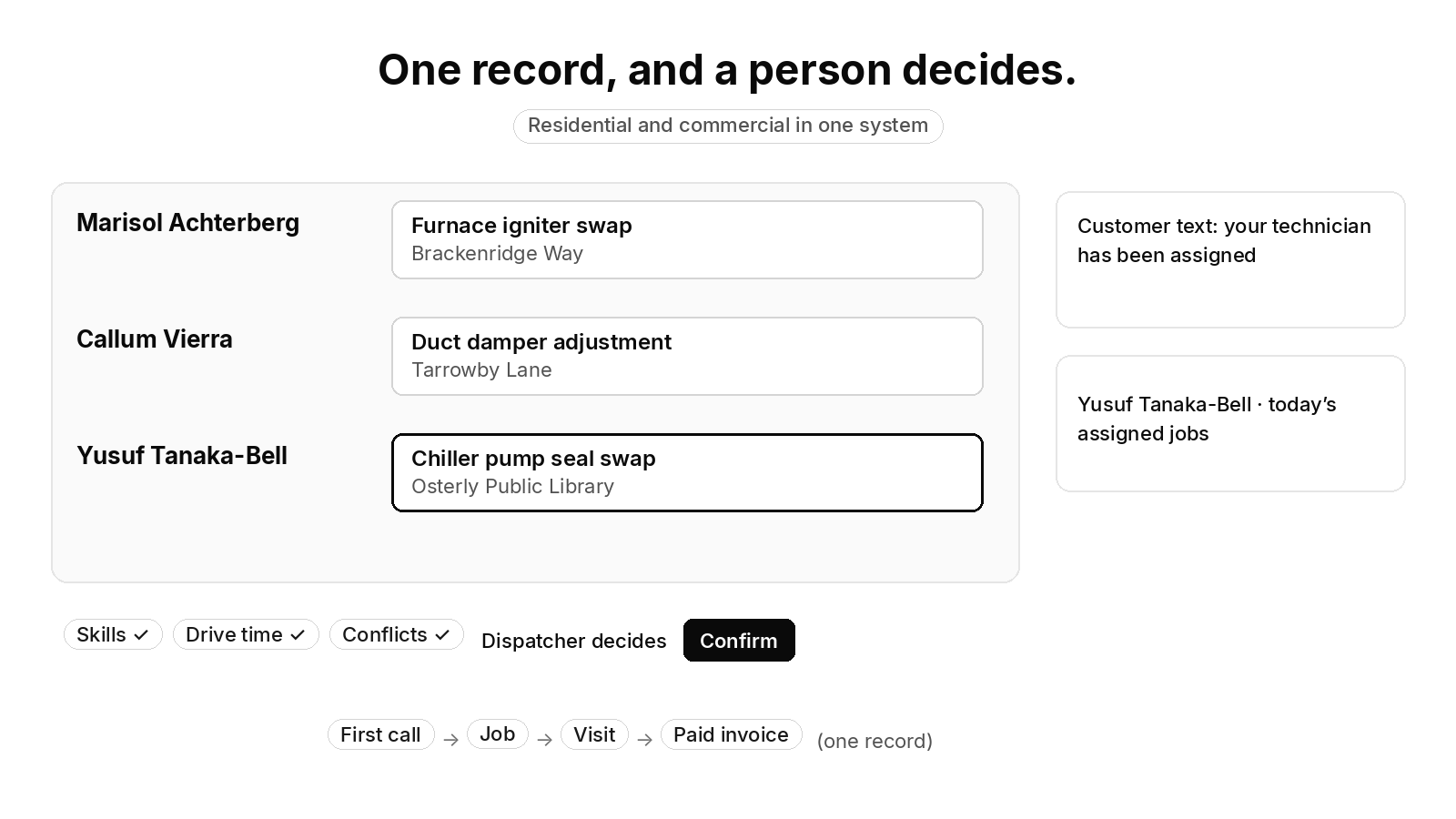
One record, and a person decides.
- Marisol Achterberg: Furnace igniter swap · Brackenridge Way
- Callum Vierra: Duct damper adjustment · Tarrowby Lane
- Yusuf Tanaka-Bell: Chiller pump seal swap · Osterly Public Library
Skills ✓ · Drive time ✓ · Conflicts ✓ · Dispatcher decides · Confirm
Customer text: your technician has been assigned
Yusuf Tanaka-Bell · today’s assigned jobs
First call → Job → Visit → Paid invoice (one record)
Residential and commercial in one system
Posting a diagnostic fee? Book a 30-minute walkthrough to see how a job moves from the first call onto the dispatch board.
Frequently asked questions
Do all HVAC companies charge a diagnostic fee?
No. Some shops charge a diagnostic fee or service call fee on every visit, some waive it for maintenance-agreement members, and some credit it toward the repair. Whatever your policy is, put it in your price book or rate card so the phone agent states your posted diagnostic fee, or says there isn’t one, the same way on every call, after any safety instruction.
Is diagnostic fee included in repair?
It depends on the shop’s policy. Some contractors credit the diagnostic fee toward the repair when the customer approves the work, and others charge it as a separate line for the technician’s time. Decide which you do, write it into your fee rules, and have the agent say it when it names the fee, so the caller isn’t surprised by the invoice.
Can I refuse to pay the diagnostic fee?
A caller can decline the fee before anything is booked, which is why, after any safety instruction, the agent should name your posted diagnostic fee and ask the caller to accept it before booking. A caller who declines is not booked: the agent thanks them, offers a callback or a person, and the declined fee is logged on the unbooked call. A dispute after a visit belongs with a person in your office, not with the agent.
What is an HVAC service fee?
An HVAC service fee, also called a service call fee or trip charge, covers the technician’s trip to the address. A diagnostic fee covers finding the problem once the technician is there, and some shops combine the two into one fee. If you charge them separately, the agent should name each one on its own so the caller hears both before agreeing.
What is a reasonable diagnostic fee?
A reasonable diagnostic fee is one you can explain: it should cover the technician’s time and travel to find the problem, and it should be the same posted fee each caller hears for the same time window and zone. Set it yourself, decide whether it is credited toward the repair, and load it into the price book or rate card the agent reads, so the fee on the call matches the fee on the invoice.
Final recommendation
Before you let an AI phone agent quote your fees, place the five test calls above yourself and check what the caller hears and what lands on the job or the unbooked-call log. Make sure every script starts with the safety instruction: a caller who smells gas should leave the building and call 911 or the gas utility from outside, before any fee, booking or dispatch step. A caller with a carbon monoxide alarm going off, or who reports a burning smell, smoke or fire, should leave the building and call 911 from outside, before any fee, booking or dispatch step.