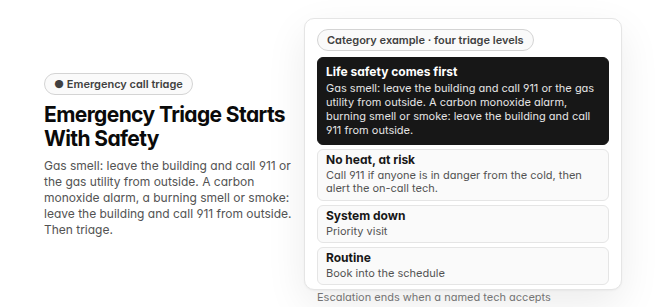
Emergency call triage
Emergency Triage Starts With Safety Gas smell: leave the building and call 911 or the gas utility from outside. A carbon monoxide alarm, a burning smell or smoke: leave the building and call 911 from outside. Then triage.
Category example · four triage levels.
- Life safety comes first: gas smell: leave the building and call 911 or the gas utility from outside. A carbon monoxide alarm, burning smell or smoke: leave the building and call 911 from outside.
- No heat, at risk: call 911 if anyone is in danger from the cold, then alert the on-call tech.
- System down: priority visit.
- Routine: book into the schedule.
Escalation ends when a named tech accepts.
AI call answering for HVAC companies picks up the line, runs emergency triage to separate genuine no-heat calls from routine work, and hands the exceptions to a person.
The triage starts with safety.
If a caller smells gas, the first instruction is to leave the building and call 911 or the gas utility from outside, before any booking, paging or dispatch step. If a carbon monoxide alarm is going off, or there is a burning smell or smoke from the equipment, leave the building and call 911 from outside, before any booking, paging or dispatch step.
After that, urgent no-heat calls are escalated to your on-call technician as a text alert, a phone call or a live transfer, carrying the address, the equipment details and a problem summary. Routine requests such as tune-ups and filter changes are booked into your schedule.
How should the AI screen each HVAC call?
When the AI picks up, it runs the same intake on every caller before it decides anything. It collects the facts your on-call tech would otherwise have to gather on a callback in the middle of the night.
The one exception is safety. If a caller smells gas, intake stops and the first instruction is to leave the building and call 911 or the gas utility from outside. If a carbon monoxide alarm is going off, or there is a burning smell or smoke from the equipment, intake stops and the first instruction is to leave the building and call 911 from outside.
- Caller and site: It captures the name, service address, callback number and any gate or access code.
- Equipment: It asks for the system type (gas furnace, heat pump or boiler) and the brand and approximate age if the caller knows them.
- Symptoms and error codes: It captures what the system is doing, along with any error code shown on the thermostat or the unit.
- Account status: It checks whether the caller is on a maintenance agreement, so members can be routed by your plan’s terms.
- Conditions: It notes the indoor temperature and who is in the building. Both feed the triage decision below.
Our guide to caller recognition covers how the AI matches a caller to a customer record or a maintenance agreement.
What are the four levels of emergency triage on the call?
Emergency triage sorts each call into one of four levels, so that true emergencies reach a person first and routine work waits for business hours. The temperature thresholds are set by your shop, not by the AI.
Safety comes first at every level. If a caller smells gas, the first instruction is to leave the building and call 911 or the gas utility from outside, before any intake, alert or dispatch step. If a carbon monoxide alarm is going off, or there is a burning smell or smoke from the equipment, the first instruction is to leave the building and call 911 from outside, before any intake, alert or dispatch step. If someone is in danger from the cold or heat, the caller should call 911.
This is a category model for writing your own triage rules, not a description of any one product.
| Level | Trigger | AI action | Who is alerted | Outcome |
|---|---|---|---|---|
| Life safety | Gas smell, carbon monoxide alarm sounding, burning electrical smell or smoke | Safety first: for a gas smell, tells the caller to leave the building and call 911 or the gas utility from outside. For a carbon monoxide alarm, a burning electrical smell or smoke, tells the caller to leave the building and call 911 from outside. The approved safety script is used, and the call takes no intake | On-call tech and dispatcher, after the safety instruction | A person takes over the follow-up |
| No heat, at risk | No heat with outdoor temperatures below your shop’s threshold, or with infants, elderly residents or medical devices in the home | If anyone is in danger from the cold, tells the caller to call 911; then completes intake and flags the call urgent | On-call technician by text alert, call or warm transfer | Tech confirms an emergency visit |
| System down, no health risk | No heat or no cool with indoor temperature still tolerable and no vulnerable occupants | Completes intake and offers the first available slot, or after-hours service per your policy | Dispatcher, in the morning queue | Booked priority visit |
| Routine | Tune-ups, filter changes, quotes, maintenance visits | Books into the calendar | No one after hours | Job on the schedule |
Our guide to emergency call prioritization covers how the dispatch board orders urgent work once it lands.
What should the AI do on a gas or carbon monoxide call?
A gas smell skips intake entirely. The first instruction is to leave the building and call 911 or the gas utility from outside; only then does the call go to a person. A sounding carbon monoxide alarm, or a burning smell or smoke, also skips intake: the first instruction is to leave the building and call 911 from outside before the call goes to a person.
- Leave first: The caller is told to get everyone out of the building before doing anything else.
- Right number: For a gas smell, the caller is told to leave the building and call 911 or the gas utility from outside. For a carbon monoxide alarm, a burning smell or smoke, the caller is told to leave the building and call 911 from outside.
- No troubleshooting: The AI never walks the caller through relighting a pilot, resetting a breaker or opening the furnace.
- Human escalation: For a gas smell, the caller is told to leave the building and call 911 or the gas utility from outside. For a carbon monoxide alarm, a burning smell or smoke, the caller is told to leave the building and call 911 from outside. Your on-call tech and dispatcher are alerted only after that, and the call is noted against the address for follow-up.
Whose emergency policy should the AI enforce?
The AI should enforce the emergency policy your shop has already approved. It should never improvise one. Three points define what good AI call answering looks like.
- Approved policy only: The AI follows your written triage rules, thresholds and scripts, and it never invents an emergency standard of its own.
- Gas means human escalation: Gas-smell calls get your approved safety instruction first, to leave the building and call 911 or the gas utility from outside, and are then escalated to a person every time, with no exceptions.
- Scheduling is not dispatching: Creating a job puts it on the calendar, but it does not confirm that a technician is on the way. The caller should only be told help is coming once a tech has accepted.
No-heat escalation: from alert to confirmed tech
No-heat escalation is not finished when the alert is sent. It is finished when a named technician has accepted the job and the caller has been told so. Many AI answering setups stop at the alert, and that is where an urgent call can still fall through.
Safety still comes first. If there is a gas smell, the first instruction is to leave the building and call 911 or the gas utility from outside before any alert goes out. If there is a carbon monoxide alarm, a burning smell or smoke, the first instruction is to leave the building and call 911 from outside before any alert goes out. If anyone is in danger from the cold, the caller calls 911.
What does the on-call alert carry?
The alert gives the tech everything needed to decide and drive without calling the customer back first.
- Channel: The alert goes out as a text alert, a phone call or a warm or live transfer, depending on the level and your rules.
- Contents: It carries the address, the equipment type, the error codes, the triage level and the reason the call was escalated.
- Accept or decline: The tech accepts or declines from the message itself.
What happens if the first tech doesn’t answer?
The call moves down a chain your shop defines, so it does not stall with one person.
- Primary: This week’s on-call technician, read from the schedule.
- Fallback: A second technician, chosen by location and skills, such as boiler or heat pump certification.
- Last resort: Your dispatcher, office manager or owner, who decides by hand.
How is the caller told a tech is confirmed?
The caller gets a confirmation only after acceptance. It names the technician and gives an arrival window, so the promise matches what the board actually shows.
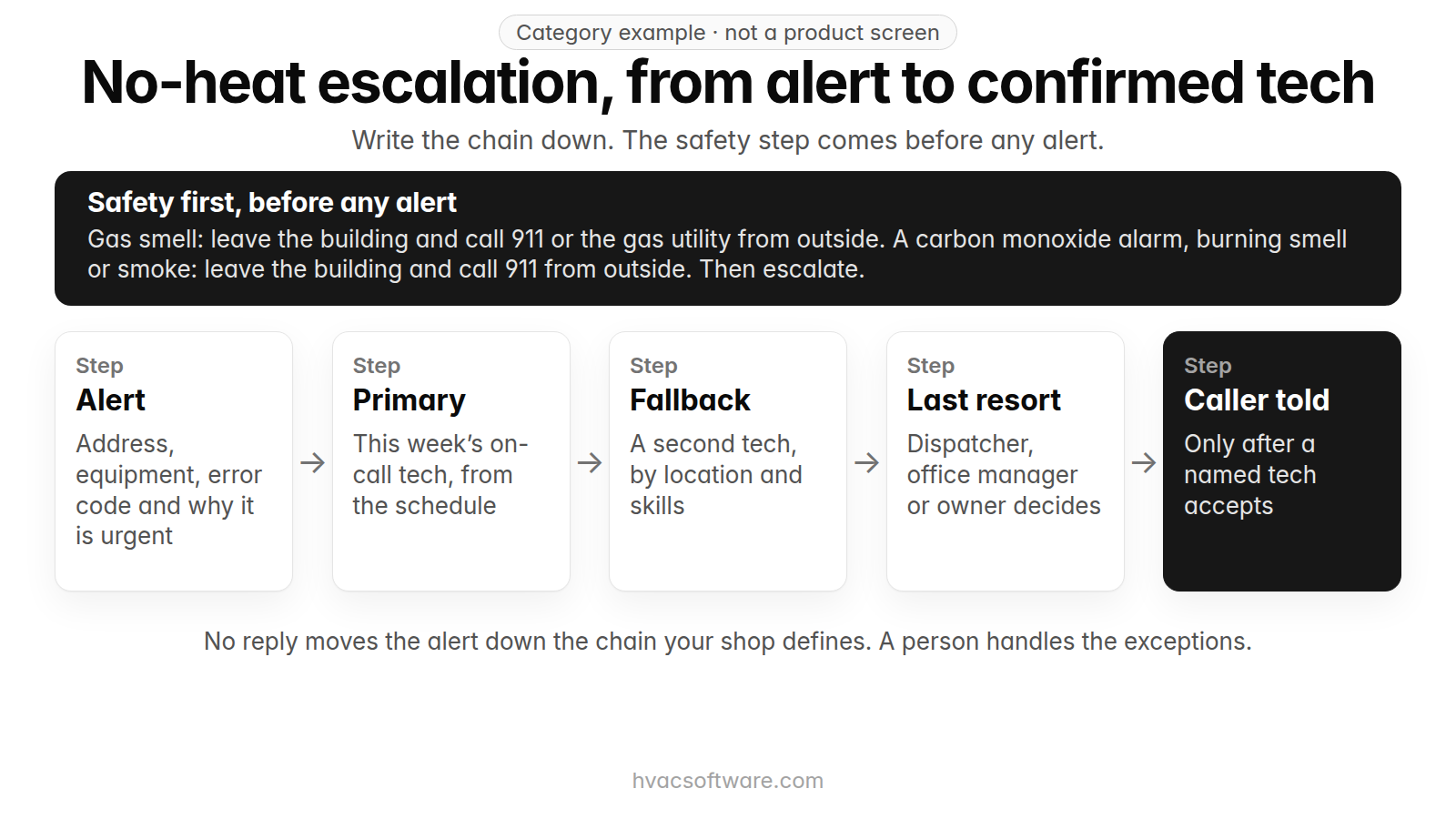
Category example · not a product screen
No-heat escalation, from alert to confirmed tech
Write the chain down. The safety step comes before any alert.
Safety first, before any alert. Gas smell: leave the building and call 911 or the gas utility from outside. A carbon monoxide alarm, burning smell or smoke: leave the building and call 911 from outside. Then escalate.
- Alert: address, equipment, error code and why it is urgent.
- Primary: this week’s on-call tech, from the schedule.
- Fallback: a second tech, by location and skills.
- Last resort: dispatcher, office manager or owner decides.
- Caller told: only after a named tech accepts.
No reply moves the alert down the chain your shop defines. A person handles the exceptions.
Our guide to why after-hours calls hit voicemail covers how weekend and holiday calls are routed before an alert ever goes out.
Residential vs commercial: different escalation paths
A commercial no-heat call usually needs a different route from a residential one, because the caller, the site and the bill payer are often three different parties. Whichever kind of call it is, safety comes first. If a caller smells gas, the first instruction is to leave the building and call 911 or the gas utility from outside, before any escalation, billing or dispatch step. If a carbon monoxide alarm is going off, or there is a burning smell, smoke or fire, the first instruction is to leave the building and call 911 from outside, before any escalation, billing or dispatch step.
- Identify the site: The AI matches the caller to the right site and unit when one account covers multiple locations.
- Know who the caller is: A property manager and a tenant may call about the same unit. Your rules decide who can authorize after-hours work.
- Bill correctly: The escalation flags whether the property manager or the tenant is billed, before the tech rolls a truck.
- Use contract terms: Service agreements with committed response times can move a commercial call up a triage level.
Routine calls: booked into the schedule
Routine calls are booked directly into your calendar, so the morning starts with jobs already on the board rather than a stack of voicemails. A call with a gas smell is never routine. The caller is told to leave the building and call 911 or the gas utility from outside first. A carbon monoxide alarm, a burning smell or smoke is never routine either. The caller is told to leave the building and call 911 from outside first.
- Tune-ups and filters: Callers are offered real open slots, not a promise of a callback.
- Maintenance members: Visits are booked against the existing agreement.
- After-hours non-emergencies: These are booked into the first available morning slot instead of waking the on-call tech.
Our guide to what missed calls cost covers what the calls that never reach the schedule are worth to your shop.
How do the types of HVAC call answering compare?
The real difference between options is where the call ends: as a message, as a booking, or as a confirmed technician. Whichever type you choose, its script should open with the safety instruction. A caller who smells gas is told to leave the building and call 911 or the gas utility from outside, before any alert or booking step. A caller who has a carbon monoxide alarm going off, or a burning smell, smoke or fire, is told to leave the building and call 911 from outside, before any alert or booking step.
This is a category comparison, not a description of any one product. Confirm each answer in a demo against your own setup.
Our comparison of an answering service vs an AI receptionist covers what each leaves behind after the call.
Where should the call details land?
The call details should land in your field service management (FSM) software as the start of the job. They should not arrive as a separate message log that someone has to retype.
- Intake becomes the work order: Equipment, error codes and notes should carry straight to the tech’s phone.
- Escalation history stays attached: You should be able to see who was alerted, who accepted and when.
- Billing closes the loop: The same record should carry through to the invoice.
Ask each vendor to show an escalated call landing this way, from the call through to the invoice. Our guide to what an AI receptionist books covers what actually lands on the board after a call.
How does FieldCamp fit a shop planning its triage rules?
FieldCamp fits contractors running residential and commercial work in one system, with a person still deciding the day. Here is what FieldCamp does today, and what to ask in a demo.
This site is published by FieldCamp.
- On the dispatch board: When your dispatcher drags a job onto a technician, the board checks skills, drive time and schedule conflicts, and the dispatcher confirms the assignment.
- For the customer: The customer gets a text when a job is assigned or moved.
- For the technician: A technician’s assigned jobs and schedule show on their phone.
- One record: Each job stays on one record from the first call to the paid invoice.
- Residential and Commercial Together: Residential service calls and commercial maintenance work run in one system, not two.
- Who decides: A person still decides the day. Assignment stays a decision the dispatcher makes.
- What to ask in the demo: This page does not describe call answering, AI call answering or answering-service connections, after-hours coverage, intake on the call, triage on the call and triage thresholds, safety scripts on the call, on-call alerts by text, call or warm and live transfer, call handoff, fallback and escalation chains, technician acceptance from an alert, caller confirmations, booking on the call, bilingual calls, caller recognition, lead qualification, fee quoting, or booking confirmations and reminders as FieldCamp features. Ask in the demo how escalated calls would reach your board, and for each piece, whether it is available today, needs setup or a connected tool, is in a pilot, or is planned. Also ask about capturing the caller, site, access code, equipment, error codes, symptoms and conditions on the job, checking maintenance-agreement status and routing members by plan terms, booking maintenance visits against the agreement, offering open slots during the call, booking after-hours routine calls into the first morning slot, placing system-down calls in the dispatcher’s morning queue, flagging a call as urgent, taking no intake on a life-safety call, not walking the caller through troubleshooting such as relighting a pilot, resetting a breaker or opening the furnace, offering after-hours service per your policy when a system is down and no one is at risk, carrying the call details through to the invoice, what an alert carries and accept-or-decline replies, reading the on-call technician from the schedule, choosing a fallback technician by location and skills, naming the technician and arrival window in the caller’s confirmation, noting a call against the address, keeping escalation history on the job, intake details carrying onto the work order, commercial site and unit matching, property manager and tenant authorization, flagging who is billed before work starts, and moving a commercial call up a triage level by contract terms, and for each of those, whether it is available today, needs setup or a connected tool, is in a pilot, or is planned.
Our guide to HVAC AI voice agents covers what a voice agent conversation should hand back to the office, and our guide to customer text notifications covers the texts a customer gets once a job is assigned or moved.
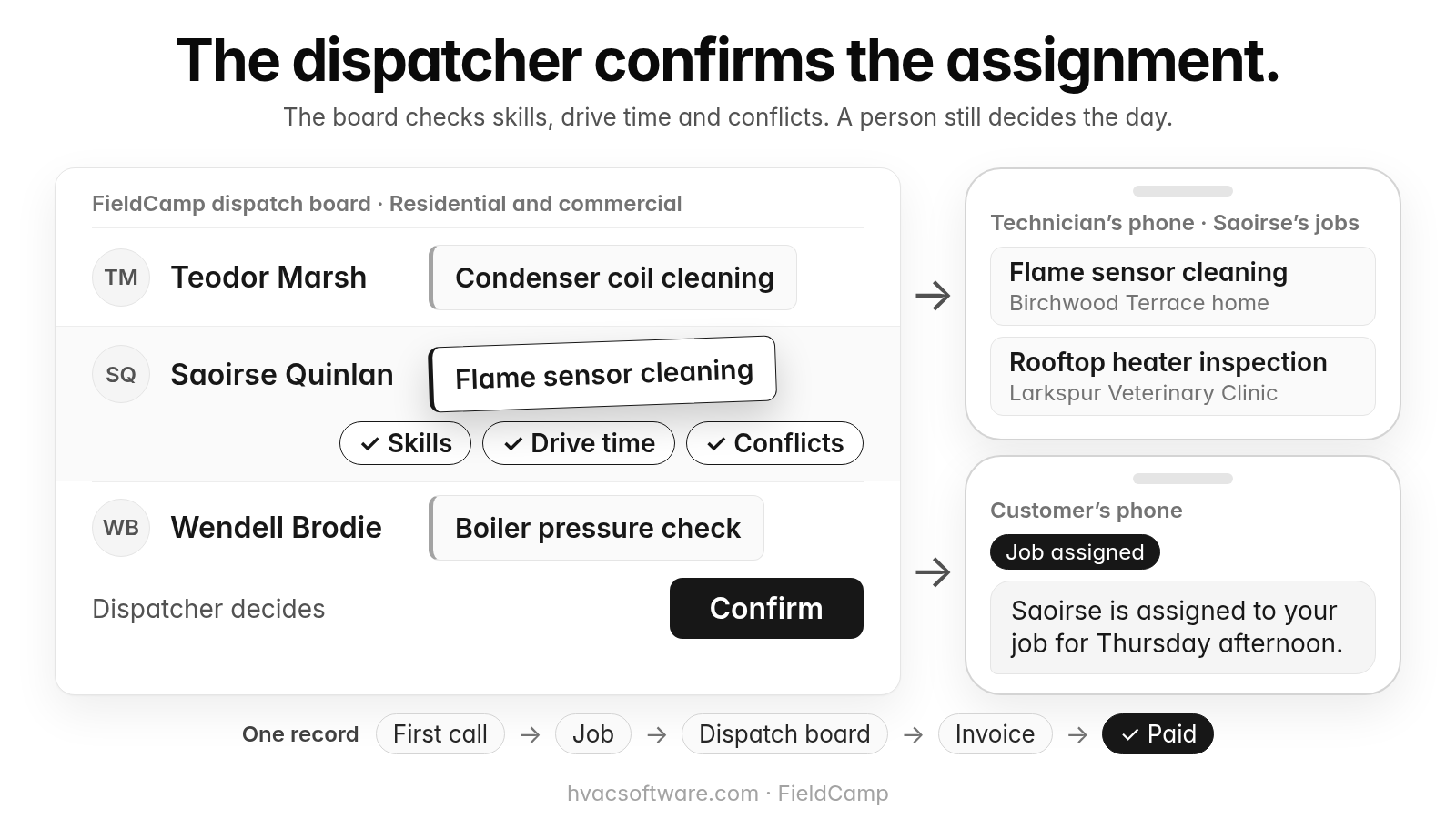
The dispatcher confirms the assignment.
The board checks skills, drive time and conflicts. A person still decides the day.
FieldCamp dispatch board · Residential and commercial: Teodor Marsh: Condenser coil cleaning. Saoirse Quinlan: Flame sensor cleaning. Wendell Brodie: Boiler pressure check.
- Skills
- Drive time
- Conflicts
Dispatcher decides: Confirm.
Technician’s phone · Saoirse’s jobs: Flame sensor cleaning (Birchwood Terrace home). Rooftop heater inspection (Larkspur Veterinary Clinic).
Customer’s phone. Job assigned: "Saoirse is assigned to your job for Thursday afternoon."
One record: First call → Job → Dispatch board → Invoice → Paid.
Writing your triage rules? Book a 30-minute walkthrough to see how a job moves from the first call onto the dispatch board.
Frequently asked questions
Is there an AI answering service for HVAC technicians?
Yes. AI answering services, often called AI receptionists or voice agents, are sold to HVAC contractors both as standalone services and as add-ons to field service software. Safety comes first on any emergency call. If a caller smells gas, the first instruction is to leave the building and call 911 or the gas utility from outside, before any booking, paging or dispatch step. If a carbon monoxide alarm is going off, or there is a burning smell, smoke or fire, the first instruction is to leave the building and call 911 from outside, before any booking, paging or dispatch step. After that, look for one that triages on your own written rules, escalates urgent no-heat calls down an on-call chain until a named technician accepts, and leaves the call details on the job rather than in a message.
How much does an AI call answering service cost?
Safety comes first. If there is a gas smell, the first instruction is to leave the building and call 911 or the gas utility from outside, before any booking, paging or dispatch step. If there is smoke, fire or a carbon monoxide risk, the first instruction is to leave the building and call 911 from outside, before any booking, paging or dispatch step. On cost, it depends on the vendor, the plan and your call volume, so there is no single price. AI call answering is often sold as a monthly plan or as an add-on to field service software, so ask what the plan covers, what happens when your calls go past it, and whether triage rules, on-call alerts and transfers are included or extra. Beyond the fee, count the internal work it leaves behind: a message someone has to retype, or an alert nobody accepted, still costs the office time. Ask each vendor for a written quote based on your own call volume.
Can I get AI to answer my phone calls?
Yes. An AI call answering service can pick up your business line for the hours and call types you choose. For an HVAC shop, the script starts with safety. A caller who smells gas is told to leave the building and call 911 or the gas utility from outside, before any booking, alert or dispatch step. A caller who has a carbon monoxide alarm going off, or a burning smell, smoke or fire, is told to leave the building and call 911 from outside, before any booking, alert or dispatch step. After that, it captures the caller's details, books routine work where it connects to your schedule and hands the exceptions to a person. Write your emergency policy down first: the safety script, your triage levels and thresholds, and the on-call chain.
What if I smell gas but no leak detected?
Treat it as a gas smell anyway. Safety comes first: leave the building and call 911 or the gas utility from outside, without using phones, switches or electronics inside and without searching for the leak. The gas utility or emergency responders decide whether it is safe to go back in. For an HVAC call-taker or an AI script, a reported gas smell skips intake every time, whether or not the caller thinks there is a leak, and the call goes to a person only after the caller has been told to leave and call 911 or the gas utility.
Final recommendation
Before you turn on AI call answering for no-heat emergencies, write down your emergency policy: the safety script, the four triage levels and your thresholds, the on-call schedule, named fallback technicians and a last-resort decision-maker. Check that every script starts with the safety instruction. A caller who smells gas should leave the building and call 911 or the gas utility from outside, before any booking, paging or dispatch step. A caller who has a carbon monoxide alarm going off, or a burning smell, smoke or fire, should leave the building and call 911 from outside, before any booking, paging or dispatch step. Then run a test no-heat call and confirm it ends with a named technician who has accepted, not just an alert.