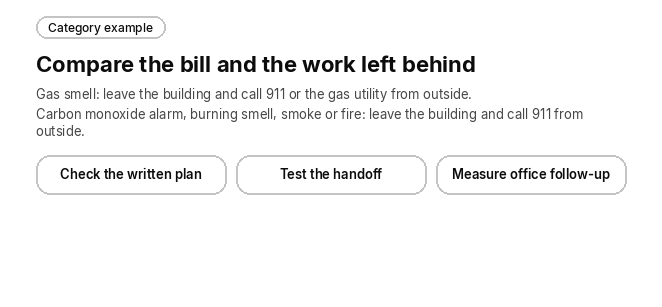
Category example
Compare the bill and the work left behind
Gas smell: leave the building and call 911 or the gas utility from outside.
Carbon monoxide alarm, burning smell, smoke or fire: leave the building and call 911 from outside.
- Check the written plan
- Test the handoff
- Measure office follow-up
The useful comparison is pricing structure, peak-season limits and what happens after the call, not a pasted monthly price range.
An outsourced answering quote may combine a monthly base with per-minute overages that rise in peak season; an AI call-handling quote may use a flat or tiered monthly plan. Neither label tells you the total bill or whether the office will still spend time returning messages and re-keying jobs.
One rule sits above the comparison. If a caller smells gas, the first instruction is to leave the building and call 911 or the gas utility from outside. If a carbon monoxide alarm is going off, or the caller reports a burning smell, smoke or fire, the first instruction is to leave the building and call 911 from outside. Give these instructions before any intake, booking, paging or dispatch step.
What does HVAC call center outsourcing cost compared with AI call handling?
Compare the terms of current quotes, not an assumed price for either category. Check current vendor pricing pages and request a written quote for your own use. A monthly base, included usage, per-minute overages and plan-tier ceilings can change the comparison. Flat does not mean unlimited, and an AI label does not prove a lower total cost.
This is a category comparison, not a description of any product. Confirm each answer in the current quote and in a demo against your own setup.
| Cost or operating question | Outsourced call center / live answering | AI call handling |
|---|---|---|
| Base and usage | Ask what the monthly base includes and when per-minute or per-call charges start. | Ask whether the plan is flat or tiered, what usage is included and what exceeds the tier. |
| Peak season | Reprice your peak month using the quoted overages rather than the quiet-month bill. | Check tier ceilings and overflow coverage; do not assume the bill stays flat as usage rises. |
| After-hours and holidays | Confirm coverage and any premiums in writing. | Confirm coverage and any premiums in writing. |
| Concurrent calls | Ask what happens when callers arrive together and what extra coverage costs. | Ask what concurrent calls the plan supports and what happens at its limit. |
| Message or booked job | Demonstrate whether agents take messages or book into your field service software. | Demonstrate whether the setup takes messages or writes confirmed jobs into your field service software. |
| Office follow-up | Measure time returning messages, checking details and re-keying. | Measure the same work, including errors or failed software connections. |
| Exceptions | Confirm who takes complex calls and what the receiving person sees. | Test warm transfer or live transfer to a person and what happens if that person does not pick up. |
Base pricing, per-minute fees and peak-season impact
Outsourced call center / live answering service
- Base pricing: Ask what the monthly fee covers and whether there is a minimum commitment.
- Per-minute fees: Confirm how usage is measured and when overages begin. Ask about per-call charges as well.
- Peak-season impact: Under a usage-based quote, more billable minutes can mean a higher bill. Confirm how after-hours and holiday premiums apply.
- Booking: Check whether the service only passes a message to the office or can book under your rules.
- Exceptions: Find out who owns scripts, service-area rules and escalation rules.
AI call handling / AI voice agent
- Base pricing: Ask whether the monthly plan is flat or tiered and what is included.
- Usage limits: Confirm the tier ceiling, overages, concurrent-call limits and how a plan change is charged.
- Peak-season impact: A flat plan only makes the cost predictable within its written limits. Price the busy season against those limits.
- Booking: A connection to field service management software must be demonstrated, not inferred from the phrase AI receptionist.
- Exceptions: Test the handoff to a person and the fallback when the person is unavailable.
Our comparison of an answering service and an AI receptionist covers the operating models; this page focuses on how to compare their bills.
Why can a peak month change the comparison?
Per-minute billing connects the service bill to billable talk time. A heat wave or cold snap can bring more calls and more office follow-up, so a quiet-month invoice is a poor substitute for a peak-month quote. That does not establish how much a particular service will cost.
Use your own quiet-month and peak-month logs. Ask each provider to apply its current terms to those same logs, including included usage, overages, tier changes, after-hours premiums and concurrent-call limits. Keep setup and connection costs visible rather than burying them in the monthly comparison.
The test is whether the quoted plan can handle your busiest operating conditions within a bill you understand. Our guide to peak-season overflow covers the coverage questions to test alongside the quote.
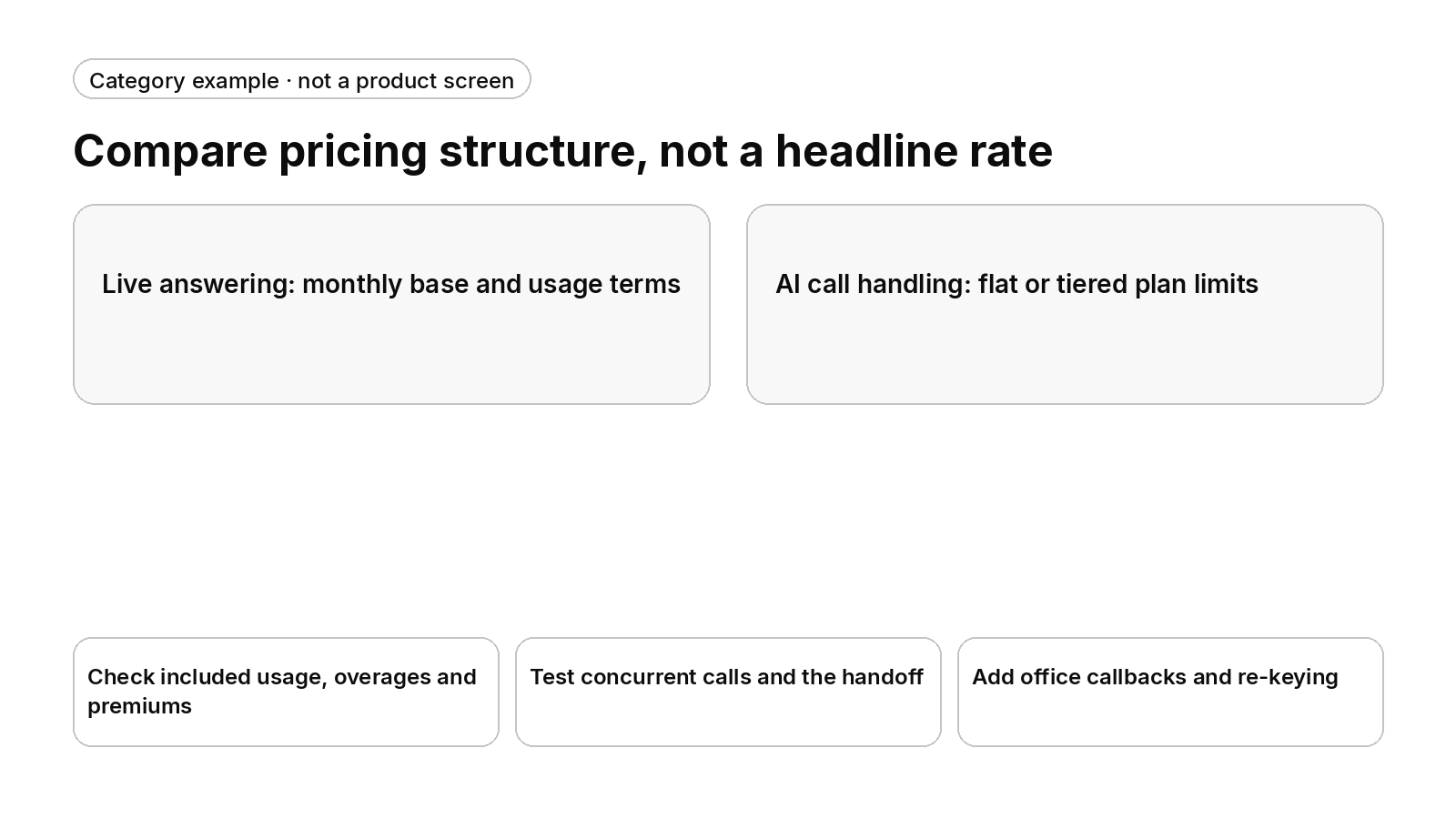
Category example · not a product screen
Compare pricing structure, not a headline rate
Live answering: monthly base and usage terms
AI call handling: flat or tiered plan limits
Check included usage, overages and premiums
Test concurrent calls and the handoff
Add office callbacks and re-keying
What happens after the call: a message, or a booked job?
The second cost is office time. A message may still need a callback, a schedule check and manual job entry. An apparent saving on the service invoice can disappear if the office does the same follow-up work as before.
Ask both categories to show the complete handoff. Does a call end as a message or a confirmed booking? Who checks availability before offering a visit? What is written into your field service management software? What does the office do if the connection fails?
Do not assume that an AI setup writes jobs or that a live answering service cannot. Confirm the actual setup, the connection it needs and the work left for your office. Our guide to calls becoming job records explains that handoff, and booking jobs on the call covers what to test.
How should safety and escalation work under either model?
Safety comes first. If a caller smells gas, the first instruction is to leave the building and call 911 or the gas utility from outside. If a carbon monoxide alarm is going off, or the caller reports a burning smell, smoke or fire, the first instruction is to leave the building and call 911 from outside. If anyone in the home is in danger from heat or cold, the caller should call 911.
Only after those safety instructions should the service follow your written escalation list for a system that won’t heat or cool. Specify which office person or on-call technician receives the call, how paging works and what happens if nobody picks up. Do not substitute an HVAC appointment for emergency help.
Ask the provider to demonstrate emergency or urgency triage and call routing with your script. The safety instruction must precede intake, booking, paging or dispatch, whichever tool or person answers. Our guide to emergency call triage covers the escalation checks.
How should you compare cost per booked job?
Use your own logs and labor costs, not a model based on technician headcount or someone else’s call length. Keep the service bill and office follow-up work together.
Cost per booked job = total service cost plus office callback and re-keying labor cost, divided by jobs booked.
Use the same period and the same definition of a booked job for each option. Separate a confirmed booking from a message and note how much work the office still has to do. Include setup and connection costs on a consistent basis, and ask about minimum commitments and cancellation terms before comparing the totals.
If the logs do not distinguish messages from booked work, fix that measurement before claiming a saving. A qualitative comparison is more honest than filling the gaps with invented figures. Our guide to missed HVAC calls covers a related source of follow-up work.
Where does a live person still matter on HVAC calls?
Plan for a person to take high-emotion, complex or disputed calls: an upset caller after a repair, a billing question or a commercial request with several sites. These are test scenarios, not proof that either category handles them well.
Ask whether warm transfer or live transfer keeps the caller on the line, whether the receiving person sees the caller’s details and what happens when nobody picks up. Confirm who owns that fallback during office hours and after-hours calls.
How should commercial and multi-site calls be handled?
Write down which site and contact details the service should collect, then confirm when a person takes over. Do not assume the call-handling tool understands the billing party, equipment or approval process. Test the request against your own scripts and software setup.
What is a hybrid model, and how should you price it?
A hybrid setup combines AI call handling with a person handling defined exceptions. It may cover routine requests, after-hours calls or peak-season overflow, but that coverage is something to confirm, not a promise made by the category name.
Price both parts. Ask which calls reach a person, whether that changes usage charges and how the service records the handoff. Hybrid is an option to test, not the default answer for every growing shop.
Which option fits your shop?
Consider AI call handling when: your scripts are clear, you can test the routine call types and the written plan covers your seasonal usage. Confirm the booking connection before relying on it.
Consider outsourced live answering when: you want a person taking the front line and the provider can show how agents follow your scripts, handle exceptions and pass work to your office.
Consider hybrid when: you can define which calls belong with a person and who takes them. Compare the combined bill and remaining office work with the other options.
Call volume and software setup inform the decision, but neither decides it alone. Shops using paper schedules should include manual entry in the comparison rather than assuming either service removes it. The contact-center guide covers the wider office workflow.
What should your demo checklist include?
- The current written quote: base, included usage, overages, tier ceilings, premiums, setup, connections and cancellation terms.
- Concurrent calls and peak-season overflow coverage, tested against your own operating conditions.
- Booking on the call, writing into field service software and the fallback when the connection fails.
- Warm transfer or live transfer to a person, including a test where nobody picks up.
- Transcripts, call recording, bilingual calls, caller recognition, lead qualification, fee quoting and missed-call text-back: ask whether each is available and what setup or charge it requires. Do not assume it is included.
- The safety instruction first, followed by your written escalation rules, with test calls before relying on the setup.
The voice-agents guide, caller-recognition guide, lead-qualification guide and fee-quoting guide explain those category checks.
How does FieldCamp fit residential and commercial work?
FieldCamp fits contractors running residential and commercial work in one system, with a person still deciding the day. Here is what FieldCamp does today, and what to ask in a demo.
This site is published by FieldCamp.
- On the dispatch board: When your dispatcher drags a job onto a technician, the board checks skills, drive time and schedule conflicts, and the dispatcher confirms the assignment.
- For the customer: The customer gets a text when a job is assigned or moved.
- For the technician: A technician’s assigned jobs and schedule show on their phone.
- One record: Each job stays on one record from the first call to the paid invoice.
- Residential and Commercial Together: Residential service calls and commercial maintenance work run in one system, not two.
- Who decides: A person still decides the day. Assignment stays a decision the dispatcher makes.
- What to ask in the demo: This page does not describe call answering, outsourced call centers or live answering services, AI call handling, AI receptionists or voice agents, per-minute billing, overages, flat or tiered monthly plans, after-hours or holiday premiums, concurrent calls, booking on the call, writing into field service management software, warm transfer or live transfer, emergency or urgency triage, call routing, escalation rules, on-call paging, transcripts, call recording, bilingual calls, caller recognition, lead qualification, fee quoting, missed-call text-back, hybrid AI and human handling, or peak-season overflow coverage as FieldCamp features or pricing. Ask about each of those, including included usage, tier ceilings, per-call charges, setup and connection costs, minimum commitments, cancellation terms, the total bill in a quiet month and a peak month, office time returning messages and re-keying, and the cost per booked job using your own logs. Ask how the safety instruction comes before any intake, booking, paging or dispatch step, how danger from heat or cold prompts the caller to call 911 before escalation, who takes over when the tool cannot handle a call, what happens when the person does not pick up, whether the receiving person sees the caller’s details, how the service records the handoff, what happens if a software connection fails, how commercial and multi-site requests reach a person, and how to place test calls against your own scripts. Confirm who owns scripts and service-area rules, how schedule availability is checked before a booking, whether a call produces a message or a confirmed job, and which connected tool or setup each part needs. Ask for the current written quote and a demonstration rather than assuming a flat plan includes unlimited usage or any call-side capability, and for each of those, whether it is available today, needs setup or a connected tool, is in a pilot, or is planned.
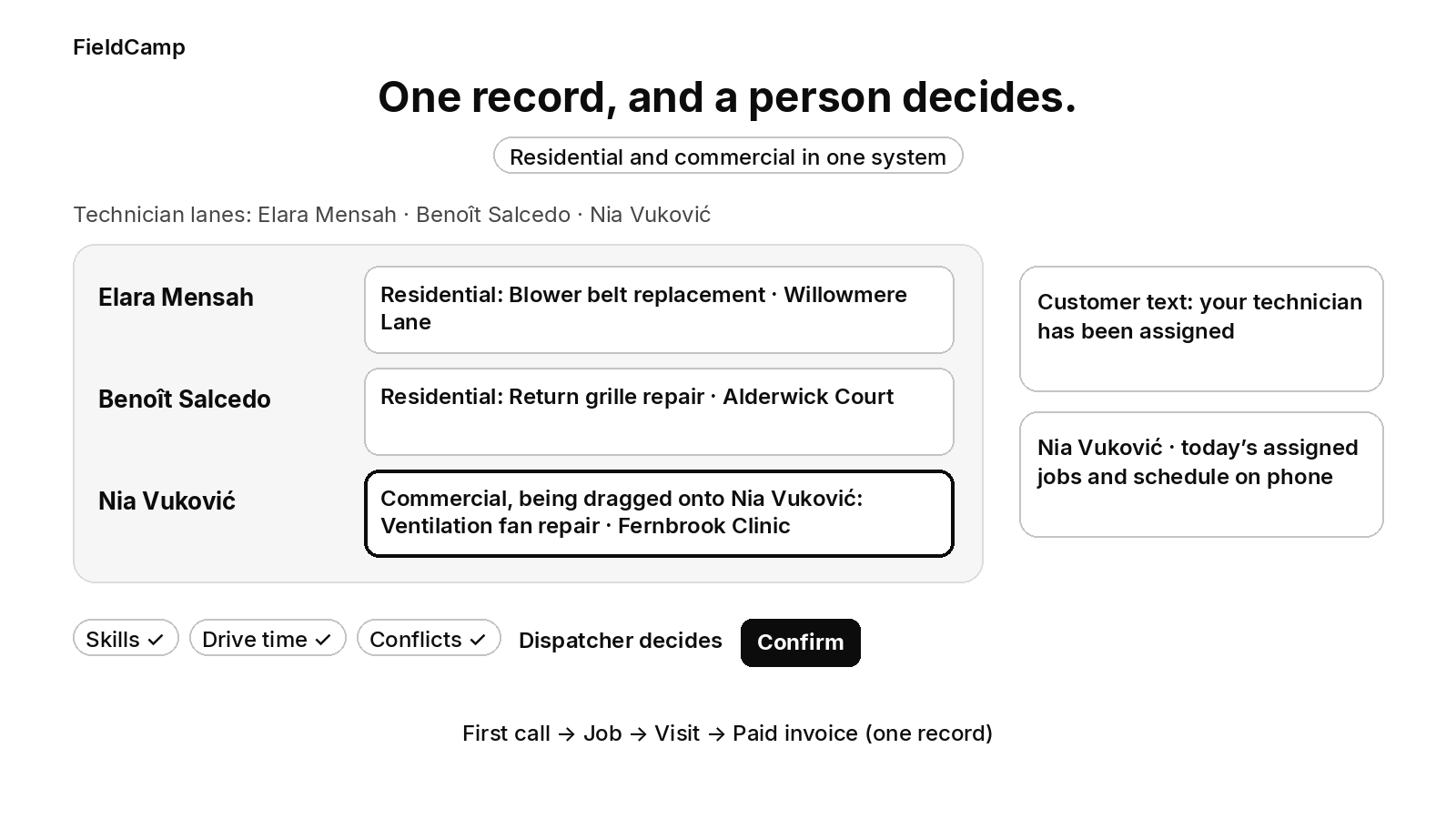
FieldCamp
One record, and a person decides.
Technician lanes: Elara Mensah · Benoît Salcedo · Nia Vuković
Residential: Blower belt replacement · Willowmere Lane
Residential: Return grille repair · Alderwick Court
Commercial, being dragged onto Nia Vuković: Ventilation fan repair · Fernbrook Clinic
Skills ✓ · Drive time ✓ · Conflicts ✓ · Dispatcher decides · Confirm
Customer text: your technician has been assigned
Nia Vuković · today’s assigned jobs and schedule on phone
First call → Job → Visit → Paid invoice (one record)
Residential and commercial in one system
Book a 30-minute walkthrough and bring your current workflow to the demo.
Frequently asked questions
What is the average cost of call center outsourcing?
There is no verified average or rate range on this page. Check current vendor pricing pages and request a written quote for your own usage. Compare the monthly base, included usage, overages, after-hours premiums, commitments, setup and connection costs. Apply each quote to the same quiet-month and peak-month logs rather than assuming a category average fits your shop.
Will call center agents be replaced by AI?
Safety comes first, before any intake, booking or dispatch step. Treat replacement as a workflow question, not a promise. Test which call types the setup can handle, which need a person and who owns the fallback. A hybrid setup may fit some calls without removing the need for office judgment.
Is there an AI answering service for HVAC technicians?
Safety comes first, before any intake, booking or dispatch step. Treat an HVAC-specific label as a starting point for questions, not evidence of capability. Ask a provider to demonstrate your service-area rules, routine requests, booking setup, software connection and handoff to a person. Confirm the written plan and the work left for your office.
Which AI call answering service is the best?
Safety comes first, before any intake, booking or dispatch step. There is no universal winner in this comparison. Test your own scripts, booking setup, handoff to a person and remaining office work, then compare current written terms. Do not choose from an assumed saving or an unverified price range.
Can AI handle multiple calls at once?
Safety comes first, before any intake, booking or dispatch step. Ask the provider to demonstrate concurrent calls within the quoted plan. Confirm the limit, what happens when it is reached and whether peak-season overflow changes the bill or the level of coverage. The category label alone does not establish capacity.
What if AI can’t handle a specific call?
Safety comes first. If a caller smells gas, the first instruction is to leave the building and call 911 or the gas utility from outside. If a carbon monoxide alarm is going off, or the caller reports a burning smell, smoke or fire, the first instruction is to leave the building and call 911 from outside. If anyone in the home is in danger from heat or cold, the caller should call 911. Only then should a call follow the written escalation list. Test warm transfer or live transfer to the named person and a fallback for when that person does not pick up. Confirm whether the receiving person gets the caller’s details.
Final recommendation
Compare current written terms against your own quiet-month and peak-month logs, then add the office work left after the call. Choose the setup you can test, not the cheapest-looking headline or an assumed saving.
If a caller smells gas, the first instruction is to leave the building and call 911 or the gas utility from outside. If a carbon monoxide alarm is going off, or the caller reports a burning smell, smoke or fire, the first instruction is to leave the building and call 911 from outside. If anyone in the home is in danger from heat or cold, the caller should call 911. These instructions come before any intake, booking, paging or dispatch step.