Category example
Stop refilling the phone desk.
Gas smell: leave the building and call 911 or the gas utility from outside.
Carbon monoxide alarm, burning smell, smoke or fire: leave the building and call 911 from outside.
- Cover overflow and after-hours
- Take the phones off the dispatcher
- Write the booking playbook down
Customer Service Representative (CSR) turnover in HVAC usually starts with the job itself: urgent callers, seasonal surges and one person answering phones while also running the dispatch board wear people out and keep the seat turning over. Instead of refilling the same seat, change the operating model: cover overflow and after-hours calls with AI and keep a person on the exceptions, hand the front line to a trade-trained answering service, widen the hiring pool, or redesign the in-house role so call intake and dispatch are separate jobs. You can combine two of the four, and each one works better when the booking playbook is written down instead of living in one veteran’s head.
One rule sits above every staffing model. If a caller smells gas, the first instruction is to leave the building and call 911 or the gas utility from outside, before any intake, booking or dispatch step. If a carbon monoxide alarm is going off, or the caller reports a burning smell, smoke or fire, the first instruction is to leave the building and call 911 from outside, before any intake, booking or dispatch step.
Why HVAC CSR turnover keeps happening
The office phone is a pressure point in an HVAC shop. Callers are often uncomfortable, sometimes upset, and they want a time today. Call volume can jump when the weather turns, and the same CSR is often expected to book the call, find a tech and explain why a slot moved.
New hires feel that pressure most in their first months, while they are still learning the service area, the price rules and who gets escalated calls. When that knowledge lives in a veteran’s memory instead of in writing, every departure takes it out the door, and the next hire starts from scratch.
Is it a hiring problem or a turnover problem?
Before you choose an alternative, split the pain in two:
- Hiring: you can’t find applicants, or the ones you find can’t handle the calls.
- Turnover: you can hire, but people leave before they settle into the role.
The alternatives below fix these two problems differently. The comparison table further down shows which one each fixes.
What happens when one person answers phones and runs dispatch?
When the same office person answers phones while dispatching, one person is doing two real-time jobs at once. Call intake can be interrupted. A dispatch board needs steady attention: who is available, who is closest, who has the right skills, and which job moves when the day changes. Every ringing phone pulls that person off the board.
The result shows up on both sides of the desk:
- calls that ring out while the board is being reshuffled
- callers on hold while a routine booking finishes
- techs calling the office because nobody has updated them
- an office person who burns out and leaves
This is a workload problem, not a people problem. Training doesn’t let one person do two jobs at once, and the pressure peaks on busy mornings and during heat waves and cold snaps, when the phones and the board are both full. Our guide to what missed HVAC calls cost covers the calls that ring out. The rest of this page covers the staffing side.
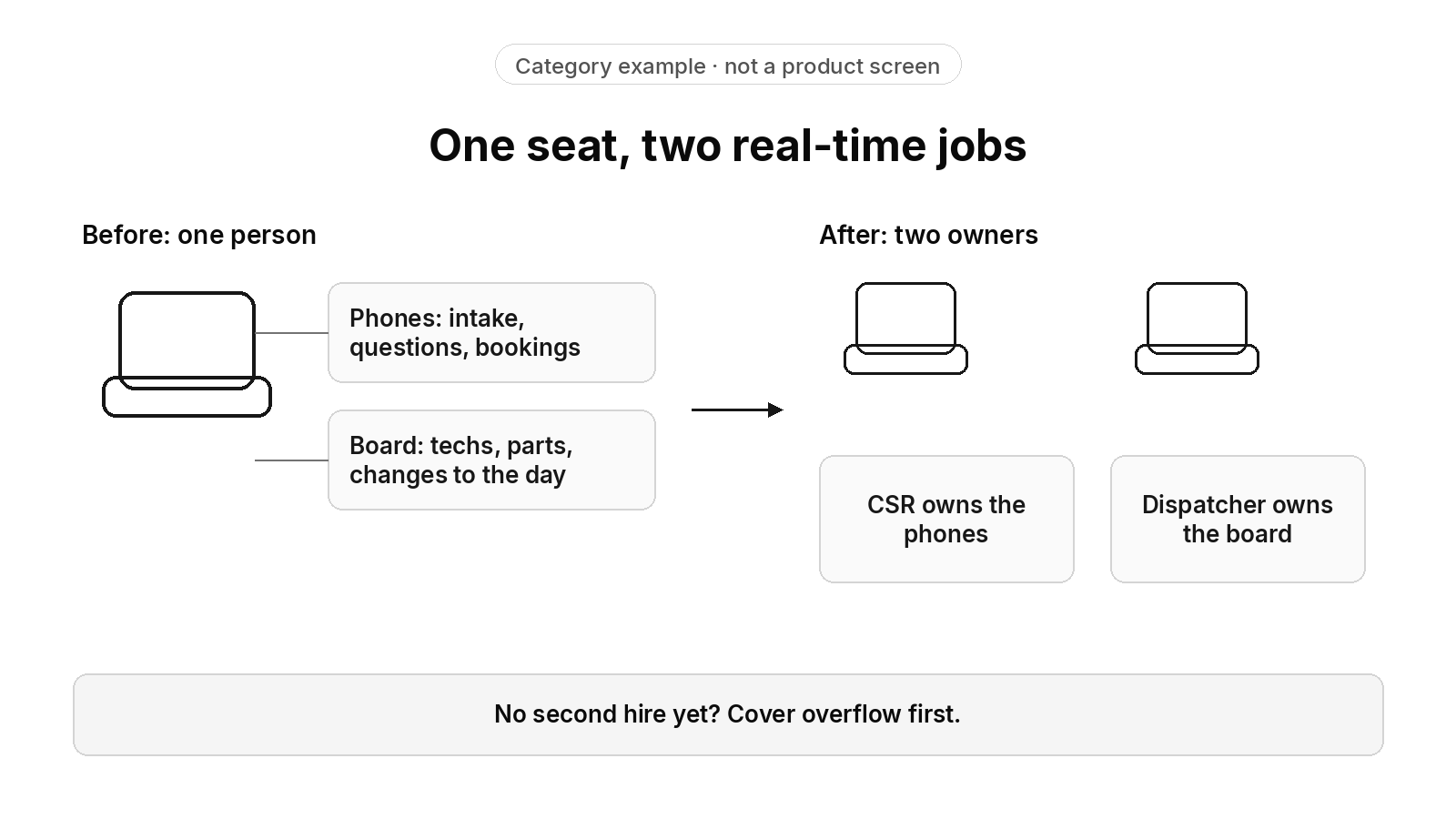
Category example · not a product screen
One seat, two real-time jobs
Before: one person
- Phones: intake, questions, bookings
- Board: techs, parts, changes to the day
After: two owners
- CSR owns the phones
- Dispatcher owns the board
No second hire yet? Cover overflow first.
Four alternatives to the hire-train-replace cycle
Each alternative starts from a different idea of where the phone work should sit. Read the checks under each one before you commit.
Cover overflow and after-hours with AI, and keep a person on the exceptions
Instead of staffing the phones for your busiest day, let an AI receptionist take overflow, lunch-break and after-hours calls while your CSRs keep business hours and handle the exceptions.
How it works: Your in-house CSR or CSRs own the daytime phones. An AI receptionist picks up when every line is busy and outside office hours, collects the caller’s details and, where it is set up to, books the job. Calls that fall outside your written escalation rules go to a person. The booking should land on your dispatch board as a job, not as a note in an inbox.
Why it helps with turnover: You staff for a normal day instead of the busiest one, so one departure leaves a smaller gap in coverage. Published comparisons of AI and human booking come from vendors, so keep people on the calls where judgment matters and test the AI on your own call types before you rely on it.
What to check:
- Does the AI create a booked job, or only take a message?
- Can your office write and change the escalation rules?
- Who picks up an exception, and how is that person reached?
Our guides to after-hours calls and peak-season overflow cover the coverage settings in more detail.
Hand the front line to a trade-trained answering service
Instead of recruiting, onboarding and replacing CSRs yourself, hand the front line to an answering service whose agents are trained on HVAC calls.
How it works: Trained agents pick up under your company name, sort the calls that need a fast response from routine ones under your rules, and take or book the job in your field service software. Providers range from US-based trade call centers to offshore and nearshore teams, and coverage can be full-time, after-hours only or overflow only.
Why it helps with turnover: The provider carries recruiting, onboarding and seasonal staffing. When an agent leaves, the provider replaces them, not your office manager. Ask what the provider needs from your office before it starts: scripts, service area rules and access to your schedule.
What to check:
- Does the provider create the job record, or only take a message?
- Can agents see your live board availability?
- How does the provider staff a surge week?
Our comparison of an answering service and an AI receptionist covers the message-versus-booked-job test, and our guide to why calls don’t land as job records covers what a call should write into your software.
Widen the hiring pool: remote CSRs and hires from outside the trade
Instead of competing for the same few experienced CSRs in your local market, change where you look and whom you look for.
How it works: Remote CSRs log in to your phone system and field service software from home, so commuting distance stops limiting your applicant pool. Recruit from hospitality, retail and restaurant work, where people already handle demanding customers and busy rushes.
Why it helps: This alternative mainly fixes hiring, because a bigger pool fills seats faster. Screening for temperament instead of trade experience can also help retention, because the pace of the job is familiar to these hires. HVAC knowledge can be taught on the job. Patience with an upset caller is harder to teach.
Hiring remote staff, especially in another state, raises employment, payroll and tax questions. Confirm them with qualified counsel or an employment advisor before you post the role. This page is not legal advice.
What to check:
- Can a remote CSR do the whole job from your software, without asking someone in the office?
- Is your booking script written down, or does it live in a veteran’s memory?
- Does your interview test how a candidate handles a frustrated caller?
Keep CSRs in-house, and redesign the job
Instead of one overloaded person who books, dispatches and calms every upset caller, divide the role so it can be learned and kept.
How it works: Separate booking from dispatching. The CSR owns the phones and intake. The dispatcher owns the board and assigns the right tech by schedule, location and skills. Build a visible path from CSR to dispatcher to office or operations manager. Pay SPIFFs on maintenance agreements sold and calls booked. Hold stay conversations before the busy season, not exit interviews after it.
Why it helps with turnover: People leave jobs that feel overwhelming and go nowhere. A narrower role is easier to learn in the first months, and a career path gives people a reason to stay after that.
What to check:
- Can booking and dispatch be done by different people in your software without double entry?
- Are SPIFFs tracked in your software, or tallied by hand at month-end?
- Is anyone talking to your CSRs before the busy season starts?
When should you split the CSR and dispatcher roles?
Split the roles once calls regularly interrupt dispatch decisions. No single shop size triggers it, so watch for the signs instead:
- calls ringing out while the board is being reshuffled
- board changes that wait until the phones go quiet
- techs calling the office for their next job
- the office person staying late to catch up on the board
Splitting the roles doesn’t have to mean a new hire on day one. These first steps work before a second full-time person:
- Let overflow coverage act as the CSR during busy windows, so the dispatcher stays on the board.
- Stagger shifts or create a phone-only shift so someone always owns the phones through lunch and breaks.
- Cross-train so the dispatcher can cover the phones in a pinch without owning them every day.
Think of the CSR as the person who fills the board and the dispatcher as the person who runs it. The two jobs need different strengths: patience and warmth on the phone, and quick, calm judgment on the board.
How should urgent calls be handled under any staffing model?
Safety comes before any staffing decision. If a caller smells gas, the first instruction is to leave the building and call 911 or the gas utility from outside. If a carbon monoxide alarm is going off, or the caller reports a burning smell, smoke or fire, the first instruction is to leave the building and call 911 from outside. After that, if anyone in the home is in danger from heat or cold, the caller should call 911.
Then the call follows a written escalation list that every CSR, outside agent and AI setup uses the same way:
- What counts as urgent: for example, a system that won’t heat or cool, and which other conditions qualify under your policy.
- Checks before a truck rolls: the thermostat and breaker checks a caller can safely try.
- Who gets it: office staff or the on-call technician, and in what order.
- When a person takes over: the point where an AI receptionist or outside agent passes the call to someone on your team.
Our guide to how urgent calls reach a tech covers escalation when the on-call tech doesn’t pick up.
Which calls can you take off the desk before anyone answers?
Some inbound calls aren’t new work. Your own process creates them:
- customers asking when the tech will arrive
- techs asking the office what’s next
- routine maintenance customers who just want a time
The fixes are category tools to confirm in a demo:
- On-the-way texts answer the where-is-my-tech question before anyone has to call.
- A technician app gives techs their next job and lets them close the current one without phoning in.
- Online booking gives routine maintenance requests a self-service path.
- Missed-call text-back reaches a caller you couldn’t pick up.
Check your phone reports for the hours that bring the most calls and how many are status checks, then staff those windows and take the status checks off the desk.
Shrink the cost of every departure, not just the turnover rate
Every alternative on this page lowers turnover pressure, and none of them brings it to zero. Agents rotate, remote hires move on and AI setups need tuning. So the second question is how quickly a replacement becomes useful.
That depends on where the booking playbook lives. Often, the answers a new CSR needs are spread across sticky notes, a spreadsheet and a veteran’s memory. Write the playbook into your software and your training notes, and any replacement starts from the same base:
- Service area: which ZIP codes you serve and where the boundaries are.
- Price guardrails: the fees and prices the office has set, so nobody improvises a quote.
- Escalation rules: what counts as urgent, who gets it and in what order, after the safety instruction.
- Customer and equipment history: attached to the customer and job records, so the next person sees what happened last time.
When those four things are written down, turnover still costs you a person, but it no longer costs you everything that person knew.
How CSR turnover spills into technician turnover
A revolving CSR desk can push problems into the field. Techs sent to jobs that were misdescribed, poorly qualified or not worth the trip get frustrated, and each new CSR qualifies calls a little differently.
The fix is upstream: consistent call qualification written into the booking flow, and dispatch that matches the job to a tech’s skills. Our guide to how an AI receptionist qualifies leads covers the qualifying questions. That protects the field team whichever alternative you choose.
How the four alternatives compare
This is a category comparison, not a description of any one product. Confirm each answer against your own shop and in a demo.
| Alternative | What it fixes | What it doesn’t fix | What to watch |
|---|---|---|---|
| AI with a person on the exceptions | Turnover pressure and the number of seats to fill | Exceptions still need a person | Booked jobs versus messages, by call type |
| Trade-trained answering service | Hiring and turnover, because the provider carries both | Job quality, if agents only take messages | Poorly described jobs reaching techs |
| Remote and outside-the-trade hires | Hiring | Turnover, if the role stays overloaded | Who stays past the first months |
| In-house redesign | Turnover | Overflow and after-hours coverage | Who stays, and calls ringing out at busy times |
Which alternative fits your shop?
Start with the problem, then your size:
- You can’t find applicants: widen the pool with remote and outside-the-trade hires, or hand the front line to an answering service so recruiting becomes the provider’s job.
- People leave in their first months: reduce the load with overflow coverage, redesign the role and write the playbook down.
- One office person on phones and dispatch: cover overflow and after-hours first, so the board isn’t interrupted by every ring and losing that person doesn’t leave the phones unanswered.
- Several CSRs and a growing fleet: split booking from dispatch and add a CSR-to-dispatcher path before adding seats.
- More than one location: use one booking playbook across every location, whatever mix of people, providers and AI takes the calls.
Our guide to the HVAC contact center covers the office side of the phones, and our guide to what an AI receptionist books covers what should land on the board after a call.
How does FieldCamp fit a shop rebuilding its front office?
FieldCamp fits contractors running residential and commercial work in one system, with a person still deciding the day. Here is what FieldCamp does today, and what to ask in a demo.
This site is published by FieldCamp.
- On the dispatch board: When your dispatcher drags a job onto a technician, the board checks skills, drive time and schedule conflicts, and the dispatcher confirms the assignment.
- For the customer: The customer gets a text when a job is assigned or moved.
- For the technician: A technician’s assigned jobs and schedule show on their phone.
- One record: Each job stays on one record from the first call to the paid invoice.
- Residential and Commercial Together: Residential service calls and commercial maintenance work run in one system, not two.
- Who decides: A person still decides the day. Assignment stays a decision the dispatcher makes.
- What to ask in the demo: This page does not describe call answering, overflow or after-hours coverage, AI receptionists, answering services, call routing, call transfer, call recording, call transcripts, bilingual calls, caller recognition, lead qualification, fee or price quoting, booking on the call, urgency triage, escalation rules, on-call paging, missed-call text-back, online booking, on-the-way texts, remote CSR access, office staffing or CSR scheduling as FieldCamp features, and it does not say any software lets you hire fewer people. Ask in the demo how a call taken by an in-house CSR, an outside answering service or an AI receptionist would reach your board as a job, and for each piece, whether it is available today, needs setup or a connected tool, is in a pilot, or is planned. Also ask about giving the safety instruction first on the call, before any intake, booking or dispatch step, telling the caller to call 911 if anyone in the home is in danger from heat or cold, sending urgent calls about a system that won’t heat or cool to office staff or the on-call technician under your written escalation list, covering overflow, lunch breaks and after-hours when the office lines are busy, keeping call intake off the dispatcher, letting a remote CSR work from the same screens as the office, giving an outside answering service or an AI receptionist live board availability, keeping the booking playbook (service area, price guardrails and escalation rules) where every new CSR, outside agent or AI setup can use it, splitting booking from dispatching without double entry, tracking SPIFFs and booked calls by CSR, sending the customer a text when the technician is on the way, letting routine maintenance customers book online, recovering a missed call with a text, placing test calls before go-live, a standalone receptionist, an answering service or an agent inside your field service software, and which connection, app or import has to be in place first, and for each of those, whether it is available today, needs setup or a connected tool, is in a pilot, or is planned.
Our guides to HVAC AI voice agents, caller recognition and how an AI phone agent quotes fees cover the call side around the desk.
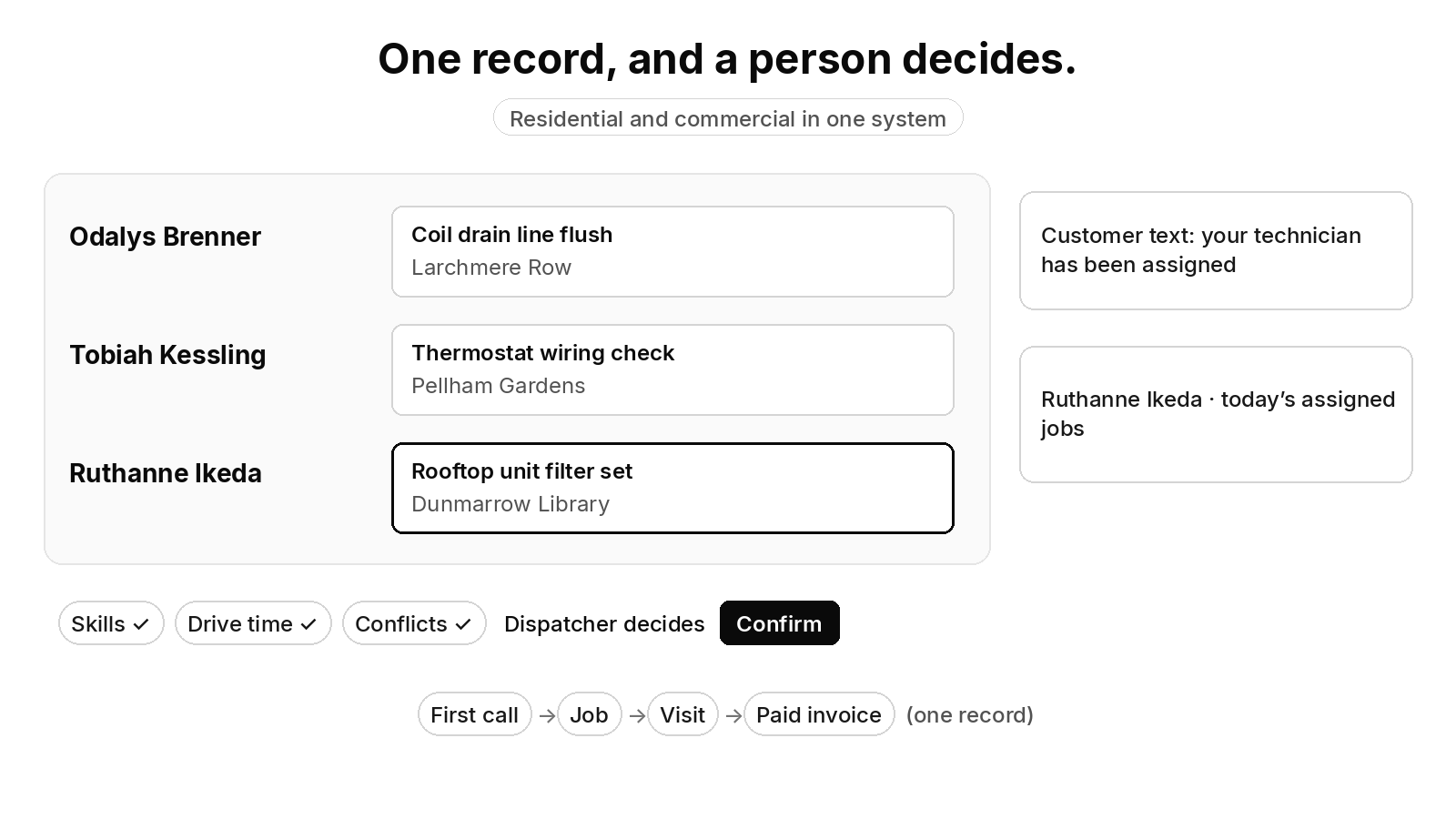
One record, and a person decides.
- Odalys Brenner: Coil drain line flush · Larchmere Row
- Tobiah Kessling: Thermostat wiring check · Pellham Gardens
- Ruthanne Ikeda: Rooftop unit filter set · Dunmarrow Library
Skills ✓ · Drive time ✓ · Conflicts ✓ · Dispatcher decides · Confirm
Customer text: your technician has been assigned
Ruthanne Ikeda · today’s assigned jobs
First call → Job → Visit → Paid invoice (one record)
Residential and commercial in one system
Rebuilding the front office? Book a 30-minute walkthrough to see how a job moves from the first call onto the dispatch board.
Frequently asked questions
What is a CSR in HVAC?
Safety comes first: when a call involves a safety risk, the CSR gives the safety instruction before any intake, booking or dispatch step. Beyond that, a Customer Service Representative (CSR) answers the phones for an HVAC company, takes the caller’s details, books the visit and sets expectations about timing. In smaller shops, the CSR often runs dispatch too. In larger shops, the CSR passes the booked job to a separate dispatcher.
What does a dispatcher do for an HVAC company?
Safety comes first: any call with a safety risk gets the safety instruction before a dispatch step. Beyond that, the dispatcher runs the board. That means matching each booked job to a tech by schedule, location and skills, moving jobs when the day changes, and keeping techs and customers updated. The dispatcher works from the jobs the CSR books, so the phones and the board stay separate jobs.
What is a CSR dispatcher?
Safety comes first, before any booking or dispatch step. A CSR dispatcher is one person doing both jobs: answering the phones and running the dispatch board. The combined role often appears in smaller shops. Split it once calls regularly interrupt dispatch decisions, or cover overflow and after-hours calls first so the board gets that person’s attention.
Why is call center turnover so high?
Call center roles combine a steady stream of calls, upset callers and pressure to keep calls moving, often with little control over the day. In HVAC, seasonal surges and a CSR who also runs the board add to that load. New hires are most likely to leave while they are still learning, so writing the booking playbook down and narrowing the role can help them settle in.
Is being an HVAC dispatcher hard?
Safety comes first. If a caller smells gas, the first instruction is to leave the building and call 911 or the gas utility from outside. If a carbon monoxide alarm is going off, or the caller reports a burning smell, smoke or fire, the first instruction is to leave the building and call 911 from outside. Beyond those calls, dispatching is demanding because the day keeps changing: a job runs long, a tech calls in, and urgent calls about a system that won’t heat or cool have to fit in after the safety instruction. It gets much harder when the dispatcher also answers the phones, which is why splitting the two roles or covering overflow first can help.
What strategies reduce CSR turnover?
Safety comes first: write the safety instruction into every script, before any intake, booking or dispatch step. Then reduce the load. Cover overflow and after-hours calls, split booking from dispatch, and give CSRs a path to dispatcher or office manager. Tie SPIFFs to booked calls and agreements sold, hold stay conversations before the busy season, and write the booking playbook down so new hires don’t have to learn it from memory.
Final recommendation
Before you post the next CSR job ad, decide whether you have a hiring problem or a turnover problem, take call intake off whoever runs the board, and write the booking playbook down so the next hire, agent or AI setup starts from the same base. Make sure every script starts with the safety instruction: a caller who smells gas should leave the building and call 911 or the gas utility from outside, before any intake, booking or dispatch step. A caller with a carbon monoxide alarm going off, or who reports a burning smell, smoke or fire, should leave the building and call 911 from outside, before any intake, booking or dispatch step.