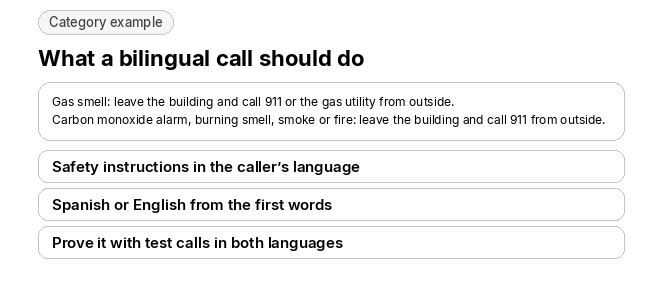
Category example
What a bilingual call should do
Gas smell: leave the building and call 911 or the gas utility from outside.
Carbon monoxide alarm, burning smell, smoke or fire: leave the building and call 911 from outside.
- Safety instructions in the caller’s language
- Spanish or English from the first words
- Prove it with test calls in both languages
An HVAC AI receptionist with Spanish and bilingual call handling is judged by what happens in the caller’s first few words. It should carry the call in English or Spanish, recognize the caller’s language from those first words without a “press two for Spanish” menu or a transfer, give the safety instructions first in that language, sort urgent no-heat and no-AC calls under your rules, and hand a complete request to your office. Your team should then be able to read the call in English, even when the whole call was in Spanish. What a tool actually does on a live Spanish call varies by product. Check the vendor’s current documentation and prove it with test calls in both languages before you sign.
One rule sits above every call, in either language. If a caller smells gas, the first instruction is to leave the building and call 911 or the gas utility from outside. If a carbon monoxide alarm is going off, or the caller reports a burning smell, smoke or fire, the first instruction is to leave the building and call 911 from outside. Give these instructions before any intake, booking, paging or dispatch step, in the language the caller is using.
What should an HVAC AI receptionist with bilingual call handling do?
A bilingual HVAC receptionist should run the whole service call in the caller’s language, from greeting to the handoff to your office. These are the capabilities to hold any system to, in the order a real call uses them, with safety first:
- Safety Instructions First: Before any other question, it should give the safety instructions above in the language the caller is using, and a call that needs them goes to a person under your written escalation list.
- Language Detection: It should recognize Spanish or English from the caller’s opening words, then hold the whole HVAC call in that language: greeting, triage questions, address capture and booking confirmation.
- No Phone Menus: Spanish-speaking callers should not have to press a key for Spanish, wait for a bilingual agent or be transferred to a separate line where the call can drop.
- Mid-Call Switching: A caller can start in English and move to Spanish, or hand the phone to a family member who speaks the other language. The receptionist should follow the switch without restarting intake.
- HVAC Urgency Sorting: After the safety instructions, it should flag no heat, no AC, water leaks and refrigerant issues as urgent in either language and escalate them to the on-call technician under the rules your office sets.
- System-Specific Intake: It should collect system type, equipment age, make and model, any error codes on the thermostat or unit, and the service address, then check the address against your service area before booking.
- Booking Under Your Rules: It should book the job into an open slot under your rules rather than take a message for someone to call back. Urgent requests go to your dispatcher, who decides who goes.
- English Summaries for Your Team: A Spanish call should produce an English summary, a transcript and a recording, so a dispatcher or technician who does not speak Spanish still knows what the caller reported.
- Human Handoff for Exceptions: When a call falls outside the rules, it should go to a person on your team with the call details attached. Examples are a billing dispute, a warranty question or a caller who asks for a human.
This is category guidance, not a description of any product. Confirm each answer in the vendor’s current documentation and in a demo with test calls in both languages.
How does bilingual language detection work on an HVAC call?
Bilingual HVAC receptionists usually reach Spanish in one of two ways, and both can meet the standard as long as the caller never touches a keypad.
- First-Word Detection: The system listens to the caller’s opening words and answers in Spanish if the caller speaks Spanish.
- Greet-Then-Switch: The system greets in English, sometimes with a short invitation to speak Spanish, and switches once the caller responds in Spanish.
The difference matters most on urgent and safety calls. A caller who opens in Spanish should hear the safety instructions in Spanish, not sit through an English greeting before being understood. Ask in the demo which approach the tool uses and how it handles HVAC terms and regional Spanish.
How should safety instructions work in Spanish and English?
Safety comes first. If a caller smells gas, the first instruction is to leave the building and call 911 or the gas utility from outside. If a carbon monoxide alarm is going off, or the caller reports a burning smell, smoke or fire, the first instruction is to leave the building and call 911 from outside. If anyone in the home is in danger from heat or cold, the caller should call 911.
These instructions should be available in Spanish as well as English, so a caller who opens in Spanish hears them in Spanish without waiting through an English greeting or a transfer. Ask the vendor to play the Spanish safety script in the demo, and have a native Spanish speaker on your team review its wording before it goes live.
Only after those safety instructions should the receptionist sort the request under your rules into urgent or routine and follow your written escalation list. Do not substitute an HVAC appointment for emergency help. How triage levels and escalation should work has its own page: emergency call triage. Night and weekend ownership is covered in after-hours calls.
Where should a Spanish call land?
A bilingual receptionist can treat the call as finished once the English summary reaches your inbox or CRM. For an HVAC shop, that is where the work starts.
A Spanish call should create or update the records your whole shop works from:
- Customer: The caller’s name, phone number and preferred language.
- Site: The service address, gate codes and access notes.
- Unit and Equipment: System type, equipment age and make and model.
- Job: The triage result, the booked slot and the call details.
From there, the job should carry through dispatch, the estimate, any maintenance agreement visit and the paid invoice, so nobody retypes a summary. Ask in the demo where each piece lands. The wider handoff into the job workflow is covered in calls becoming job records, and booking mechanics are covered in booking jobs on the call.
What happens after a Spanish no-heat call at night?
This is an illustrative category example, not a description of any product.
- Safety checked first: The call opens in Spanish, and the receptionist stays in Spanish. It gives the safety instructions first whenever a caller reports danger, and if anyone in the home is in danger from the cold, the caller should call 911. This caller reports none: the furnace stopped and the house is getting cold.
- Triage marks it urgent: No heat on a winter night meets the office’s urgent rule, so the call skips the next-day queue.
- Intake fills the request: The receptionist captures system type, approximate equipment age, any error code on the thermostat and the service address. The address passes the service-area check.
- Your dispatcher decides: The request reaches your dispatcher with everything captured, and the dispatcher decides which technician goes.
- The English summary goes on the job: The technician opens the job and sees the English summary, transcript and recording attached to it, not in a separate inbox.
- The language preference stays on the customer: Arrival texts, the next-day follow-up and appointment reminders reach the caller in Spanish.
- The work carries forward: The repair estimate, the invoice and any maintenance agreement offer stay with the same customer, and renewal reminders go out in the language the caller used that first night.
The language step is where setups often fall short. If the language preference is never saved, the caller gets a bilingual phone call followed by English-only texts. Run this same call in Spanish against your own scripts in any demo.
How do standalone and built-in bilingual setups compare?
A standalone bilingual receptionist can handle Spanish calls well. What it requires is everything around the call. This table compares the two setups on the points that decide how a Spanish call becomes paid HVAC work.
| What the call needs | Standalone bilingual receptionist | Bilingual answering inside HVAC field service software |
|---|---|---|
| Call details through invoicing | Requires a connection or manual re-entry to move the Spanish call summary into your field service records | Should open the job that later holds the estimate, the visit and the invoice; confirm in a demo |
| Technician assignment | Requires someone to read the summary and assign the technician in a separate system | Should hand the request to your dispatcher, who assigns the technician |
| Maintenance agreement follow-up | Requires a second tool or office staff to turn a repair call into an agreement offer and renewal reminders | Should run agreement visits and renewal reminders from the same customer in the caller’s preferred language; confirm in a demo |
| Residential and commercial | Commercial calls may need separate rules or setup for sites and units | Should cover residential callers and property managers with several sites; confirm in a demo |
| Fees stated on the call | Any fee the receptionist states has to be maintained apart from your office price list | Should state only fees your office controls; confirm in a demo |
| Exceptions to a person | Go to the vendor’s own staff or back to you as a message | Should pass exceptions to a person on your team with what was captured |
| Caller language preference | Often recorded in the call summary only | Should be saved on the customer and used for later texts and reminders; confirm in a demo |
This is category guidance, not a description of any product. Confirm each cell in the vendor’s current documentation and in a demo with test calls in both languages.
How fee quoting on a call should work is covered in diagnostic fee quotes, and the wider operating models are compared in an answering service versus an AI receptionist.
Questions to ask before choosing a bilingual HVAC receptionist
Does it work with the software that runs your dispatch?
A bilingual receptionist is only as useful as the place its Spanish calls land. Ask whether it writes into your field service management (FSM) software or only sends an email or CRM note.
- Job Creation: Does the call create a real job, or just a lead someone must convert?
- Equipment Data: Do system type and make and model land on the unit?
- Language Field: Is the caller’s preferred language saved where your texts and reminders can read it?
AI only or AI plus a person?
For many HVAC shops, the practical answer is AI plus a person. The AI takes calls and books in English or Spanish under your rules, and your own staff handle the exceptions.
- AI Handles: Routine booking, urgency sorting, intake and after-hours coverage, always after the safety instructions.
- Your Team Handles: Disputes, warranty questions, complex commercial approvals and callers who ask for a human.
- Watch For: Handoffs that arrive without the transcript or recording.
All hours, or after-hours and overflow only?
Bilingual coverage often matters most on after-hours and overflow calls, when no Spanish-speaking CSR may be on shift.
- AI-First: The AI picks up first in English or Spanish, during and outside business hours.
- After-Hours and Overflow: Your CSRs answer first, and the AI covers nights, weekends and calls your team cannot pick up.
- Either Way: Safety instructions come first, and urgency sorting to the on-call technician should behave the same in both languages.
Busy-season coverage is covered in peak-season overflow.
What does the office see after a Spanish call?
The office should be able to act on a Spanish call without anyone translating it.
- Language Used: It is marked clearly on the job.
- Urgency Result: It shows which triage rule applied.
- Equipment and Address: These sit in their own fields, not buried in prose.
- Transcript and Recording: The original Spanish is kept so you can review it if a detail is disputed.
Ask about recording notice and consent rules, and whether the notice plays in Spanish as well as English. Rules vary by state.
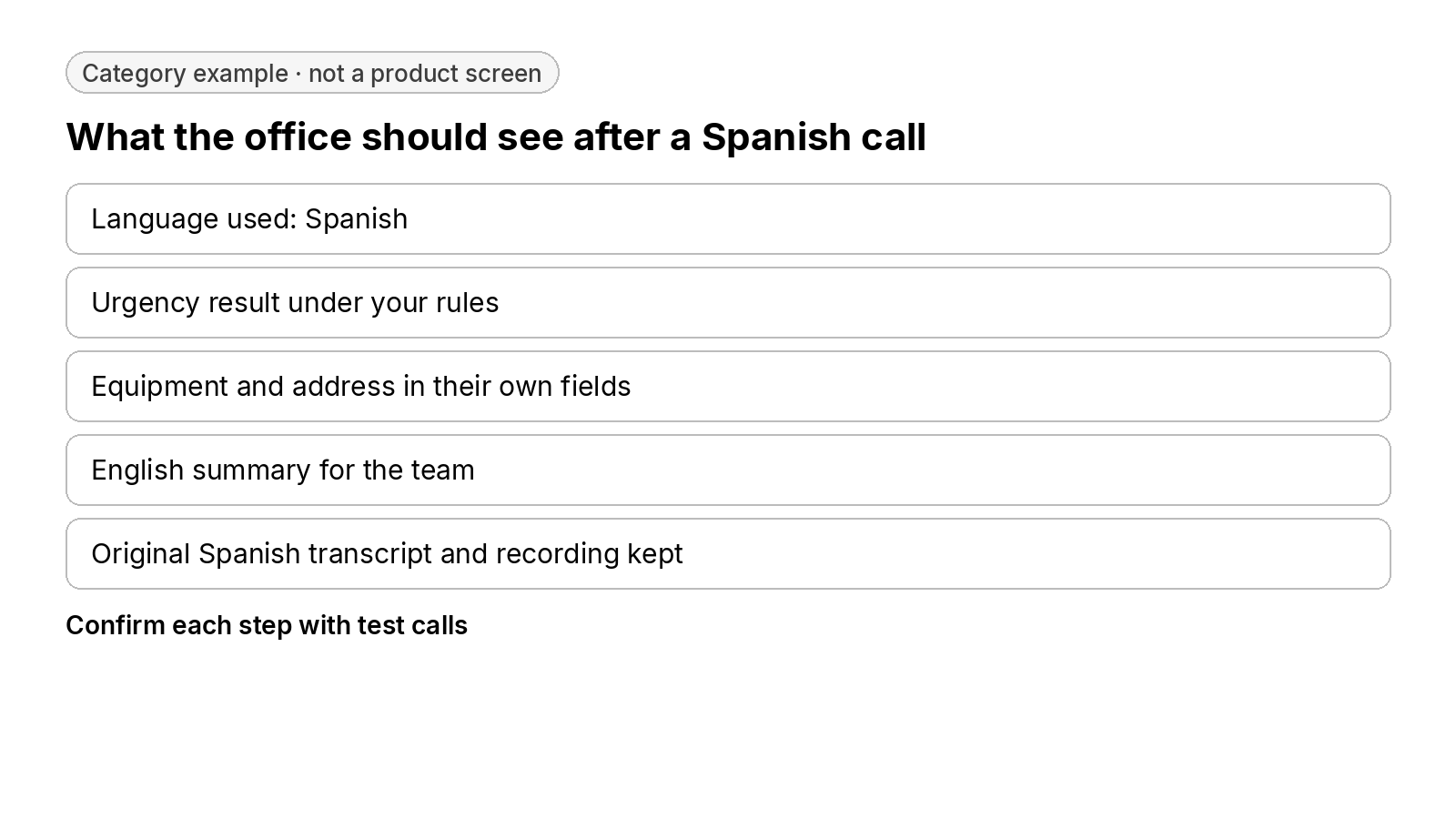
Category example · not a product screen
What the office should see after a Spanish call
- Language used: Spanish
- Urgency result under your rules
- Equipment and address in their own fields
- English summary for the team
- Original Spanish transcript and recording kept
Confirm each step with test calls
What does Spanish call handling cost?
This page does not quote a price. Ask whether Spanish handling is included in a plan or priced separately, check current vendor pricing pages and get a written quote that shows what is included and what costs extra.
Can it handle commercial calls from property managers?
It should, with one extra layer. On a commercial Spanish call, the receptionist should identify the site and unit and note who is reporting the problem, whether a tenant or on-site staff. It should then follow the property manager’s approval rules before anyone is sent. The caller’s language and the payer’s language can differ. Your summaries and invoices should follow the customer and site, not the caller.
The voice-agents guide and the contact-center guide cover the wider office workflow around these checks.
Where does FieldCamp fit?
FieldCamp fits contractors running residential and commercial work in one system, with a person still deciding the day. Here is what FieldCamp does today, and what to ask in a demo.
This site is published by FieldCamp.
- On the dispatch board: When your dispatcher drags a job onto a technician, the board checks skills, drive time and schedule conflicts, and the dispatcher confirms the assignment.
- For the customer: The customer gets a text when a job is assigned or moved.
- For the technician: A technician’s assigned jobs and schedule show on their phone.
- One record: Each job stays on one record from the first call to the paid invoice.
- Residential and Commercial Together: Residential service calls and commercial maintenance work run in one system, not two.
- Who decides: A person still decides the day. Assignment stays a decision the dispatcher makes.
- What to ask in the demo: This page does not describe call answering, AI receptionists or voice agents, Spanish or bilingual call handling, bilingual calls, language detection or recognition, keypad language menus, mid-call language switching, Spanish-language safety instructions or scripts, handling of HVAC terms or regional Spanish, after-hours answering, overflow answering, urgency sorting, triage, routing, paging, on-call escalation, handoff to a person, live transfer or warm transfer, system type, equipment, error-code and address intake from a call, service-area checks, booking on the call, jobs, customer, site or unit records created from a call, gate codes or access notes, lead capture or lead qualification, caller recognition, English summaries of Spanish calls, call transcripts, call summaries, call recordings, recording notice or consent, call scoring, caller language preference, Spanish texts, arrival texts, follow-ups, reminders or renewal notices, texts-from-calls, maintenance agreement offers, visits or renewals from a call, estimates or invoices tied to a call, fee quoting, receptionist pricing or plans, commercial site and unit identification, tenant or on-site reporter capture, property manager approval rules, syncs or handoffs to field service management software, email or CRM notes, or standalone bilingual receptionists as FieldCamp features. Ask about each of those, including whether a caller who opens in Spanish hears the safety instructions in Spanish before any intake, booking, paging or dispatch step, how danger from heat or cold prompts the caller to call 911 before escalation, where a Spanish call lands—as a job, as a request that becomes the job, on the customer record, or only as a message—whether the caller’s preferred language is saved where later texts and reminders can read it, who takes over when the tool cannot handle a call, what happens when the person does not pick up, whether the receiving person sees the caller’s details in English, how to place test calls in Spanish and English against your own scripts, and which connected tool or setup each part needs. Ask for a demonstration with live Spanish and English test calls rather than assuming any call-side capability, and for each of those, whether it is available today, needs setup or a connected tool, is in a pilot, or is planned.
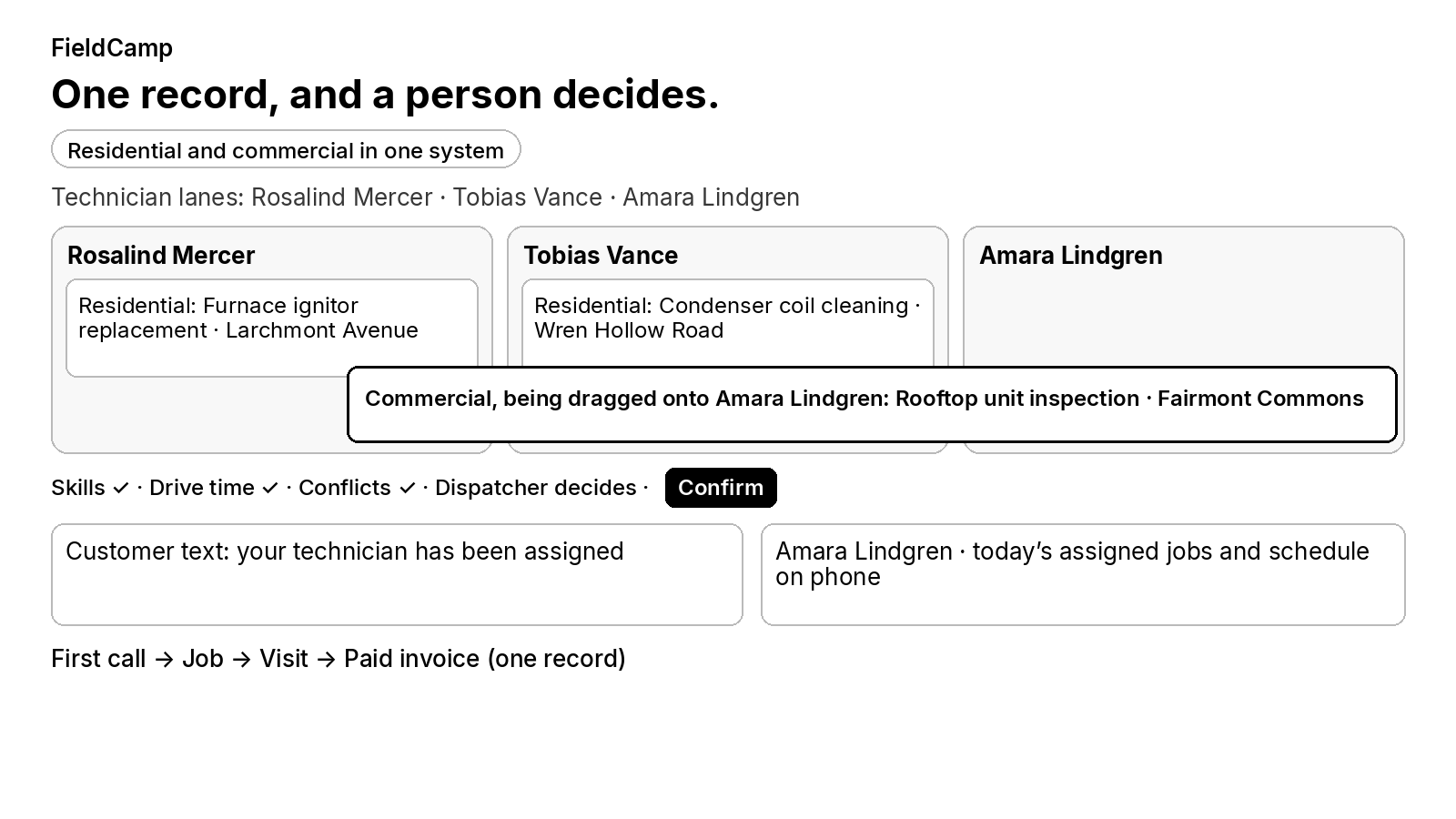
FieldCamp
One record, and a person decides.
Technician lanes: Rosalind Mercer · Tobias Vance · Amara Lindgren
- Residential: Furnace ignitor replacement · Larchmont Avenue
- Residential: Condenser coil cleaning · Wren Hollow Road
- Commercial, being dragged onto Amara Lindgren: Rooftop unit inspection · Fairmont Commons
Skills ✓ · Drive time ✓ · Conflicts ✓ · Dispatcher decides · Confirm
Customer text: your technician has been assigned
Amara Lindgren · today’s assigned jobs and schedule on phone
First call → Job → Visit → Paid invoice (one record)
Residential and commercial in one system
Book a 30-minute walkthrough and bring your current workflow to the demo.
Frequently asked questions
Is there an AI that speaks Spanish?
Yes. AI receptionists and voice agents that hold a call in Spanish are a product category. How well a tool handles HVAC terms, regional Spanish and a caller who switches languages mid-call varies by product. Ask each vendor for live test calls in Spanish, and have a native Spanish speaker on your team review the result.
Is there an AI answering service for HVAC technicians?
Safety comes first, before any intake, booking or dispatch step. AI answering services and voice agents are a product category, and some are set up for HVAC contractors. For Spanish and English callers, test whether the tool recognizes the caller’s language, gives the safety instructions in that language and hands urgent calls to a person under your escalation list. Confirm each part in a demo with test calls in both languages.
What does an AI receptionist cost?
There is no verified price or rate range on this page. Check current vendor pricing pages, ask whether Spanish handling is included or priced separately, and get a written quote that shows what is included and what costs extra. Compare that quote with what your own bilingual office staffing costs.
How does an AI receptionist compare to relying on a bilingual CSR?
Safety comes first, before any intake, booking or dispatch step. A bilingual CSR covers only the hours they work, while an AI receptionist can be set up to take calls in English or Spanish outside those hours. One common setup has CSRs answer first, with the AI covering nights, weekends and calls the team cannot pick up. In either setup, the safety instructions and urgency sorting to the on-call technician should work the same in both languages.
What goes wrong if the caller’s language preference isn’t saved?
The caller can get a bilingual phone call and then only English texts. This happens when the language is recorded only in the call summary and not on the customer. Ask any vendor whether the preferred language is stored where your texts, reminders and renewal notices can read it.
What if a caller reports a gas smell or a carbon monoxide alarm in Spanish?
Safety comes first. If a caller smells gas, the first instruction is to leave the building and call 911 or the gas utility from outside. If a carbon monoxide alarm is going off, or the caller reports a burning smell, smoke or fire, the first instruction is to leave the building and call 911 from outside. If anyone in the home is in danger from heat or cold, the caller should call 911. These instructions should be given in the language the caller is using. Only then should a call follow your written escalation list. Test in the demo that the Spanish script gives these instructions before any intake question.
Final recommendation
Hold every vendor to the language, safety and landing questions on this page, then prove the answers with test calls in Spanish and English against your own scripts. Prefer a setup where a Spanish call lands as a job your dispatcher can act on, with the caller’s language saved, rather than a summary someone has to retype.
If a caller smells gas, the first instruction is to leave the building and call 911 or the gas utility from outside. If a carbon monoxide alarm is going off, or the caller reports a burning smell, smoke or fire, the first instruction is to leave the building and call 911 from outside. If anyone in the home is in danger from heat or cold, the caller should call 911. These instructions come before any intake, booking, paging or dispatch step, in the language the caller is using.